
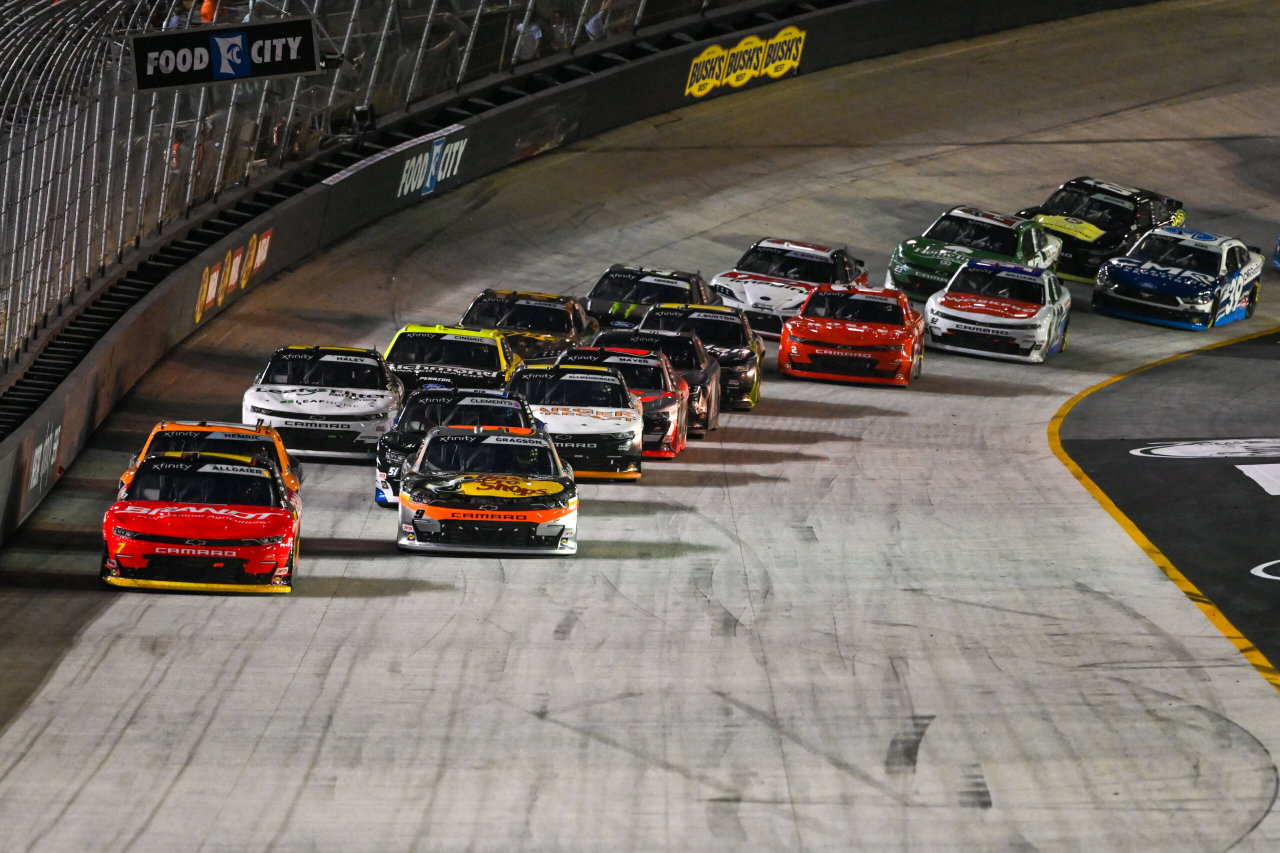
The 2026 NASCAR O’Reilly Auto Parts Series season has given fans plenty of reasons to question whether the Cup Series is still delivering the best racing in the sport. From Corey Day’s chaotic Talladega breakthrough to the door-to-door battles between Justin Allgaier and Brent Crews at Nashville, the second-tier series has repeatedly delivered the kind of competition fans want to see. Yet, beneath that exciting product is a chassis platform dating back to 2011. With its long-term sustainability becoming a growing concern, Steve O’Donnell has revealed how NASCAR is approaching the challenge.
Watch What’s Trending Now!
“So a lot of work is being done over the last two years. They’ve had conversations with the teams, no direct answer yet, but there’s a lot of work and a lot of investment candidly that’s been made into that future as well,” Steve O’Donnell revealed recently.
NASCAR has been evaluating what comes next for the O’Reilly Auto Parts Series, but the executive is not ready to announce a new car or a definitive modernization plan. The challenge is finding a platform that addresses the current machinery’s limitations without making the series more expensive for teams and drivers.
The concern starts with the age of the equipment. The current O’Reilly Series car was introduced full-time in 2011, and its fundamental chassis architecture has remained largely intact despite updates over the years. NASCAR is now facing questions about how long teams can continue using the existing platform and whether replacement components will remain available at a sustainable cost.
Dale Earnhardt Jr. has already offered a specific solution. Rather than introducing an entirely new platform, the JR Motorsports co-owner wants NASCAR to modernize the components that are becoming difficult to source. He has suggested updating the traditional nine-inch rear end and front suspension while retaining the series’ familiar mechanical character. Earnhardt does not want the division to simply copy the Cup Series Next Gen car, particularly if doing so introduces unnecessary complexity and expense.
His argument also reflects a concern about changing a product that is already working on track. O’Donnell praised the series’ racing and brought up a conversation with Tyler Reddick to make his point. The 23XI Racing driver reportedly told him that putting top Cup talent in the O’Reilly field would produce racing comparable to what fans see on Sundays. NASCAR does not want a technical overhaul to compromise the close competition that has helped the second-tier series build its following.
But the discussion has extended beyond the chassis itself. Earlier this year, NASCAR executive vice president John Probst spoke about researching crossover utility vehicle (CUV) designs as part of the sport’s longer-term plans. His comments sparked speculation about an electric CUV entering the O’Reilly Series. Probst later clarified that NASCAR was evaluating possible vehicle concepts and preparing for the future, not announcing an electric series or confirming an imminent change. Researching a technology does not mean it will become part of a particular championship.
There has also been speculation about a new-generation O’Reilly car arriving around 2028, potentially alongside a move from five-lug wheels to a single-lug system. However, neither development has been confirmed by NASCAR. The reports show how closely teams and observers are watching the aging platform, but O’Donnell’s comments make clear that the sanctioning body has not settled on a final direction.
The decision also carries implications for NASCAR’s driver-development ladder. The O’Reilly Series has long served as a proving ground for drivers preparing to compete in Cup, giving them experience in high-level stock-car racing before making the jump. The introduction of the Next Gen car in 2022 also widened the technical gap between the two divisions. A future O’Reilly platform therefore needs to retain its own identity while giving emerging drivers relevant experience that can help prepare them for the top level.
Ultimately, the decision involves more than designing a newer race car. NASCAR must work with teams and suppliers to determine which components need replacing, how those parts can be produced in sufficient quantities, and what the changes would cost.
A radical redesign could introduce expenses smaller teams struggle to absorb, while doing too little could leave the series dependent on an increasingly difficult parts supply. O’Donnell’s two-year effort is an attempt to find that balance. The next platform must keep the racing competitive, the series affordable and its place in NASCAR’s development system intact.