
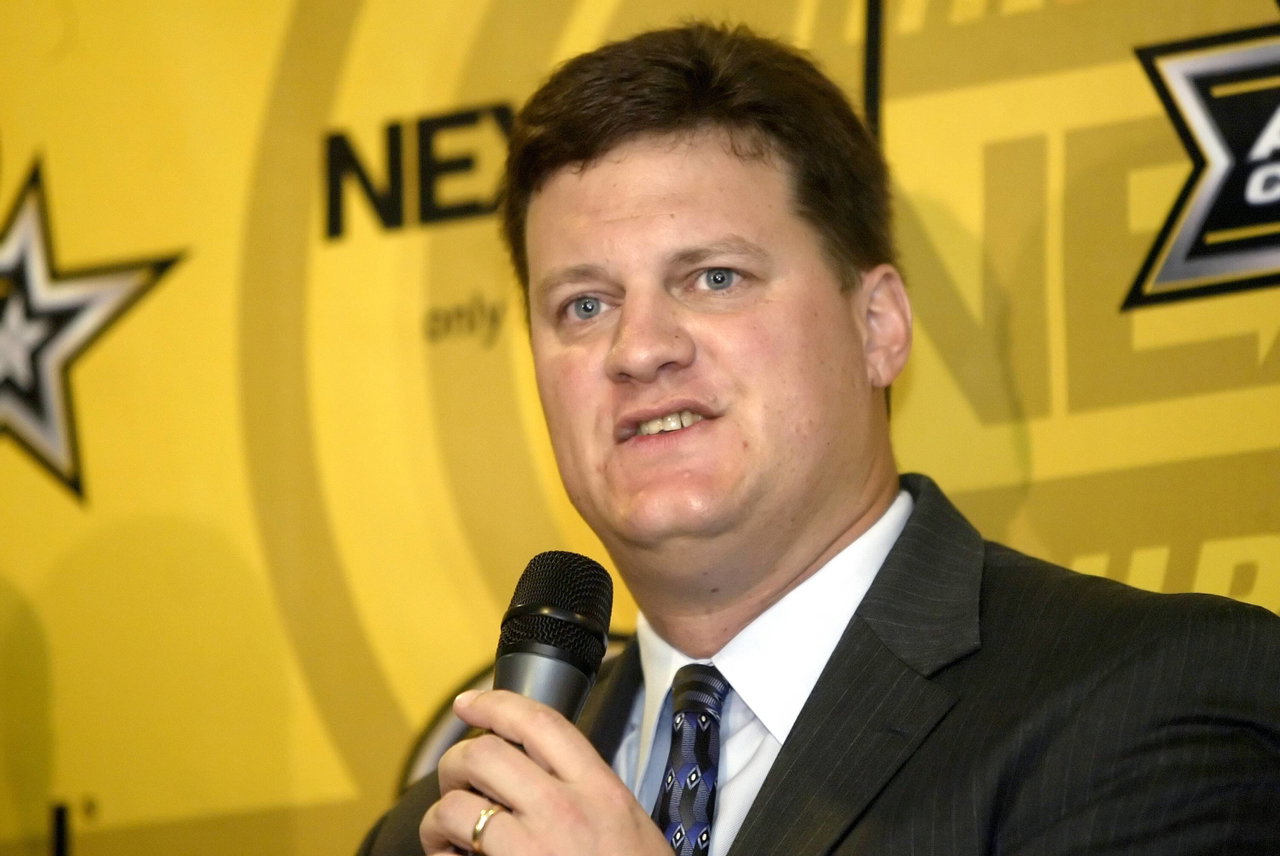
NASCAR entered 2026 with the community asking several questions about its future. Next Gen cars, the schedule, and viewership were among the main concerns, and it was up to Steve O’Donnell, who became the first CEO from outside the founding France family in NASCAR’s 78-year history, to address them. Now, as the sport considers its next steps, O’Donnell is taking a closer look at what went wrong along the way.
Watch What’s Trending Now!
“It’s not a great look for the sport,” O’Donnell said on the latest episode of the Happy Hour with Kevin Harvick podcast, while discussing how NASCAR approached decisions in the past.
After spending more than three decades inside the organization, O’Donnell now believes some decisions were made with short-term goals in mind without fully considering what they could mean for driver development, competition, and the overall race-weekend product. One of the clearest examples is the reduction in track time.
NASCAR significantly shortened practice sessions in 2020 as part of an effort to reduce costs for teams during the COVID-19 pandemic, and it never really went back. Fewer minutes on track meant lower costs for travel, personnel, tires, fuel and backup cars, but the impact went beyond team budgets.
For younger drivers, especially rookies moving through the national series, those lost laps meant fewer chances to learn. Instead of having plenty of time to get used to a new track and understand how a Cup car responds, drivers were often given just 20-to-25-minute sessions in split groups. That made preparation more dependent on simulation and engineering data.
The teams also had less time to find problems with their setups. If a car unloaded with the wrong balance, there was little time to make major changes before qualifying or the race. Well-funded teams with advanced simulation tools could prepare better for those limited sessions, while smaller teams had fewer chances to fix a mistake.
NASCAR eventually began reversing that approach in 2026. In July, the sanctioning body announced that Cup Series practice would be expanded to a single, combined 50-minute session for the remainder of the season. The change restored some of the track time that had previously been sacrificed in the name of efficiency. O’Donnell’s own example went beyond practice.
“We’ve made decisions in the past like, you know, let’s cut a set of tires to save some money. Well, what did that just do, right? Took away track time, took away driver development,” he said in the same podcast.
A decision can achieve its immediate goal while creating a different problem elsewhere. Saving money on a set of tires might look sensible on paper, but if the consequence is less time for drivers to develop, NASCAR has to consider whether the saving was worth the trade-off. The Next Gen car provides another example of that balancing act.
The Gen 7 platform was developed with cost reduction as a major objective, using standardized components and supplied parts to reduce the need for teams to spend heavily developing individual pieces. But the car also introduced a driving style that differs significantly from the cars used in lower divisions such as ARCA and Xfinity.
That creates a steeper adjustment for young drivers entering the Cup Series. The package has also faced criticism for the difficulty of passing at certain short tracks and road courses, with aerodynamic dependence sometimes making it difficult for a trailing car to make a move.
NASCAR has responded by continuing to modify the package, including changes to the underbody and aerodynamic configuration on short tracks as officials searched for a better balance between speed, grip and passing. O’Donnell indicated that this willingness to reassess will continue. He specifically mentioned the ongoing horsepower discussion and said NASCAR has also looked at areas such as Daytona qualifying speeds.
Rather than presenting those questions as already settled, he suggested they belong in the larger conversation about where the sport should go next. His bigger goal is to get the various parts of NASCAR working from the same blueprint.
“If I asked you or Rick Hendrick or Joe Gibbs, you know, where are we going in 2028, I don’t know. That’s our fault, right?” O’Donnell said. “But if I talked about, you know, what should we do for testing for the Daytona 500? We’d have a good idea.”
That is where O’Donnell’s criticism of past decisions connects to his vision for the future. He wants drivers, teams, tracks and manufacturers to agree on the biggest issues facing NASCAR, even if they disagree on how to fix them.
The goal, he suggested, is not simply to make decisions faster. It is to make sure NASCAR is moving in a direction that everyone in the sport can get behind for the long term.