
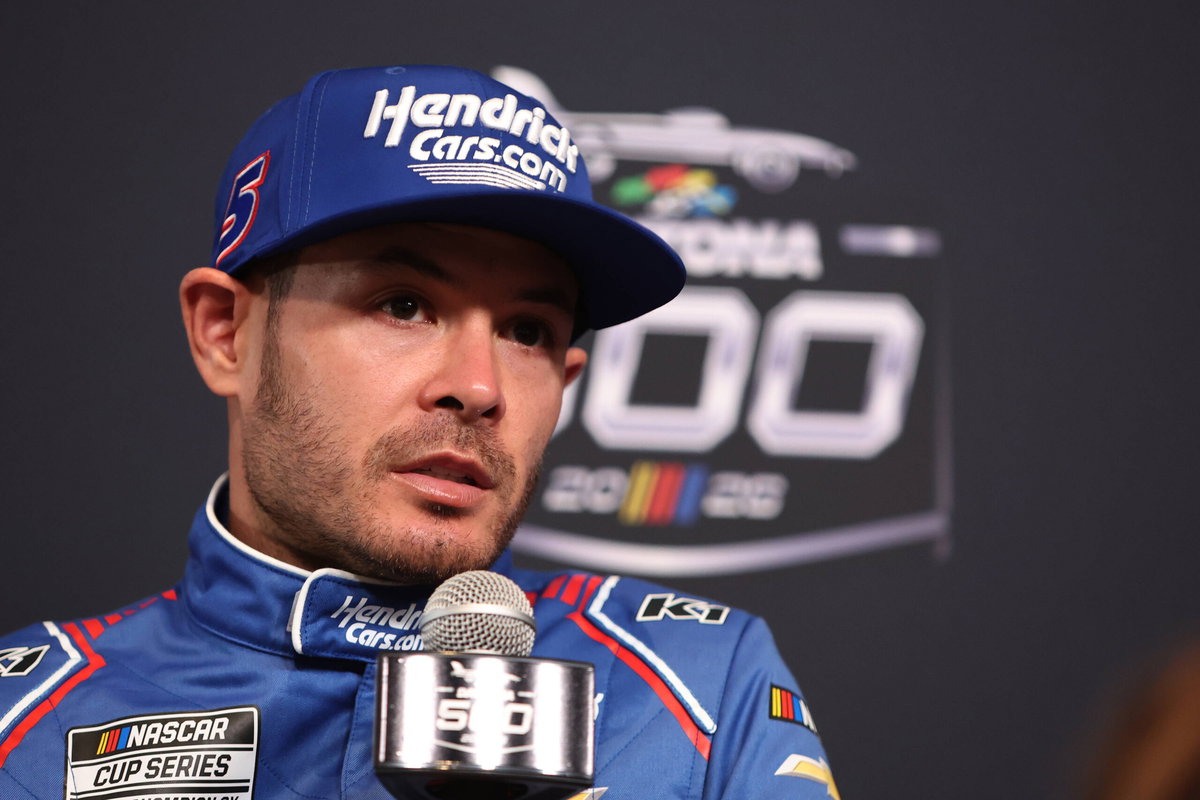
With 30 laps to go at Kansas Speedway on Sunday, Chase Briscoe’s Joe Gibbs Racing Toyota was out front and, Kyle Larson was staring at its taillights. Then Briscoe’s car went loose, he brushed the wall, and Larson slipped by. He won by 0.565 seconds after leading 235 of 267 laps, sweeping both stages and posting the fastest lap along the way.
He left with 76 points and a 26-point lead over Denny Hamlin, who had trailed him by just one point entering the weekend. So the first question that was sure to pop up was this: did this prove Chevrolet has finally gotten the better of Toyota?
“I’m not convinced that I was better than them,” he answered the surmised question in an interview with Tim Moore.
Elucidating further, “We didn’t get to qualify, you know, so I got to line up on the front row. Logano was up there. His team has kind of struggled here over the Next Gen era, I would say.”
He added that a Toyota out front might have looked better, and that qualifying seventh could have changed the whole weekend. It’s an honest answer, and it happens to be right. Here’s why.
Rain wiped out Cup practice and qualifying on Saturday, so nobody turned a timed lap. NASCAR fell back on its rain-out formula, which is 70 percent most recent race finish and 30 percent owner points. Kyle Larson ran second at Bristol last week, and Logano won it, so Logano sat on the pole with Larson.
Larson grabbed the lead early and most of his afternoon went by in clean air. By his account, Logano’s team, which has struggled at Kansas in the Next Gen era, held up the field on the first run, and that influenced how the opening stint played out.
This is turning into a habit. Three of the first four Chase races lost practice and qualifying to weather. Darlington and Bristol got the same treatment, and only Gateway ran a normal weekend. The most important stretch of the season keeps producing results without the speed data that qualifying normally gives us. Hamlin, who finished third in the No. 11 Toyota, put forth his opinion on this.
“We could be really good in the long run. In the short run, the 5 was really good. The 2 was good,” he said in a NASCAR on USA interview.
Toyota came into Kansas with 15 of the 25 available top-five finishes at traditional 1.5-mile tracks this season. That covers Las Vegas, Texas, Charlotte, Chicagoland and the spring Kansas race. Toyota drivers led 891 of 1,448 laps at those venues, 61.5 percent of the total, and won three of the five races.
Spring Kansas is the best comparison. Toyota swept the top five in practice, and four of the top five qualifiers drove Toyotas. Tyler Reddick won by 0.118 seconds after Kyle Larson’s Chevrolet tightened up badly in overtime, and Reddick’s Toyota had the better balance on the final run.
Sunday looked like the reverse, at least on the surface. Briscoe led 23 laps down the stretch, but once he got out front, his No. 19 Toyota lost the balance. Larson chased him down and took the lead back with seven laps to go. Austin Cindric’s Ford ran second, so the podium split three ways: Chevrolet, Ford and Toyota. Look underneath, though.
Three more Toyotas still finished inside the top six, with Hamlin third, Briscoe fourth and Christopher Bell sixth. Briscoe explained his problem plainly. “It was better for me being in second,” he said. “It would tighten me up and allow me to be a little better. To me, that’s a car quick when chasing and edgy when leading, a fixable problem and not a verdict on a manufacturer.”
Then there’s the driver variable. Kyle Larson has now won at Kansas four times, tying Hamlin’s record at the track. Before Sunday, he had eight top-eight finishes in his previous 10 starts there, and over that span he led 761 laps at Kansas, more than any active driver. Untangling the Chevrolet from the driver at this place is nearly impossible.
The 1.5-mile scoreboard for 2026 now reads three Toyota wins and three Chevrolet wins, but the underlying data still tilts toward Toyota. Las Vegas on Oct. 4 is next, and if qualifying actually runs, that weekend should give us the cleaner comparison Kansas never did. Don’t count on a second one at Charlotte, since the Chase stop there on Oct. 11 is the Roval. The Homestead finale is the other 1.5-mile test left. Larson isn’t wasting energy on any of this, though.
“We just got to keep executing,” he said, and there are six Chase races left to do it.
The baseline is this. Toyota probably still owns the faster cars on these tracks, and Kyle Larson is still the guy who makes a Chevrolet look like the better one. Until a real qualifying session says otherwise, Sunday proved the second part a lot more than the first.