
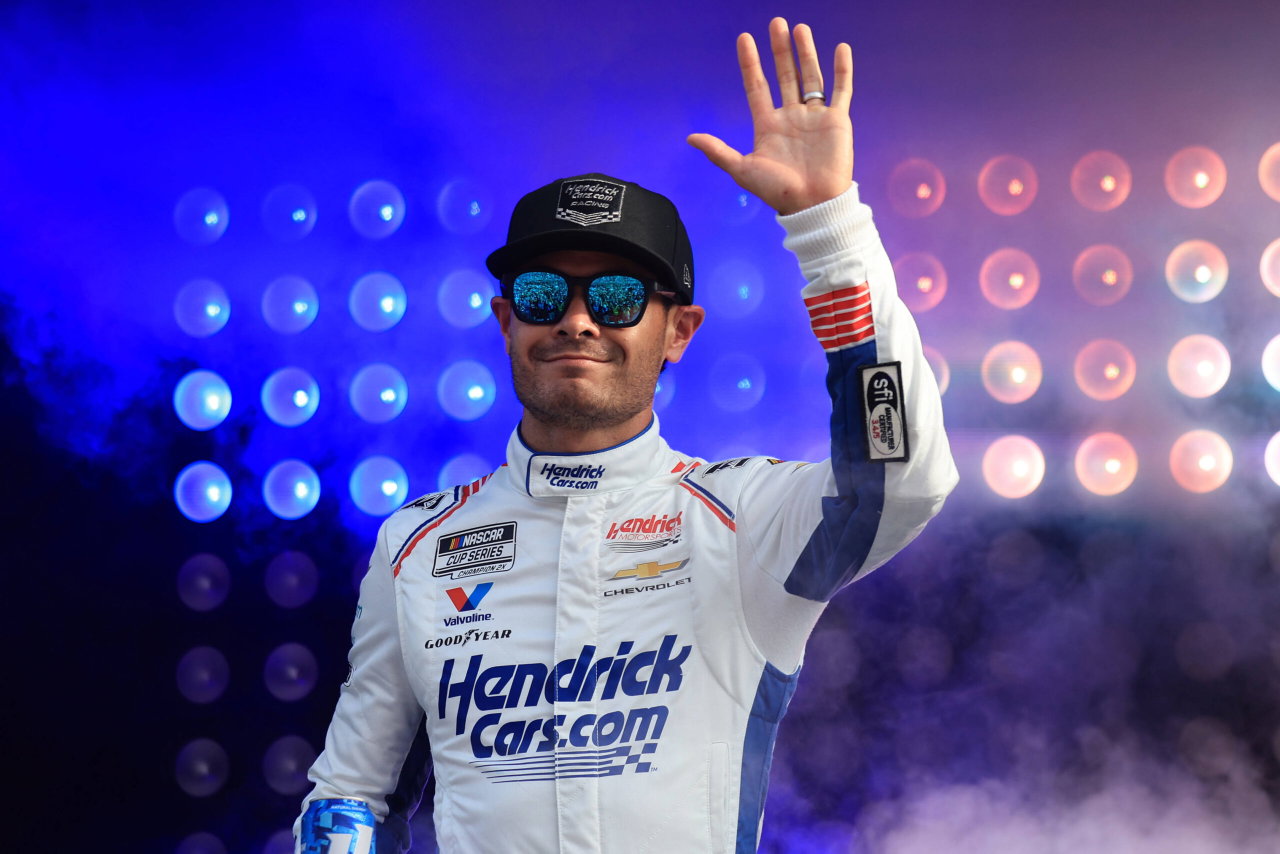
Kyle Larson has built a commanding advantage heading into Martinsville, and a strong Sunday could make him the first Cup Series driver in more than two decades to secure the championship before the season finale.
Watch What’s Trending Now!
That possibility has already put the 2026 Chase format under the spotlight. Some may question the points system or argue that a title should go down to the final race, but Petty believes neither criticism should take away from Larson’s performance if he gets the job done.
Speaking on PRNLive (via a short clip posted on X), the NASCAR veteran made his position unmistakably clear: “If Kyle Larson goes to Martinsville and clinches the championship, it should be celebrated, not criticized because of the point system, not criticized because of the way this has played out, not criticized because you don’t like it.”
Kyle Petty’s argument is about recognising what a driver and team have accomplished, even when the timing or championship format gives fans a reason to debate the result. This is particularly relevant because an early championship decision would be unusual in NASCAR’s modern playoff era. Larson has not been handed the title, and Martinsville still presents a difficult challenge.
Larson entered the Superspeedway weekend at Talladega with only a five-point advantage over Christopher Bell, but pulled away after winning the YellaWood 500 in a dramatic overtime finish. The Hendrick Motorsports driver led 23 laps and eventually beat the field despite having never won a Cup race at a drafting track before.
That victory gave Larson a 73-point lead over Denny Hamlin, with Bell 74 points behind and Chase Briscoe trailing by 79. With two races remaining in the 2026 Chase, the No. 5 Chevrolet now has a chance to settle the championship one week early.
The number Larson needs to reach at Martinsville is 59 points. Under the current scoring system, a driver can earn a maximum of 76 points in a race, combining the race victory, stage points, and fastest-lap bonus. Larson can reach the 59-point threshold by winning and collecting at least four stage points, or by winning, earning three stage points and securing the fastest-lap bonus.
NASCAR’s official championship scenarios confirm that scoring 59 points would allow Larson to clinch regardless of his rivals’ results, assuming the contenders start the season finale. He would still need to take the green flag at Homestead-Miami Speedway the following week to be officially crowned.
It is a demanding target, especially at a short track where one incident can undo an entire afternoon. Larson has been consistent at Martinsville, finishing sixth or better in seven of his last eight starts there, but he has only one victory at the Virginia venue, dating back to 2023.
Petty’s argument also draws attention to how dramatically NASCAR’s championship structure has changed over the decades. Under the older full-season points systems, drivers accumulated points throughout the schedule, and a sufficiently large lead could make the final races mathematically irrelevant.
Richard Petty’s dominance in 1964 and 1967 provides an example. According to an Autoweek analysis of NASCAR’s championship formats, Petty would have secured both championships even if he had skipped the final few races of those seasons. The points structures and scoring calculations were very different from today’s system, but the broader principle remains: NASCAR has not always required a title fight to reach the final weekend.
The more recent comparison is Matt Kenseth’s 2003 championship. He became the last Cup Series driver to clinch the title before the season finale, doing so during the penultimate race under the full-season format.
The introduction of the Chase in 2004 changed that dynamic. Across the 2004-2013 Chase era, no driver managed to wrap up the championship with a race remaining, despite Jimmie Johnson’s remarkable run of five consecutive titles. The subsequent Championship 4 format, used from 2014 through 2025, made an early clinch impossible because the title was decided among four drivers in the season finale.
The 2026 return to a 10-race Chase structure has therefore created a possibility that has not existed in the same way for years. There is still a championship fight to be settled, and Larson’s rivals have not run out of mathematical possibilities. Hamlin, Bell and Briscoe remain the closest threats, with Martinsville offering them an opportunity to force the battle into the Homestead finale.
Hamlin, in particular, has a strong record at the track, with six career Cup victories there. Larson cannot afford to treat his points cushion as a guarantee, especially after his Phoenix setback earlier in the Chase demonstrated how quickly a strong position can unravel.
Petty acknowledged that the possibility of an early clinch remains conditional. “And that’s a big if,” he stressed, making clear that Larson still has to deliver on track.
But if he does, Petty believes the discussion should focus on the achievement itself. “It should be celebrated that one team rose to the occasion and took that championship in nine races instead of 10 races,” he said.
Fans can debate NASCAR’s points system, compare it with previous formats and question whether the sport should reward consistency or create a finale decided by the final race. Petty is not saying those conversations should disappear. He is saying they should not overshadow a team that has earned the championship under the rules it was given.