
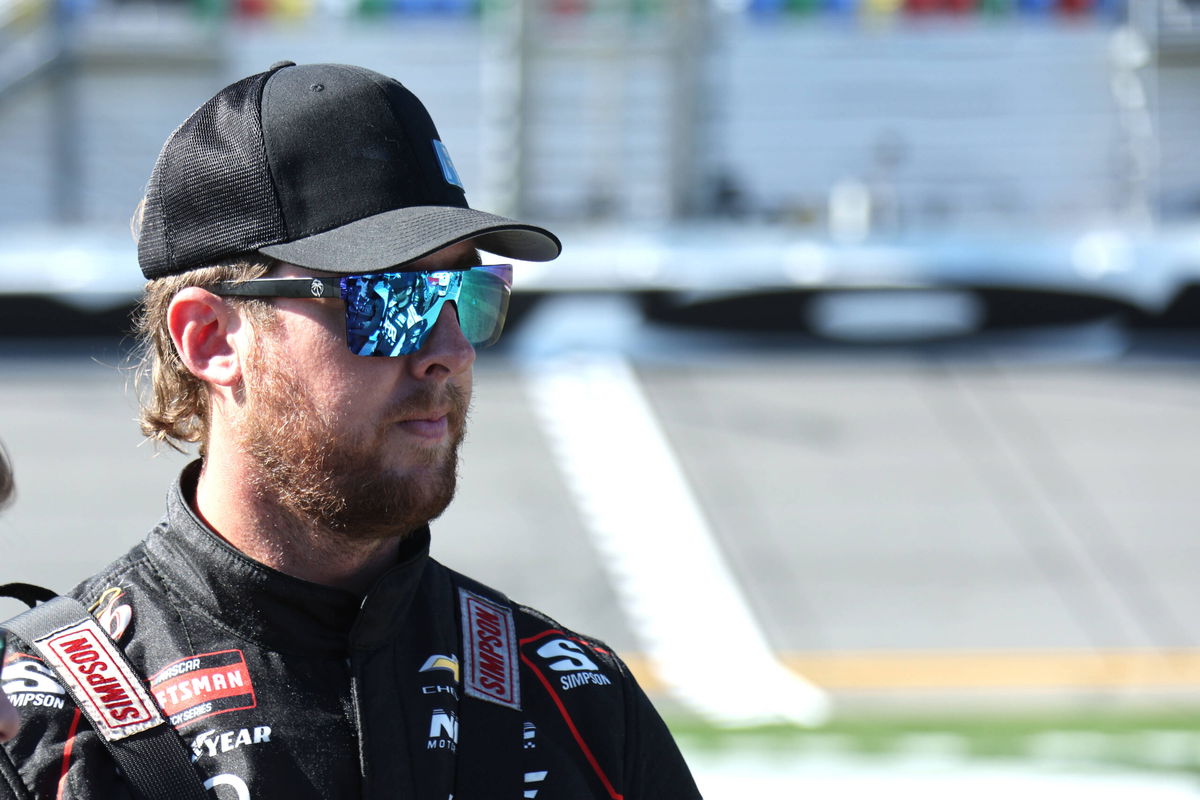
Cleetus McFarland believed he had finally found his rhythm behind the wheel of a NASCAR Truck Series machine. After a difficult debut at Daytona and months of learning, the YouTube creator felt comfortable managing his No. 4 Niece Motorsports Chevrolet at Talladega Superspeedway.
Watch What’s Trending Now!
Then, just about 17 laps into Friday’s race, a massive crash ended his afternoon before he could show what he might accomplish over a full distance.
The frustrating part was that McFarland did not believe he had brought the incident upon himself through an unnecessary mistake. He was trying to avoid the wreck when another truck struck him, sending his Chevrolet into the inside wall.
“I’m really frustrated because, you know, this time it’s not like I just did a bonehead move in the middle of the race and slammed into the wall like I did in Daytona,” McFarland told Frontstretch reporters on X after the accident.
The disappointment was obvious, but it also came with a sense of self-awareness that the situation was different from his earlier NASCAR outings.
This self-awareness matters, as he continues working toward approval for superspeedway races in the NASCAR O’Reilly Auto Parts Series. However, McFarland made clear that he would not pressure NASCAR into making that decision, even after another disappointing result.
The incident unfolded on Lap 17 of the Truck Series race on Friday, October 23. Stewart Friesen wiggled through Turns 1 and 2 after receiving contact from Andrés Pérez, sending Friesen into Kris Wright. Wright’s truck then shot across the track and struck the outside wall, triggering a multi-truck pileup that also collected McFarland and several others.
McFarland explained that he had already noticed his truck was tight while running along the bottom. Rather than forcing the issue, he moved toward the back and found a more comfortable position on the outside.
“I was on the bottom and I kept kind of coming up off the bottom. So I said, all right, no big deal. Went to the back and was riding around on the outside. It was great. Feeling it out,” he recalled.
When the wreck happened, McFarland thought he had slowed sufficiently to escape it. The contact to his left rear changed everything.
“I got slowed down. I was wound up. Thought I was good. And then I got tapped in the back left as I was coming down the track. Probably my fault,” he admitted.
He had not yet watched the replay, so he was unwilling to make a definitive judgment about what he might have done differently.
However, McFarland said he already had the steering wheel at full lock to the right. Having previously suffered wrist injuries from holding onto a steering wheel during an impact, he took his hands off it as the crash became unavoidable.
He briefly thought he could save the truck as it began to slide sideways. But the vehicle developed too much yaw, and his attempt to brake and straighten the slide came too late.
“I jammed on the brakes to try and get the truck to slide straight, but I was too late,” he said. “I already screwed myself.”
For McFarland, Talladega was supposed to be another chance to demonstrate how far he had progressed since his first NASCAR Truck Series start at Daytona in February.
He had also gained experience in ARCA and the O’Reilly Series. His ARCA performance at Talladega in the spring was particularly encouraging: he led for a few laps before narrowly missing victory after entering the tri-oval at the front on the final lap.
Those experiences help explain why he arrived feeling more confident. He understood that he needed to adjust when the truck felt uncomfortable, communicate with his spotter, and avoid forcing moves that were not available.
“I felt like I had so much leeway ahead of me,” he said of Friday’s race. “I felt like I had a long race ahead of me and I was good.”
His unfinished Talladega run also comes against the backdrop of NASCAR’s decision earlier in the year to withhold approval for O’Reilly Series superspeedway races.
After his O’Reilly debut at Rockingham, officials said they wanted to see further progression before clearing him for venues such as Talladega and Daytona. NASCAR emphasized that he remained approved for ARCA, Truck Series competition and O’Reilly Series races at short tracks.
Asked whether Friday’s outing had done enough to help his case, McFarland declined to push for an immediate answer.
“If they want to approve me to race, great. If they don’t, great. I’m not in any rush,” he said.
There was still something worthwhile in those laps. McFarland said he felt in control, had learned from the experience and genuinely enjoyed racing at Talladega alongside competitors such as Tony Stewart.
The crash denied him the chance to produce a full-race result, but it did not erase the progress he felt he had made. Nor did he pretend that a single outing entitled him to a higher level of competition.
“It’s just a bummer, but I’ll try again,” he said. “I won’t give up.”
For now, McFarland’s next step remains uncertain. His Talladega result will not automatically secure approval for O’Reilly superspeedway races, but his willingness to keep learning may matter more than one early DNF. He arrived believing he could finish the race, left frustrated that he never got the chance, and still refused to let the setback dictate his future.