
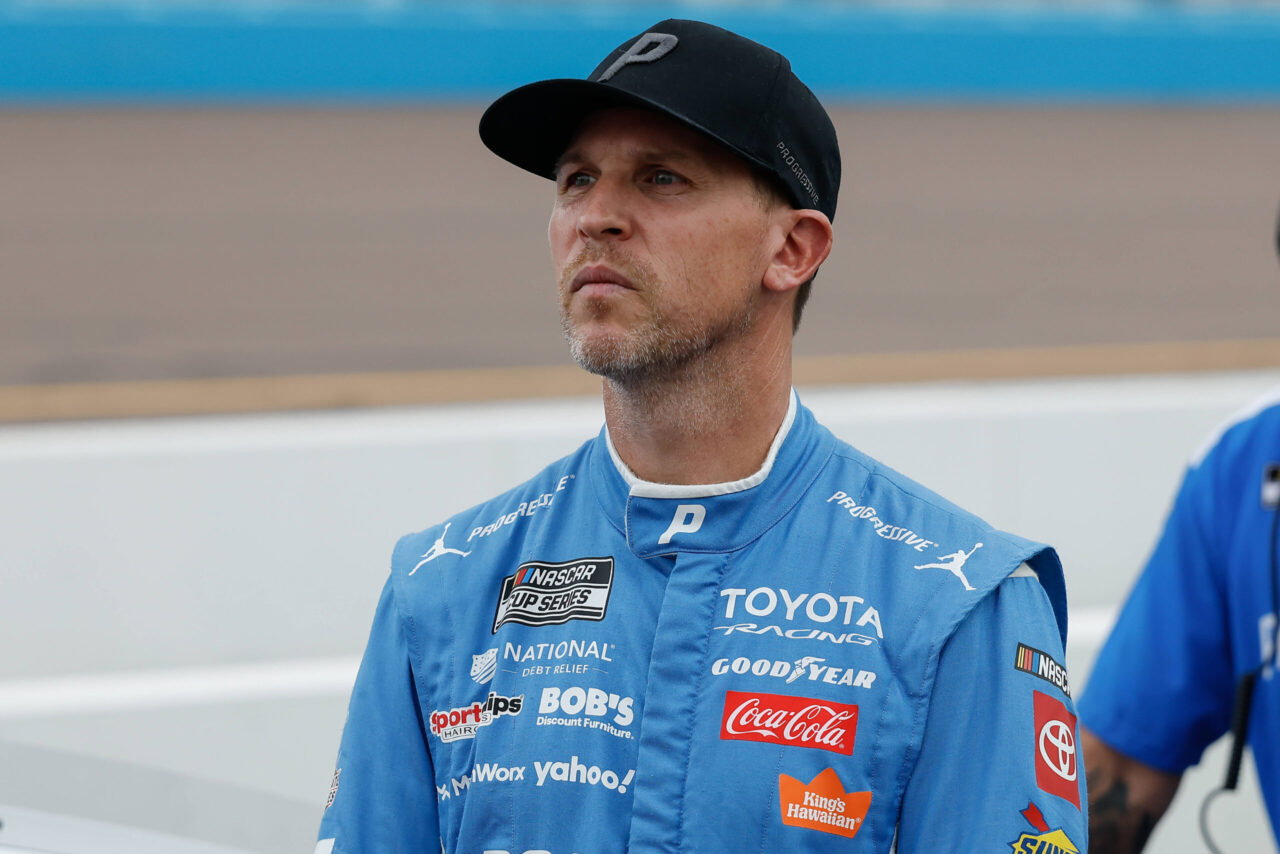
Denny Hamlin had barely finished explaining his eighth-place run at Talladega Superspeedway, and the argument he’d been making all afternoon was far from over. He had survived a 12-car wreck, nursed a damaged Toyota through the traffic, and made it to the final lap with a chance to recover.
Watch What’s Trending Now!
Then he got caught in more contact, while Kyle Larson found a way through to win. Hamlin’s race was over, but he wasn’t ready to leave it at that.
“It’s a sports car not meant to be running 200 miles an hour,” Hamlin told Matt Weaver.
The remark gave a familiar complaint fresh urgency. NASCAR had changed the car’s setup, yet Hamlin was still questioning whether it belonged at these speeds.
The cars can run nose-to-tail at 200 mph, yet a driver who leaves the wrong line can lose several places before finding another drafting partner. Denny Hamlin had spent much of Sunday dealing with that reality. His finish was respectable after the damage, yet Larson’s victory made it harder to accept.
The first major wreck sparked when contact between Joey Logano and Ryan Blaney disrupted the field. Blaney hit the wall, triggering a 12-car accident that collected Hamlin, Tyler Reddick, Chase Elliott, and several others. Hamlin’s No. 11 Toyota suffered front-end damage, including a change in its toe alignment. While some drivers were done for the day, Hamlin stayed out and tried to make the car work.
He stayed in the race, although the damage left him with little to show for the opening stages. Under NASCAR’s cumulative 10-race Chase format, every point counts toward the final standings. Hamlin could not afford to give up, but he also knew the damage limited what he could do.
When asked whether he would have accepted eighth place before the race, Denny Hamlin admitted he probably would have. The problem was the driver now sitting 73 points ahead of him.
“I mean, if you asked me to start the day, would I take an eighth? I mean, probably. I mean, I guess so, but obviously, you know, the five’s on a massive run at the right time of the year. And so it’s just, we’re, that’s what we got.”
Larson had been quick throughout the afternoon. He finished fourth in Stage 1 and second in Stage 2. Chris Buescher won the opening stage after the RFK Racing Fords of Buescher, Ryan Preece and Brad Keselowski worked together to build a substantial lead.
Then the race took another dangerous turn with five laps remaining. Carson Hocevar made contact with Logano, sending the No. 22 Ford spinning before it flipped onto its roof. The accident brought out a red flag and removed another championship contender from the fight.
Hamlin survived again. On the final lap, he was pushing Ricky Stenhouse Jr. forward, believing Stenhouse would race according to his own interests rather than follow Chevrolet’s preferences. But Todd Gilliland clipped Denny Hamlin, sending him into Austin Hill and killing the No. 11’s momentum.
Larson had fallen as low as 11th, but he found an opening in the closing stretch and charged past seven cars. He beat William Byron by 0.041 seconds to secure his first Talladega victory. Hamlin finished eighth, and Larson left Alabama with a 73-point championship lead.
Hamlin was not even watching Larson’s final charge when it happened.
“I didn’t see it, truthfully,” he revealed.
He explained that he thought he had wrecked, then found himself behind another car and high on the track. He had missed the finish itself. Denny Hamlin hadn’t even seen how Larson won. He had felt the problem from inside the No. 11.
NASCAR had already tried to change what drivers experience at superspeedways. For the August race at Daytona International Speedway, officials reduced the rear spoiler from seven inches to four and lowered engine output from 510 to 465 horsepower. The goal was to reduce aerodynamic drag and give drivers more freedom to pass instead of relying so heavily on track position.
For Talladega, NASCAR reduced the spoiler further to 3.5 inches while retaining the 465-horsepower configuration. Officials also set the stage endings at laps 98, 143 and 188, aiming to encourage more aggressive racing and reduce the incentive to save fuel for long stretches.
The three RFK Fords ran together and pulled away from much of the field, which was conserving fuel. Their formation helped them maintain speed while other drivers had to manage how much fuel they burned. Buescher went on to lead 53 laps, but his day ended in the late accident.
A smaller spoiler can reduce drag, but it cannot remove the need for drafting partners or eliminate fuel-saving strategy. At Talladega, leaving a line at the wrong moment can cost several positions. A driver can have a fast car and still struggle to pass without help. When momentum disappears, the cars behind can quickly close in.
The result gave Hamlin another reason to question a car he believes isn’t suited to these speeds. NASCAR has reduced the spoiler and horsepower, but drivers are still balancing fuel, drafting and positioning in a race where one mistake can undo hours of work.
Denny Hamlin now trails Larson by 73 points with Martinsville Speedway and Homestead-Miami Speedway remaining. He has little room for another difficult afternoon, and Larson has given himself a strong position heading into the final two races.
Talladega left Hamlin with a finish he could have accepted before the race, but not one that helped his championship cause. He survived the wreck, recovered enough to compete, and lost his momentum at the worst possible moment. NASCAR’s changes were meant to give drivers more control over their races. NASCAR made the changes. Now it has to decide whether the racing they produced is good enough.