
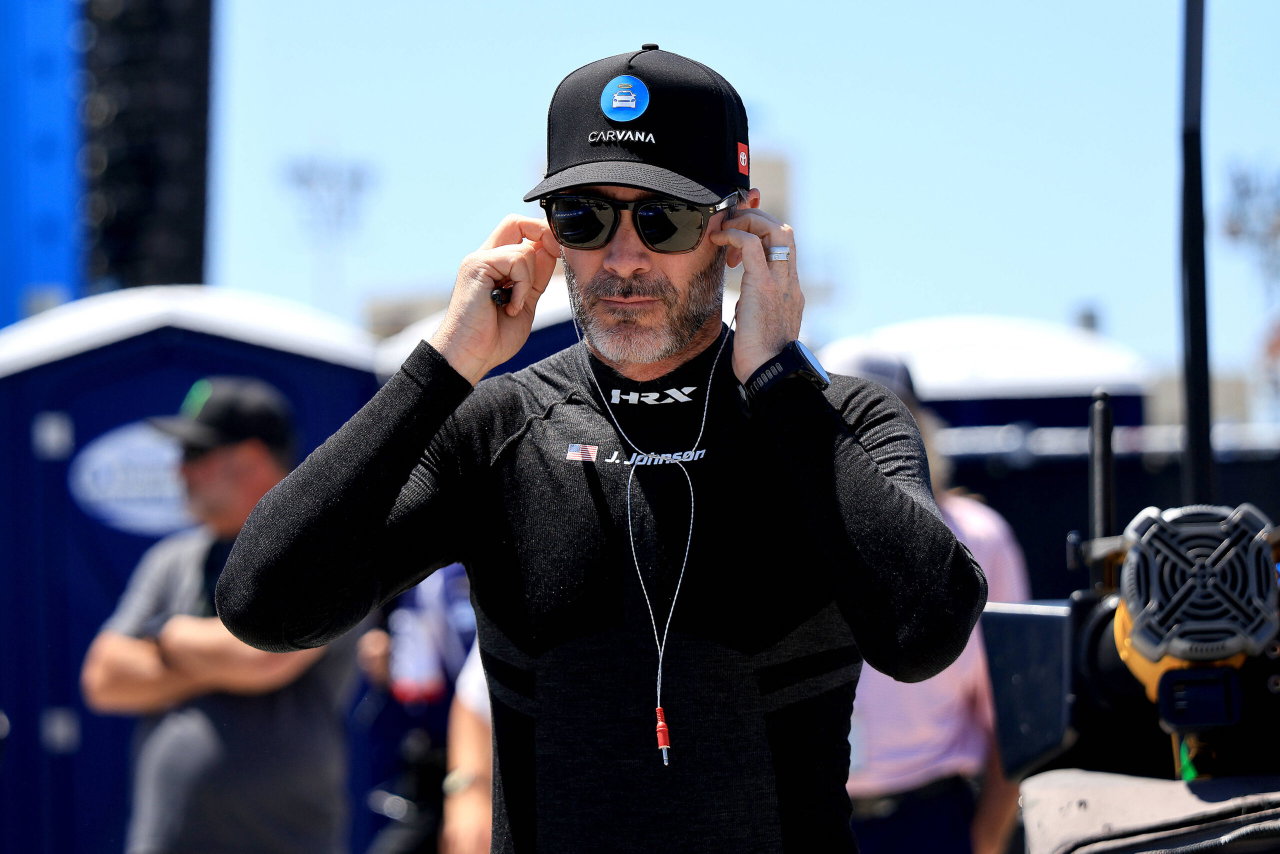
Josh Berry’s remarkable late-season purple patch made him an attractive option for Legacy Motor Club. However, Jimmie Johnson insists there was more behind the team’s decision to move on from John Hunter Nemechek.
Watch What’s Trending Now!
For the team owner, the switch was not simply a reward for Berry’s recent results. It was a difficult organizational decision involving performance, long-term planning, and responsibilities to everyone invested in the team.
Speaking on the Door Bumper Clear podcast, Johnson was asked whether Berry’s strong run had made it almost impossible for Legacy to pass up the opportunity to sign him.
“I feel like it doesn’t hurt, but it’s not the sole reason behind it,” Johnson explained.
Johnson acknowledged that changing drivers is never easy, especially when he has responsibilities beyond making decisions on the racetrack.
“The timing is never easy or fun in the role that I find myself in now, and with the responsibility I have to partners, investors, and the people that work within our shop, you’ve got to make some tough decisions,” he said.
Johnson added that Legacy’s leadership group makes these calls collectively, rather than leaving them to one individual. That matters because the decision affects not only the driver in the car but also the wider organisation and its long-term direction.
In an earlier discussion on The Dale Jr. Download podcast (as reported by On3), Johnson explained that Legacy had studied three years of performance data. The team assessed multiple areas, including qualifying results, positions gained during races, and overall execution.
Johnson said Berry’s numbers stood out across several categories, ranking among the top three in many and the top five in most. He also pointed to execution as an area where Legacy felt it had an advantage, particularly through pit stops, strategy, and other race-day decisions.
Johnson also noted that contracts and manufacturer agreements complicate these decisions. He revealed that Nemechek had an auto-renewal earlier in the summer, but pressure to consider a change continued to build. Ultimately, Legacy decided that moving in a different direction was necessary.
Although Johnson insists the recent results were not the primary reason for the switch, Berry’s resurgence could hardly have come at a better time.
His 2026 season with Wood Brothers Racing had been difficult. In July, Berry was struggling to secure strong finishes and did not yet have a confirmed Cup Series seat for 2027. He admitted that the setbacks had taken an emotional toll and worried that people were judging him differently because of one difficult season.
Then, at Indianapolis in July, Berry finished seventh. He followed that up with a fourth at Iowa and eighth at Richmond. He then recorded a season-best third-place finish at New Hampshire, where he led 73 laps, before adding top-10 results at Daytona and Darlington.
The six-race streak gave Berry momentum at a crucial time. Johnson acknowledged the importance of that form, saying Berry’s run made an already difficult decision easier to accept. But again, he insists that the results strengthened the case for Berry, instead of creating it from scratch.
Berry was announced as Nemechek’s replacement in Legacy’s No. 42 Toyota last month. The move also fits the team’s plan to field three full-time Cup cars in 2027, with Berry joining Erik Jones and Riley Herbst.
While Legacy is looking ahead, Johnson clarified that the decision does not mean he has stopped supporting Nemechek.
“I deeply care for John Hunter and am certainly trying to help if I can help him find a home and keep going,” Johnson continued in the same episode of the Door Bumper Clear. “So, fingers crossed he lands something really competitive.”
These comments are particularly relevant because rumours circulated after Nemechek’s exit was announced that he and Johnson had clashed following the race at New Hampshire. Johnson dismissed those claims in an interview with Motorsport.com, saying there had been no confrontation and that the two had even exchanged messages about the speculation.
Johnson described the separation as a difficult professional decision. Nemechek has had a challenging season, with one top-five and two top-10 finishes through 26 races, but Johnson’s explanation points to a broader evaluation of what Legacy needs going forward.
Nemechek, for his part, has expressed disappointment but said he remains motivated to continue his career. Finding a competitive seat for 2027 will be his next challenge.
For Johnson, the priority is building a lineup that can help Legacy progress. Berry’s recent results have certainly helped, but the team’s data, leadership discussions, and long-term goals shaped the decision.
That is why Johnson’s clarification matters. Berry’s hot streak may have softened the difficult choice, but it was not the whole story. Legacy believes the move fits its wider plan, even as Johnson hopes Nemechek finds a strong opportunity elsewhere.