
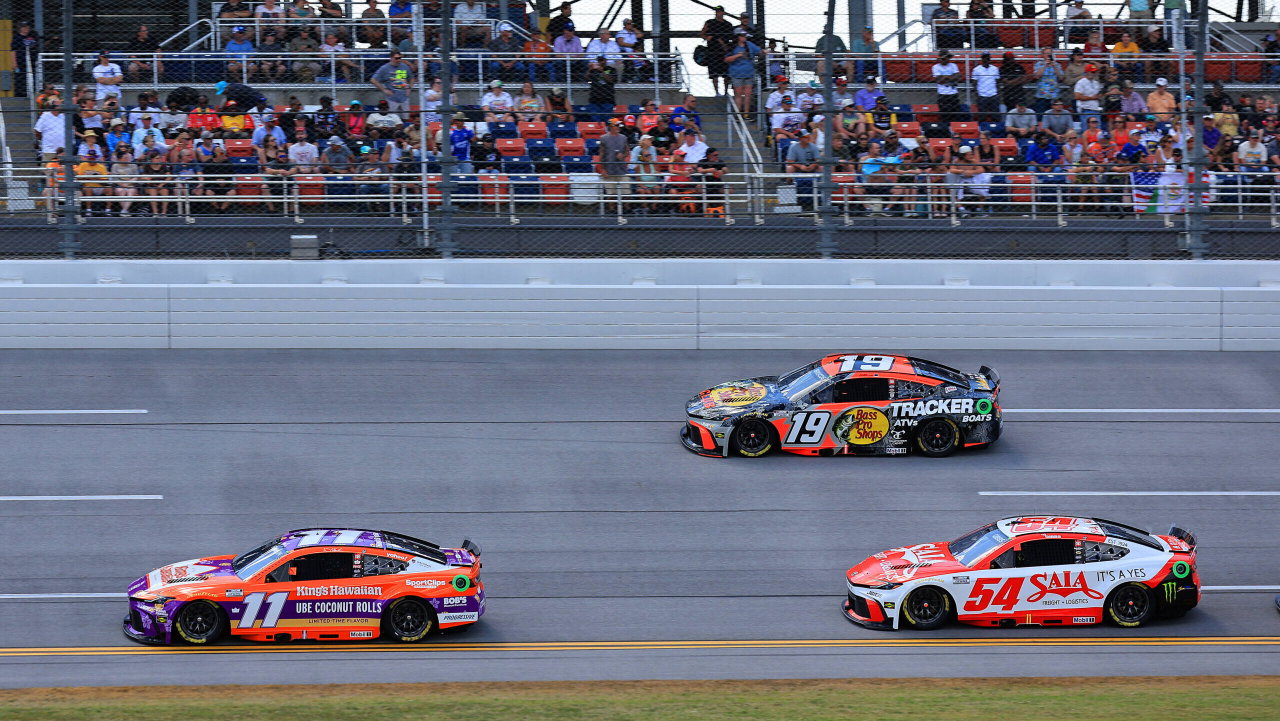
Iowa exposed a brake problem that nearly derailed multiple Toyota teams before the race even settled in. Denny Hamlin and Chase Briscoe battled inadequate brake pressure, while teams worked deep into Saturday night to find solutions. Yet Joe Gibbs Racing still managed to salvage strong finishes. Behind the crisis was a far more complicated decision than simply choosing the right brake setup, as a JGR insider explained.
Watch What’s Trending Now!
“There’s lots of potential problems with the brake system and it’s not very straightforward,” Christopher Bell’s crew chief Adam Stevens told Motorsport.com. “So part of it depends on your driver’s driving style and your car setup — which prevents everyone from gravitating to the same answer.”
That complexity became painfully clear for Toyota at Iowa Speedway.
Teams’ lack of information was not the only cause of the braking issues. According to Motorsport.com, the damage resulted from separate teams’ configuration decisions based on information produced by the JGR-23XI technical alliance. Each crew chief then had to choose how aggressive the braking package should be.
Before the race, teams were allowed to bleed their brake lines. This allowed them to solve some of the issues without facing consequences. However, the vehicles had very little alternatives once they were on the circuit.
Teams cannot replace brake pads during a race weekend until after the green flag, according to NASCAR regulations. Losing many laps would result from doing this. Brake splitting, which combines several brake-pad combinations to obtain desired characteristics, is another prevalent technique used by teams.
The problem was that the Toyota teams had made choices they could not simply undo. Denny Hamlin’s No. 11 Toyota suffered the most dramatic version of the issue. By Lap 3, his brake pedal went straight to the floor.
Chase Briscoe encountered a similar problem by the beginning of the second stage. This left both the Joe Gibbs Racing teams facing precisely the scenario they had hoped to avoid.
Yet neither driver gave up. Hamlin and Briscoe battled through the physical demands of driving cars with compromised braking systems and somehow finished fifth and sixth, respectively.
That made the result particularly impressive given where both teams stood before the race. The brake problems had already forced the crews to work deep into Saturday night, trying different adjustments to give their drivers a chance of surviving 350 laps.
Instead of simply exposing a bad component, Iowa showed how difficult the brake decision can be. The same technical information can be shared across an alliance. But the final setup still has to account for the individual driver, car and conditions. On the flip side, Ty Gibbs and Christopher Bell from JGR found themselves up front, racing for the win.
Ty Gibbs and Christopher Bell show the other side
While Denny Hamlin and Chase Briscoe were fighting through Iowa with compromised brakes, Joe Gibbs Racing had two other drivers battling for something much bigger: race win.
Ty Gibbs and Christopher Bell turned the closing laps into an all-JGR fight. And Gibbs eventually held off his teammate by just 0.253 seconds. The contrast was striking.
Gibbs’ No. 54 Toyota had no major brake concerns and was able to execute the strategy his team had planned. Bell’s No. 20 was equally competitive. This allowed the two JGR drivers to fight for the victory while their teammates were simply trying to survive.
Tyler Allen, Gibbs’ crew chief, explained that JGR’s technical alliance provides plenty of information. However, the team is increasingly relying on its own data and feedback.
“We rely on our teammates, all the information is shared, but we’re finally building on our notebook from last year and our recent races this year and we made decisions that we think will best suit Ty,” Allen said.
That approach paid off at Iowa. Gibbs overcame an early pit-road problem that dropped him from fourth to 29th before charging back through the field. He eventually took the lead and survived Bell’s four-tire advantage in the closing laps.
Bell had another strong finish but remains winless in 2026. For Joe Gibbs Racing, however, the Iowa result provided two very different lessons. Hamlin and Briscoe showed how costly the wrong brake choice can become. On the other hand, Gibbs and Bell demonstrated what is possible when the setup works.
With Richmond next on the horizon, those lessons could prove crucial.