
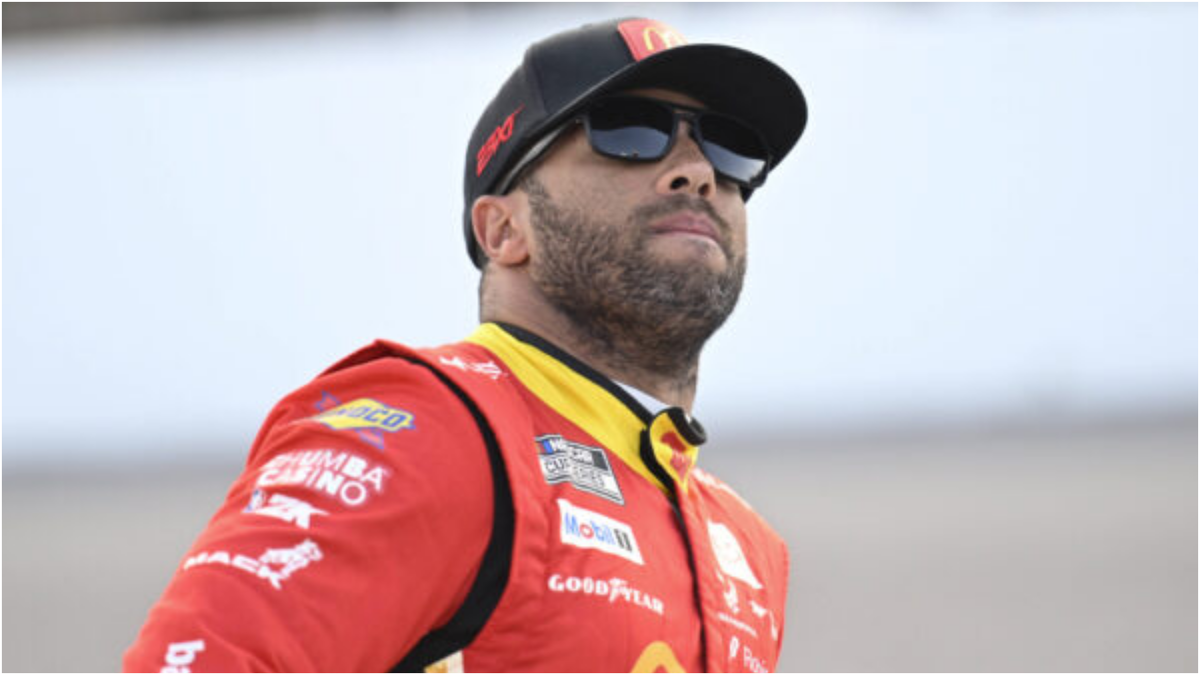
Bubba Wallace gave Atlanta everything he had. He survived a three-and-a-half-hour rain delay, fought back from a spin his own Toyota teammate Ty Gibbs put him in during Stage 2, and worked his way back to third for a green-white-checkered restart that didn’t wrap up until nearly 2 AM. On the final lap, he shoved his way to second behind race winner Ryan Blaney. Then NASCAR took it away.
Watch What’s Trending Now!
One ruling sent him from second to 29th, the last car on the lead lap. Two days later, people who cover this sport for a living still can’t agree on what actually happened out there.
“Yeah, that’s not what I saw,” said Jeff Gluck on The Teardown podcast.
His co-host, Jordan Bianchi, had argued that Wallace’s brief dip below the yellow line carried him into second place outright. Gluck disagreed. His read was that Wallace went three-wide with Blaney and Carson Hocevar, ducked below the line briefly, and only reached second when Gibbs shoved him from behind on a legal part of the track.
“I thought he made the sweeping move and he’s third. When he gets back onto the track, he’s still third,” Gluck said. “I don’t think he moved into second when he came back. Maybe I’m wrong.”
Bianchi was careful to note that NASCAR never publicly walked through its reasoning in detail. What he’d heard came from conversations behind the scenes, not an official statement from race control.
Wallace made his own case just as directly. He and his 23XI Racing Team spent 31 minutes inside the NASCAR hauler arguing the call, backed by his car’s telemetry data.
“It says advancing your position, which I did not do,” Wallace said. “I stayed third, and I was all over the brakes to make sure I did not advance. That move should have propelled me to the lead, and it didn’t, because I knew it was wrong because my car did not like that move.”
NASCAR wasn’t moved by the data. The league’s own driver-meeting warning, read to media every week, spells out the standard plainly: race above the double white line, and if NASCAR judges that a driver went below it to improve position, that driver gets black-flagged. Officials determined Wallace had done exactly that, going from third to second while below the line, regardless of what happened once he got back up to speed.
That reading left Wallace with no way to fix it either. Under normal circumstances, a driver who dips below the line mid-race gets a radio call and a lap to hand the position back voluntarily. On the final lap under caution for the checkered flag, that option didn’t exist.
The Part That Cannot Be Appealed for Bubba Wallace
Wallace also leaned on the sport’s older, unwritten standard, the idea that visibly trying to give a position back earns some benefit of the doubt. NASCAR wasn’t buying that either.
Cup Series Managing Director Brad Moran confirmed the ruling was a judgment call, and judgment calls under the current rulebook aren’t eligible for appeal. Wallace’s team filed an immediate protest instead, a separate process from a formal appeal, and NASCAR upheld the penalty anyway. The 27-point swing was final the moment it came down, dropping Wallace from an 82-point cushion above the playoff cutline to just 55.
Denny Hamlin, Wallace’s team co-owner at 23XI, offered his own read on why the ruling held up the way it did. Speaking days later at Pocono, Hamlin suggested the live broadcast may have played a role, with cameras on Wallace the instant it happened, unlike penalties that get sorted out well after a race has already moved past the moment. He also confirmed the team won’t pursue the matter further, calling it a learning moment instead.
Gluck’s real frustration wasn’t really about whether the penalty was right or wrong. It was that nobody explained it in a way that matched what viewers actually saw happen on screen.
“It’s still not clear to me whether going below the yellow line applies if you don’t actually gain a position,” Gluck said.
Wallace and Gibbs will both be back on track this weekend, with the postseason cutline now sitting tighter behind Wallace than it did before the checkered flag fell in Atlanta.