
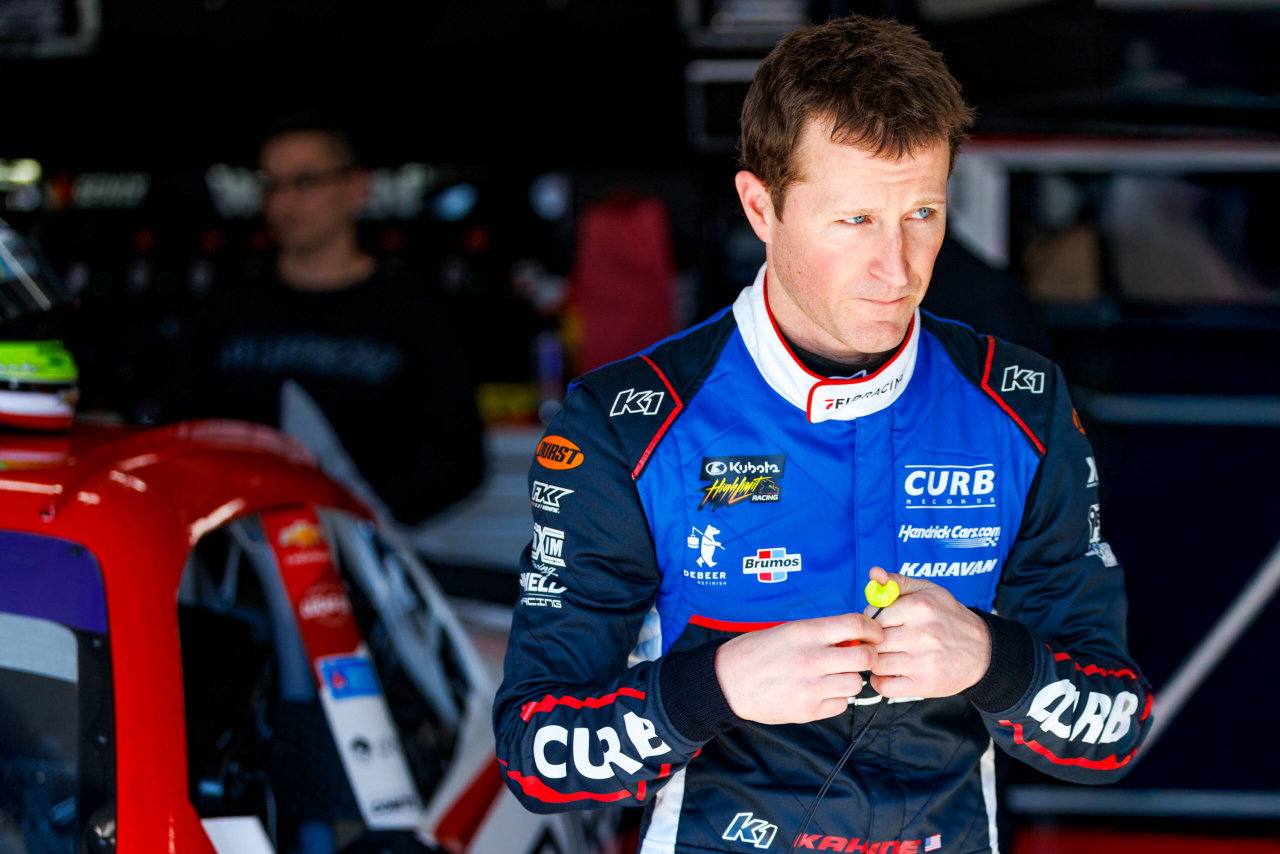
Few NASCAR garage lineups carry the kind of nostalgia attached to Hendrick Motorsports in the early 2010s. Four Chevrolets, four established names, and a competition room filled with experience that most organizations could only dream of assembling. Jeff Gordon, Jimmie Johnson, Dale Earnhardt Jr., and Kasey Kahne weren’t simply sharing an employer. They were bringing together different generations of Cup Series success under one roof.
Watch What’s Trending Now!
Kahne got his place in that group when he replaced Mark Martin in the No. 5 Chevrolet for the 2012 season. He arrived with 14 career Cup victories of his own, but joining an organization with Gordon and Johnson meant entering an environment where the standards had already been set exceptionally high. Years later, his recollection of that experience offers a glimpse into what made the arrangement special and why it was never quite as straightforward as the dream-team label suggests.
“They were all on at the top of their games, also kind of on the back side of it,” Kahne said on the Stacking Pennies podcast. “Jeff left or retired pretty quickly from when I was there. Then Dale, Jimmie—like, it was all. Jimmie didn’t when I was there, but yeah, they all kind of had been doing it a long time, had a ton of experience, looked at things differently than what I did, and then sometimes, similar.
“And at that same time, we were starting to get a lot more data and kind of understand how each one of us were driving. And you had that at the test, but then it started coming into the races a little bit, the simulator stuff started coming, and then kind of we all basically had moved on. But yeah, it was a neat lineup there.”
The timing of Kahne’s arrival is important to understanding that lineup. Johnson was coming off five consecutive Cup championships between 2006 and 2010, while Gordon had already established himself as one of the greatest drivers in the sport’s history. Dale Jr. had joined Hendrick in 2008, bringing an enormous fan following and the responsibility of carrying one of NASCAR’s most recognizable surnames.
Kahne completed a formidable four-car operation. He was hardly an outsider in terms of ability, having won six races in 2006 alone, but his move from Red Bull Racing to Hendrick offered an opportunity to compete with the resources of a championship-winning organization.
The results arrived quickly. Hendrick won 10 Cup races in 2012, with Johnson contributing five, Gordon and Kahne taking two apiece, and Dale Jr. adding another. Kahne won the Coca-Cola 600 at Charlotte and the race at New Hampshire, finishing fourth in the championship standings. It remains the highest points finish of his Cup career.
The following season brought another nine victories for Hendrick. Johnson won his sixth championship, while Kahne added two more victories at Bristol and Pocono. Gordon remained competitive, and Dale Jr. continued to deliver, making the organization a regular presence at the front of the field.
However, the four-driver combination was always going to have a limited window. Gordon announced that 2015 would be his final full-time season, ending a remarkable career with 93 Cup victories and four championships. Chase Elliott eventually inherited the No. 24, while the other three continued together.
For Kahne, those years also provided an opportunity to understand what separated two of Hendrick’s most successful drivers. Gordon and Johnson had accumulated an extraordinary amount of experience, but their methods behind the wheel were not interchangeable.
Kahne had spent years racing against them. Sharing an organization allowed him to examine those differences much more closely.
Johnson’s driving style was particularly interesting to Kahne. The No. 48 driver had built his success around consistency, speed, and an ability to keep the car moving through corners without sacrificing momentum. That approach was a major part of the Hendrick-Johnson combination that dominated the championship picture for much of the previous decade.
“I always felt like Jimmie and Jeff drove pretty differently. I thought Jimmie, to me, I always just thought he carried a lot of speed,” Kahne said. “He was really good at carrying speed into the corner, carrying throttle through the corner, things like that when there was a lot more off-throttle time, and he was always like part throttle in places, and I felt that’s how I looked at it, and I kind of drove more like that, to where Jeff was more aggressive and then off and then aggressive, and I’d put him more kind of like a Kevin Harvick style of driving. It was neat to be teammates with those guys.”
There was a technical distinction behind what Kahne was describing. Maintaining partial throttle through a corner can help preserve momentum and keep the car balanced, particularly when managing the transition between braking and acceleration.
A more aggressive approach involves a different rhythm of lifting, rotating the car, and getting back to the throttle. Both methods can produce speed, but the driver’s ability to adapt them to the car and circuit makes the difference.
It was also a period when NASCAR teams were becoming increasingly sophisticated in their use of simulation and driver data. The introduction of the Generation-6 car in 2013 added another layer to the development process.
Having four experienced drivers offering different feedback gave Hendrick valuable information to work with, even if translating individual driving characteristics into a faster race car was never straightforward.
Kahne’s own results at Hendrick eventually became more difficult to sustain. After finishing fourth in his first season, he placed 12th in 2013, followed by 15th in 2014, 18th in 2015, and 17th in 2016. He still managed a victory at Atlanta in 2014, but the consistency that had marked his arrival was missing.
His final season nevertheless delivered one of the more memorable moments of his Hendrick tenure. Kahne ended a 102-race winless streak by winning the Brickyard 400 in 2017, holding off Brad Keselowski in an overtime finish at Indianapolis. It was his sixth and final victory with the organization.
By then, the original lineup had already begun to disappear. Gordon had moved into retirement from full-time competition, Dale Jr. was preparing to step away after the season, and Kahne’s departure was confirmed, with William Byron set to take over the No. 5. Johnson remained, eventually adding his seventh championship in 2016 before retiring from full-time Cup competition after 2020.
Kahne’s six seasons produced six victories and a fourth-place championship finish, respectable achievements in an organization where expectations were always demanding. His time there did not deliver the sustained success many anticipated, but it did give him a rare opportunity to work alongside three drivers whose careers helped define an era.
That is what makes his recollection worth revisiting. The Hendrick lineup was not simply a collection of famous names. It was a meeting of different driving philosophies, championship experiences, and personalities at a time when the sport was changing how teams understood performance. For Kahne, being part of that room was a privilege, even if the window to experience it did not stay open for long.