
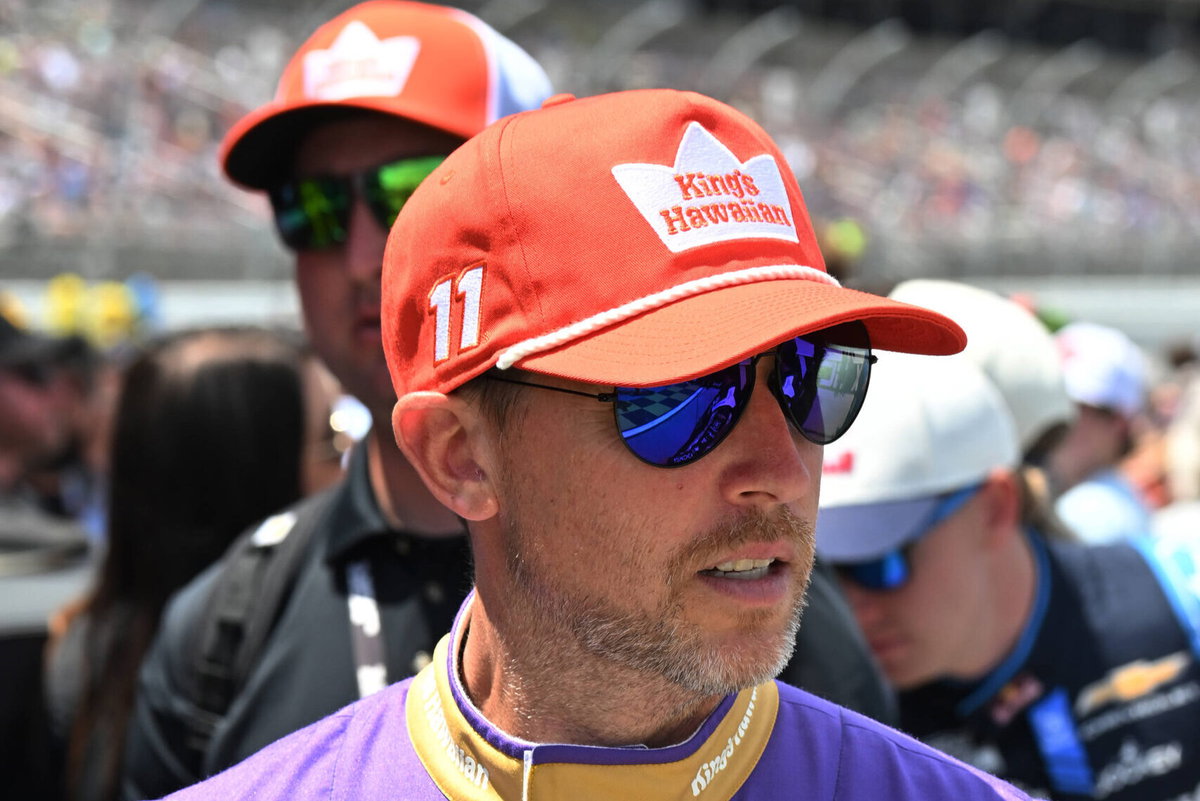
Denny Hamlin and Christopher Bell arrived at Martinsville Speedway knowing they needed to take points away from Kyle Larson. By the end of the afternoon, Hamlin had finished sixth, Bell was 10th, and Larson had somehow strengthened his championship position without having a particularly good race. The Hendrick Motorsports driver finished ninth, scored no stage points and spent part of the afternoon a lap down. Yet, his closest challengers could not turn that difficult afternoon into a meaningful championship gain.
Watch What’s Trending Now!
Jordan Bianchi and Jeff Gluck set the premise for this in a conversation on Dirty Mo Media.
“So, the opportunity was actually there. It was there. It was actually there today, and nobody could capitalize.”
The frustration becomes clearer when looking at Larson’s points total. He collected just 28 points at Martinsville, his second-lowest haul of the entire 2026 chase. Only Phoenix had produced a worse result. With no stage points to his name, Larson had given his competitors considerable room to make up ground.
A 76-point performance from either JGR driver would have created a 48-point swing against Larson. Under NASCAR’s new 10-race cumulative Chase format, that could have brought the championship fight within roughly 20 points of the leader. Instead, Hamlin and Bell left Martinsville with another missed chance.
Martinsville gave JGR more than one opening Hamlin initially looked capable of taking advantage. Starting on pole, he chose to stay out during the opening stage rather than pit for fresh tires. Larson followed the same strategy, but drivers who stopped gained an advantage as the stage progressed.
Ryan Preece passed Hamlin for the lead before William Byron and Ty Gibbs moved ahead. Hamlin eventually lost valuable track position and failed to score stage points. Larson also struggled, falling a lap down.
Hamlin later acknowledged the damage, saying, “It came down to the first stage. That was an absolute killer for us.”
Bell appeared better positioned after finishing fourth in the opening stage. However, a speeding penalty on pit road sent him backwards. His afternoon deteriorated further on Lap 216, when Joey Logano made contact entering Turn 1. Bell spun, and Hamlin got caught in the incident alongside his teammate.
Both Toyotas lost ground, while Larson received the free pass and returned to the lead lap. The No. 5 team had another chance to rescue its afternoon, and it took advantage.
William Byron eventually controlled the race, leading 362 of 500 laps to secure his first victory of the season. Larson recovered to ninth, while Hamlin finished sixth and Bell settled for 10th. Neither JGR driver delivered the points haul needed to punish Larson’s struggles.
However, these two reporters’ criticism went beyond this particular race. He pointed to a pattern that had repeatedly allowed Larson to maintain his advantage.
Hamlin had scored zero stage points in three of the previous five races. Larson had also failed to score stage points in two of the last three, including Phoenix and Martinsville. The difference was that Larson’s team kept recovering before those poor stage results could become championship disasters.
They also recalled Las Vegas as another example. Hamlin had an opportunity to put Larson a lap down but failed to do so. He subsequently spun, allowing the No. 5 team to recover once again.
Larson’s consistency makes those missed chances expensive There is another reason these opportunities have become such a problem for JGR. Larson is producing a postseason performance that belongs among NASCAR’s historical benchmarks.
They referred to the statistics sheet he had prepared for media day, comparing Chase average finishes, wins and mulligans. Larson currently holds a 6.8 average finish, with three victories and just one mulligan. That matches Jimmie Johnson’s average finish during his 2009 championship run.
Larson has not needed to dominate every race. His advantage has come from consistently limiting the damage when things go wrong. Even at Martinsville, where he scored only 28 points, he finished ahead of Bell.
Following the November 1 race, Larson leads the standings with 2,469 points. Bell trails by 67, while Hamlin sits 70 points behind. Only these three drivers remain eligible for the championship heading into the November 8 finale at Homestead-Miami Speedway.
That leaves JGR with one final opportunity to change the outcome. But the challenge is no longer simply catching Larson. Hamlin and Bell must overcome a deficit that could have been considerably smaller had they capitalized on the openings throughout the Chase.
The insiders’ closing observation captures the frustration: “Every opportunity has been there to stick the dagger in the No. 5 team’s heart, and they haven’t done it.”
At Homestead, Larson’s rivals will have to find a way to finish what they repeatedly failed to start.