
NASCAR’s superspeedway package faces another important test as the Cup Series returns to Talladega. The spring race highlighted how difficult it could be for drivers to advance through tightly packed traffic, with fuel saving and track position shaping their options. Daytona then provided an early look at NASCAR’s revised aerodynamic approach. With another adjustment planned for Talladega, attention turns to whether the changes can create a different racing dynamic at a track where drafting and momentum are crucial.
Watch What’s Trending Now!
Former Wood Brothers Racing driver Harrison Burton has offered his perspective after experiencing the revised package at Daytona. Speaking with Steve Letarte, Burton discussed the handling challenges he encountered and explained why he expects Talladega to produce a different racing dynamic.
“I thought the cars drove overall worse, which was good for the racing. I remember me and Reddick were kind of running top of three-wide there, trying to save fuel a little bit, and all of a sudden he got really tight,” Burton told Steve Letarte on ‘Inside the Race,’ as per the video uploaded by Letarte on X. “He hit the wall. I got tight behind him. I hit the wall. Like, we both had a big blowout moment, tight, just out of nowhere.”
The incident illustrated the handling challenges drivers encountered under the revised package. NASCAR reduced the rear spoiler from seven inches to four inches for Daytona, while lowering engine output from 510 to 465 horsepower. For Talladega, the series planned to retain the 465-horsepower configuration but reduce the spoiler further, from four inches to 3.5 inches.
The spoiler reduction is intended to reduce the aerodynamic grip holding the rear of the car down, changing how drivers manage the car in traffic. That matters at superspeedways because cars depend on the draft to build speed, yet they must also stay stable when changing lanes or making a move out of line.
The smaller spoiler is therefore not simply a bid for more passing; it changes the balance drivers have to manage while racing inches apart. The results may vary depending on how cars approach and follow one another.
Burton also pointed to Carson Hocevar’s crash after the driver attempted to move toward the bottom of the track, highlighting another moment when the car became difficult to control.
“Hocevar, when he tried to rip down to the bottom, he busted his tail. Huge wreck all by himself. You don’t really see that at Daytona in the previous rules package. So it was definitely a little bit nervous with the steering wheel. You had to be slow. You could feel that lack of rear downforce, and now they’re going to have another half inch off of that.”
Imago
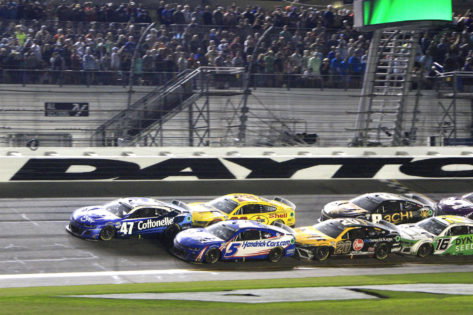
DAYTONA, FL – FEBRUARY 19: Ricky Stenhouse Jr 47 JTG Daugherty Racing Kroger/Cottonelle Chevrolet and Kyle Larson 5 Hendrick Motorsports HendrickCars.com Chevrolet lead the field during the running of the NASCAR, Motorsport, USA Cup Series Daytona 500 on February 19, 2023 at Daytona International Speedway in Daytona Beach, FL. Photo by Jeff Robinson/Icon Sportswire AUTO: FEB 19 NASCAR Cup Series DAYTONA 500 Icon2302192165500
Despite those concerns, Burton expects Talladega to present a different challenge. Although both tracks rely heavily on drafting, Talladega’s wider racing surface and lower emphasis on handling could give drivers more opportunities to use momentum and move through the field.
“Talladega is a little bit less of a handling racetrack, so I think what happens is those runs will be bigger, the runs will be more aggressive, and the drivers will take them, and you’ll see some good passing.”
The contrast is central to NASCAR’s latest package experiment. Daytona exposed the handling trade-offs, while Talladega will test whether the additional spoiler reduction can encourage more aggressive runs and passing opportunities.
Steve Letarte wants more room for drivers to make moves
Letarte’s concern centers on the congestion that defined the spring Talladega race. He argued that drivers often had little room to advance, even when they had the speed to challenge cars ahead.
“I’m hoping that there’s just space, and what I mean by that is, you know, when I go back to the spring Talladega race, it kind of looked like rush hour. Now it’s at 200 miles an hour, but it looked like it was, you know, Atlanta traffic. There was just nowhere for a guy to go, even the best.”
Fuel saving and restart position compounded the problem. Drivers who did not restart near the front could struggle to gain ground because the traffic left few openings to make a move.
“Fuel savings mattered because if you didn’t restart in the front two rows, you just couldn’t get there, and it didn’t matter how fast you were; there was just nowhere to go. You were blocked in. I just hope there’s more space so that they can make some more runs.”
Talladega will provide the next test of NASCAR’s revised approach. Burton’s Daytona experience highlighted the handling challenges, while Letarte’s concerns underline the need for room to pass. Whether the smaller spoiler delivers that balance will become clearer once the field takes the track.