
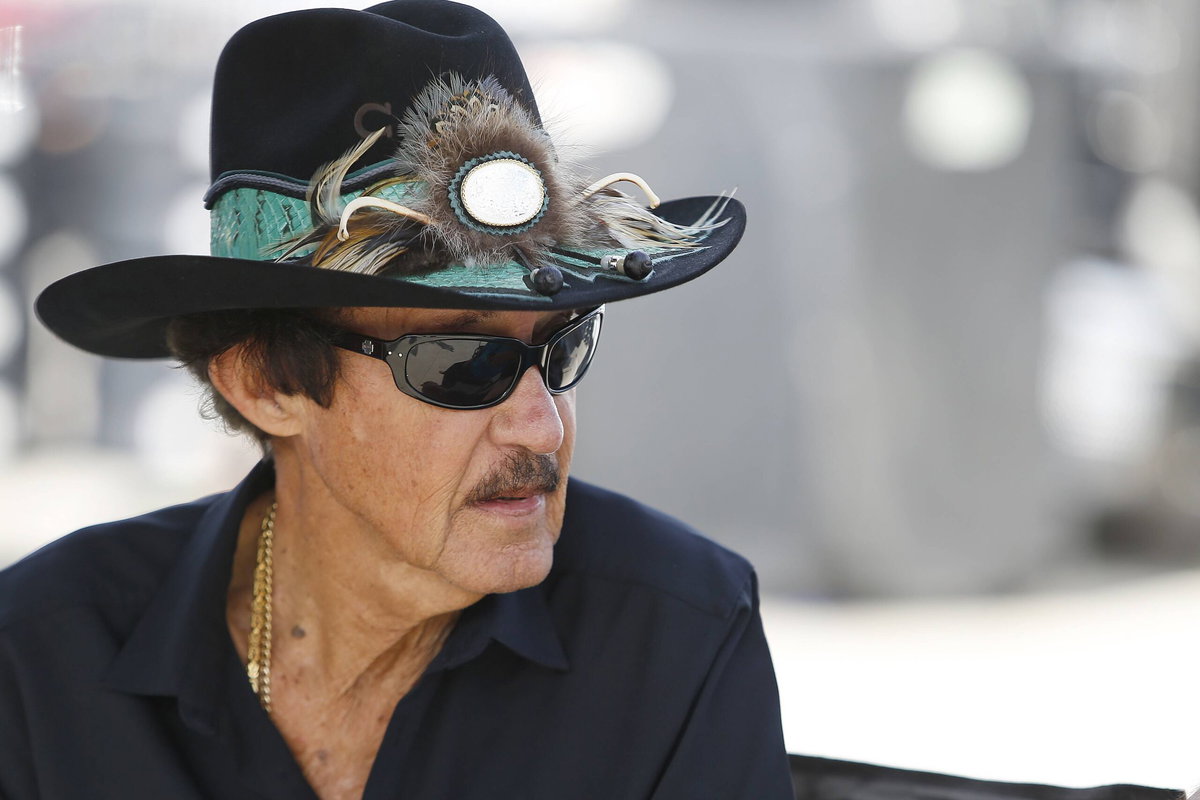
Richard Petty has spent a lifetime watching NASCAR championships get decided, so when “The King” questions how much credit a driver really deserves, it carries plenty of weight. With Denny Hamlin’s once-commanding Chase lead shrinking and Kyle Larson continuing to pile up points, Petty believes the current battle is proving an old NASCAR truth. The driver may be the face of a championship, but he is hardly the only reason a team wins one. In fact, Petty’s blunt assessment puts the driver’s contribution at “probably not even half” of the equation.
Watch What’s Trending Now!
“So, you know, the driver always gets credit for winning a championship, but to me, he’s just a big part of winning a championship, but he’s probably not even half of what it takes to win a championship,” Richard Petty’s assessment is about as blunt as it gets, especially coming from a seven-time NASCAR Cup Series champion.
The King is not saying the driver does not matter. Instead, he is challenging the way championships are remembered, with one driver ultimately receiving the trophy while the crew, engineers and car often receive far less recognition.
Hamlin entered the Chase with a substantial advantage and looked capable of turning the championship battle into a runaway. Five races later, however, Kyle Larson has taken control, while Hamlin sits second with five races remaining. Petty believes that kind of swing is exactly why the car and crew deserve far more attention.
Las Vegas was the latest example. Larson qualified sixth but quickly dropped to 14th as the No. 5 Chevrolet struggled with its handling. Rather than simply accepting the problem, crew chief Cliff Daniels and the team made a major adjustment during a green-flag pit stop, changing the front ride heights and crossweight.
The decision came with a heavy price. Larson spent 26 seconds on pit road, fell a lap down and appeared to have thrown away a valuable championship opportunity. But the adjustment worked. A subsequent caution allowed Larson to take the wave-around, and the No. 5 team gradually rebuilt the car and its track position. Larson eventually finished second.
That was not simply a case of a great driver rescuing a bad car. The team made the decision to sacrifice track position early because it believed the adjustment would give Larson a better car later. Daniels and the crew took the risk, executed the change and gave Larson something he could work with.
Kansas provided an even cleaner example. Larson dominated the race, but his victory was not secured until the final green-flag pit cycle. When Chase Briscoe came to pit road on Lap 216, Larson followed with a last-second call. The No. 5 pit crew executed the stop well enough to put Larson back in front at the end of the cycle.
Briscoe eventually passed him, but Larson fought back and retook the lead with seven laps remaining. The numbers from Kansas were staggering. Larson led 235 of 267 laps, swept both stages and scored 76 points. Yet even the No. 5 team emphasized that the victory was a complete effort.
Then there was Gateway. Larson had not won in 51 races, but his team helped put him in position to finally end that drought. On the final pit stop, Larson’s team elected to put four fresh tires on the No. 5 Chevrolet while Joey Logano’s team took only right-side tires. That decision became decisive during the late restarts.
Larson’s fresh tires allowed him to charge through the field, take the lead and survive two overtime attempts to claim the victory. Logano’s crew chief Paul Wolfe later acknowledged that the No. 5’s tire advantage made a difference.
Three races. Three different examples. At Las Vegas, the team rescued a struggling car with a difficult setup call. At Kansas, the pit crew and strategy helped Larson retain control when the race tightened late. At Gateway, a four-tire decision gave him the advantage he needed to end his long winless streak.
That is precisely what Petty means when he says the driver is not even half of the championship equation. The driver still has to execute. Larson had to take advantage of every opportunity those decisions created.
But without the people making those calls, preparing the car and executing on pit road, those opportunities may never have existed. And Larson’s 2026 Chase campaign is showing just how important that support can be.
The No. 5 driver may eventually receive the championship trophy if he holds on over the final five races. But Petty’s argument is that the trophy belongs to far more than the person holding the steering wheel.