
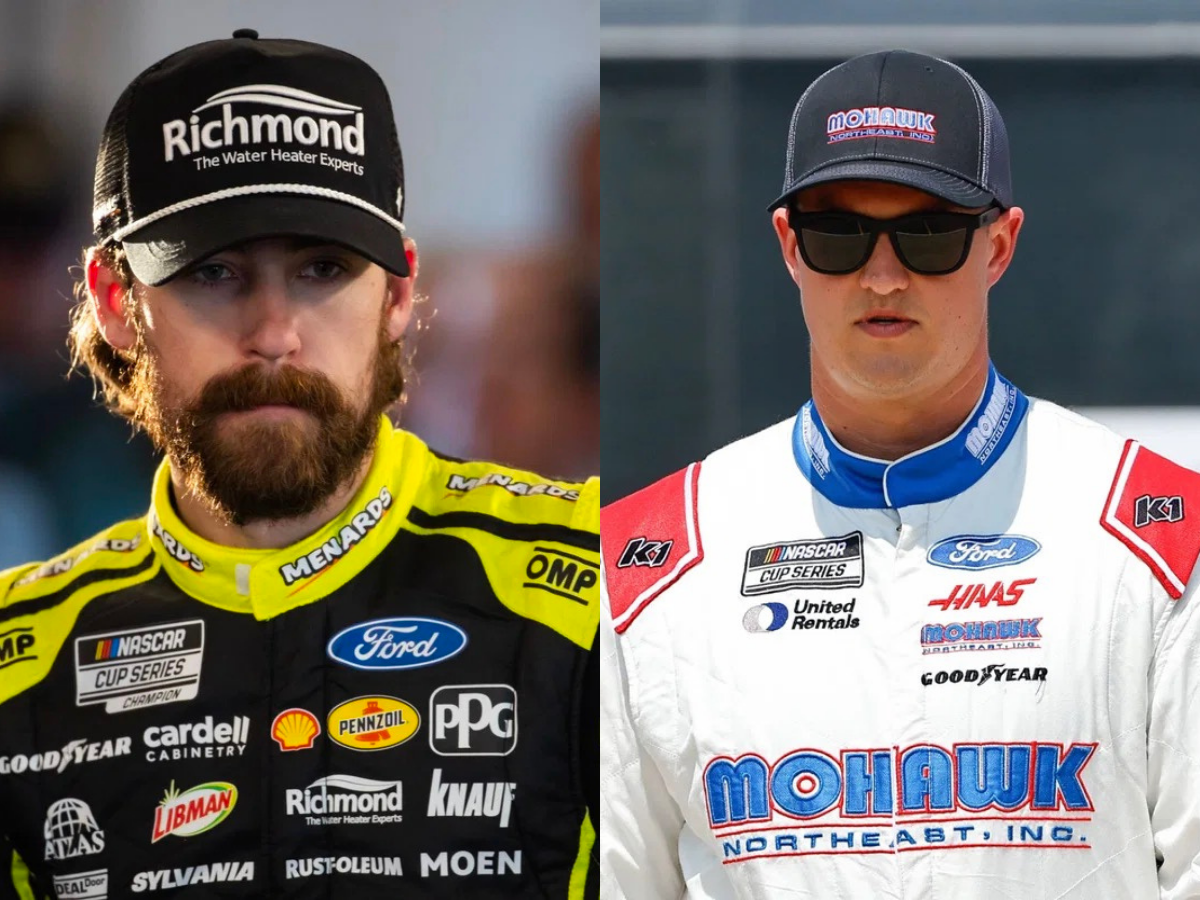
Ryan Preece arrived in Nashville still carrying the fallout from the penalty that followed his run-in with Ty Gibbs at Texas. NASCAR’s decision to dock him 25 points and fine him $50,000 survived RFK Racing‘s appeal, leaving the driver with little room to challenge the ruling publicly. So when Preece was asked about the incident this week, his response was less about revisiting Texas and more about what he believes the punishment was meant to accomplish.
Watch What’s Trending Now!
Speaking to Kelly Crandall in Nashville, Ryan Preece was of the opinion that he does not need any babysitting to control his words. “I don’t know. Here’s what I can tell you: It wouldn’t have taken $50,000 and 25 points to adjust at all. All it took was one conversation from Mr. Jack Roush, and I promise you I wouldn’t have hit that button, so respect for him,” he remarked.
As he elaborated, Preece echoed Ryan Blaney’s words about drivers using the radio to vent adrenaline during races. “I want to say there was a driver who talked about this. You aren’t going to sit in front of a mirror and talk to yourself. You need somebody to hear it, right? But yeah, I certainly won’t be hitting that button, I guess.” While referring to the decision of the authority, he also said, “I think that statement was pretty powerful for… Read between the lines.”
Preece stopped short of naming the driver he was thinking of. He didn’t need to. Earlier this month, Blaney explained how he treats radio outbursts. “You’ve got to hit the button, man,” he claims. “It’s like going to therapy. You can’t do therapy looking in a mirror.”

And that statement from the appeals panel? "Read between the lines ..."
The line Preece said at the end of the interview feels rather concerning in retrospect. It mirrors Formula 1’s intense policing policy, which has made drivers go silent in front of the media. FIA had started to issue fines for drivers for swearing in front of the media. It was supposedly not ‘family friendly.’ NASCAR seems to be taking a similar direction if their drivers are avoiding calling out what they feel is unfair.
What’s more concerning is the fact that the appeals panel neglected the SMT data that showed that Preece didn’t make intentional contact with #54 at Texas. Despite that the panel focused on Preece’s comments and chose to uphold the penalty by NASCAR. “Although not a unanimous decision, NASCAR and RFK Racing presented competing interpretations of common data. Neither side clearly proved their point, but Mr. Preece’s comments showed that he chose to not cut his competitor any breaks,” the statement read.
NASCAR recently saw exactly what Preece was talking about. At Dover, Natalie Decker had a total meltdown over her radio as she struggled to come to terms with the various penalties issued against her during the race. Decker was crying and blaming the authorities for being biased against her as she immediately decided to quit the NASCAR Truck Series.
Drivers risking their lives during the races need outlets for their adrenaline. NASCAR penalizing radio venting misses the point entirely. Many drivers openly swear or suggest that they are going to enact revenge on their rival. Using their words against them is not something that is ideal for a sport built upon retaliation.
What Ryan Preece did is not an exceptional case
When we look at it objectively, Preece’s radio was the biggest giveaway of his intentions. He was penalized under Sections 4.3 and 4.4. A in the NASCAR Rule Book. Earlier, he openly threatened to wreck Ty Gibbs over his radio.
“What a f****** idiot that kid is. He is so lucky his car is so f****** fast. … All right, when I get to that 54, I’m done with him. F****** idiot,” Preece burst over his radio.
Kyle Busch made an identical move on John Hunter Nemechek later that race. However, NASCAR ignored it, citing a lack of conclusive data. Fans saw the double standard, seeing Busch and Preece in the same light.
There are many precedents of NASCAR drivers speaking without filter over the radio in the past. “I don’t care how you do it.” “Wreck him! Wreck him!” These two radio calls are one of the worst examples of NASCAR’s bad race officiating in the past. At Richmond 2024, Austin Dillon intentionally wrecked both Joey Logano and Denny Hamlin while claiming it over the radio.
It took NASCAR three days to admit Dillon was wrong and penalize him, only after drivers caused a massive uproar over NASCAR’s poor decision-making and apparent promotion of wrecking in the win-and-in system. Even then, Dillon was allowed to keep his win.
In the 2026 season itself, Carson Hocevar was the biggest target for every driver owing to his overly aggressive driving. Kevin Harvick had literally urged the drivers to wreck him out to teach him a lesson. Over the years, wrecking drivers has become an essential part of NASCAR racing. So it doesn’t make a lot of sense when they choose to exclude some incidents while heavily punishing some chosen ones.