
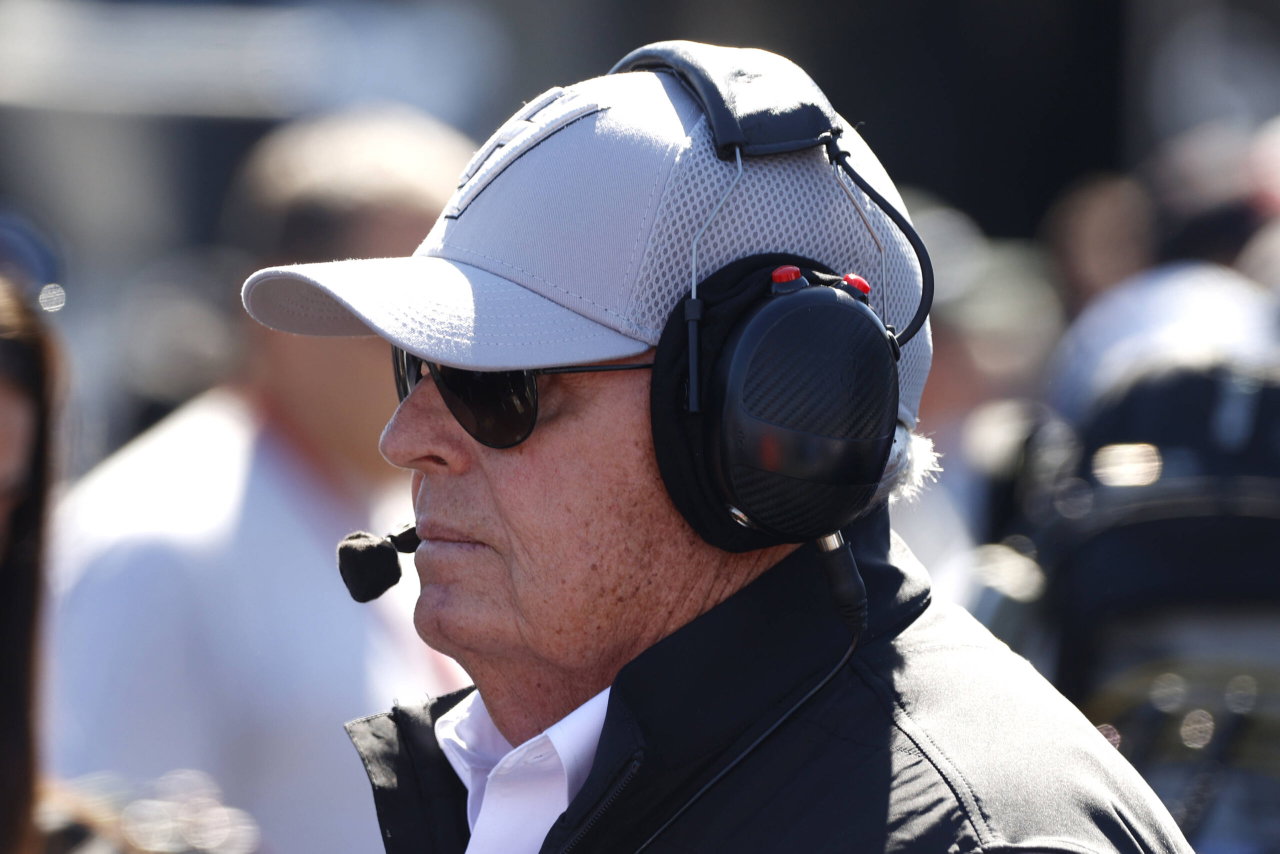
Rick Hendrick fired back at Denny Hamlin. The Joe Gibbs Racing driver had accused the HMS owner of controlling Chevrolet’s technical pipeline and suggested Hendrick’s influence shapes how manufacturer support gets distributed. Hendrick’s response offered a very different account of how Chevrolet shares what it shares.
“Someone said that we get all the information from Chevrolet, and that’s not the case, and he can answer this. All of the teams that are the three organizations get the same information at the same time, and how they decide to use it is up to them. But all the information from Chevrolet and the Tech Center comes to all of those three teams, it’s Childress, Trackhouse, and us. So there’s no funnel that we get it and give it to whoever else. So he can answer that for you if he wants to, but that’s the way it works,” Rick Hendrick was direct in rejecting the suggestion that his organization receives preferential technical support from Chevrolet.
His explanation was straightforward: Hendrick Motorsports, Richard Childress Racing and Trackhouse Racing receive the same manufacturer information simultaneously. What separates the organizations, in his view, is how each team interprets and applies that information once it reaches the garage.
The dispute stems from comments Hamlin made on his Actions Detrimental podcast after the Talladega race. He questioned whether Chevrolet’s affiliated teams really operate on equal footing, arguing that Hendrick’s influence gives it a level of control over the manufacturer’s technical resources.
Hamlin specifically challenged whether RCR receives the same information as HMS, despite both being major Chevrolet partners. He also described a chain of influence in which decisions effectively run through Hendrick rather than Chevrolet alone.
Hendrick’s explanation, however, draws a distinction between receiving information and making the most of it. Chevrolet’s technical resources are not limited to one NASCAR organization. The GM Charlotte Technical Center, which opened in 2022 beside the Hendrick campus, supports Chevrolet’s racing programs and provides engineering resources, simulation technology and real-time communication with teams. GM has described a collaborative approach in which teams share certain information while protecting their own confidential setup and performance data.
There is also a practical example of the Chevrolet organizations working together. Hendrick Motorsports and Richard Childress Racing established the Hendrick Childress Development (HCD) alliance for engine development. ECR engine personnel explained that the arrangement allows both organizations to share information and develop common components, with the work feeding back to Chevrolet.
The stated goal was to combine engineering resources rather than have separate groups independently developing the same parts. That does not establish that every team receives identical information in every area, but it does show that technical collaboration extends beyond Hendrick.
The distinction matters because Hamlin’s comments were not limited to technical data. He was also discussing Chevrolet’s alleged preference for Larson during the Talladega race. Before the event, journalist Danielle Trotta reported hearing that Chevrolet wanted its drivers to help Larson maintain track position and collect stage points.
Hamlin defended the report and argued that drivers such as Ross Chastain had to follow manufacturer expectations. He placed Hendrick at the top of that chain of influence, suggesting the organization held more sway than other Chevrolet teams.
Those are two separate questions: whether Chevrolet distributes technical information equally and whether it coordinates its teams to support a championship contender.
Hendrick’s response directly addressed the first. It did not provide a detailed answer to Hamlin’s broader claims about race-day instructions or the manufacturer’s internal hierarchy. That distinction is important because equal access to engineering information does not necessarily mean every team has the same influence when Chevrolet’s interests are involved.
Toyota’s relationship with Joe Gibbs Racing and 23XI Racing offers an interesting comparison. When Toyota announced its partnership with 23XI in 2020, it explicitly encouraged technical information-sharing and communication across its teams. The agreement also allowed 23XI to purchase chassis and other services from JGR. Hamlin later described the data relationship as reciprocal, saying both organizations were aware of what the other was doing.
Yet shared information has not guaranteed identical results. In March 2026, Hamlin discussed how 23XI had won four of the first six races while JGR was struggling to match that early-season form.
He explained that teams use shared information as a starting point before developing their own setups through simulation, driver feedback, and engineering decisions. In other words, access to the same data does not automatically produce the same competitive outcome.
That example also reinforces Hendrick’s central argument. Manufacturer support can give affiliated teams a common technical foundation, but each organization still has to translate that information into performance.
Hamlin is questioning whether Chevrolet’s structure gives HMS additional influence, while Hendrick insists the technical information itself is shared equally. Until Chevrolet clarifies the distinction between those two forms of support, the disagreement is unlikely to disappear.