

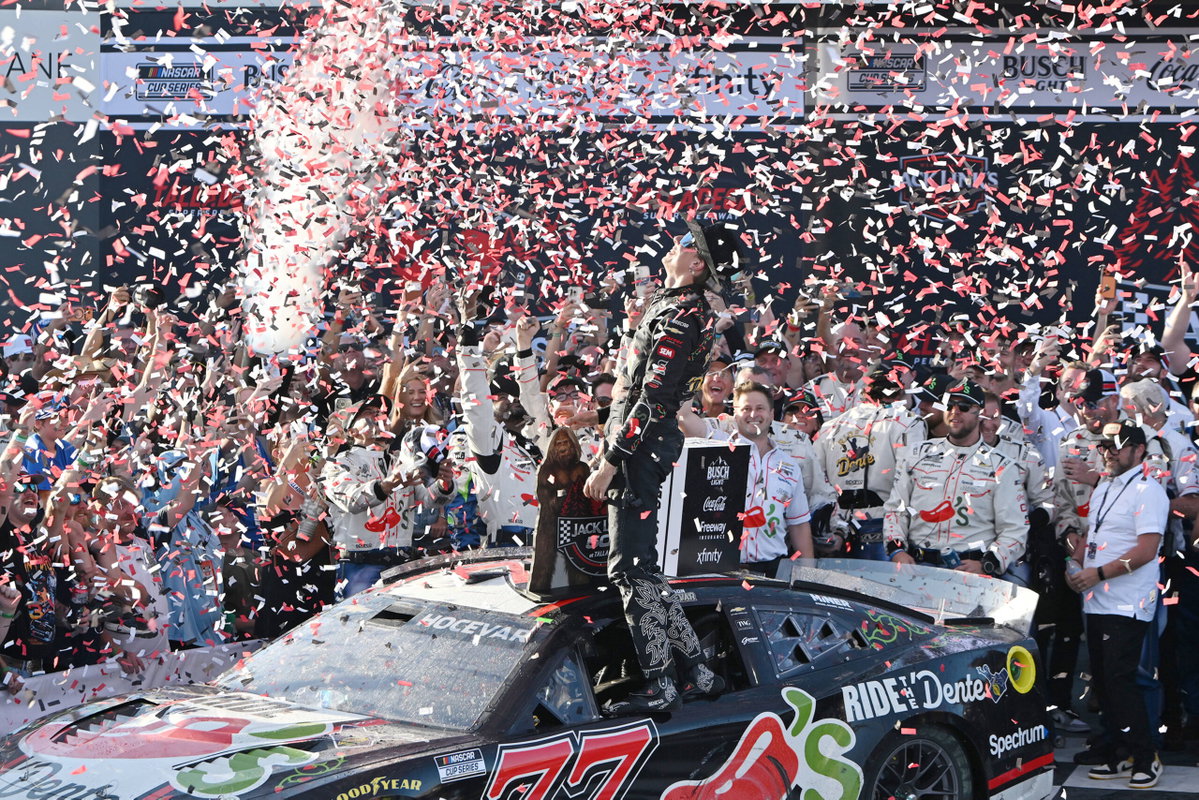
Look at how most NASCAR drivers celebrate their first Cup win. Usually, it’s pretty standard: a smoky burnout on the frontstretch and maybe a wave here and there toward the sponsor boxes. But Carson Hocevar isn’t one of those drivers. After winning at Talladega, he nearly gave his team a heart attack as he climbed out of the window, stood on the door, and used his legs to steer the car down the frontstretch while waving to the crowd. It was chaotic and risky but in a sport that now feels extremely rehearsed it felt authentic and nostalgic. Maybe that’s why Mike Joy sees something different in him.
Watch What’s Trending Now!
“One thing I really like about what he does is he doesn’t hide in the coach lot all weekend,” Joy said on the Happy Hour podcast with Kevin Harvick.
“If there’s a Saturday race, he’s up in the stands, sitting with the fans, taking it all in. Uh, and it takes me back to the days of I think Rusty Wallace being the last driver that you’d see out and about around town, making appearances not just for the sponsors but being out to dinner…” he added. And that is a huge comparison in itself.
Rusty Wallace was truly a fan favorite. He was not from the era of drivers that now disappear behind sponsor obligations, private motorhomes, media schedules, and carefully managed public appearances. In fact, he was famous for being someone who would stick around after the race ended, taking time to interact with the fans and sign autographs. People would often find him enjoying a meal at a local restaurants among regular folks minus all of the usual celebrity fanfare.
In fact even after he retired, the 1989 Cup champ continued giving fans the same level of importance. He even launched the Rusty Wallace Racing Experience in 2010 (now defunct), allowing everyday fans to drive actual stock cars at major speedways. So the Carson Hocevar comparison is huge, but there there is no denying that you can see a glimpse of the drivers of the past in Hocevar for sure.
Imago
TALLADEGA, AL – APRIL 26: Carson Hocevar 77 Spire Motorsports Chili s Ride the Dente Chevrolet celebrates in Victory Lane following the running of the NASCAR, Motorsport, USA Cup Series Jack Links 500 on April 26, 2026, at Talladega Superspeedway in Talladega, AL. Photo by Jeffrey Vest/Icon Sportswire AUTO: APR 26 NASCAR Cup Series Jack Links 500 EDITORIAL USE ONLY Icon2604264117
In fact, after the Talladega race, when he was asked about his move, his answer was telling of that.
“I just wanted them to get as loud as possible. I felt like they would if they could see me seeing them. Yeah, I mean, ultimately, I just wanted to make sure I soaked every bit of it in. I think I could tell you what everybody was wearing, where every seat was, and where every 77 shirt was. I think I could have pointed it all out to you because I remember it so clearly right now.”
This however is not a new development or something that he is doing for the media. Hocevar has long insisted that he wants to put fans ahead of any sponsors of people in suits.
“Like, you know, obviously we, you know, do the business side of it, but I was just like, if I don’t enjoy this and it’s not what I dreamt of, I’m out. Like, it doesn’t matter how much money is available, because, you know, I would just be breaking the heart of the six-year-old kid that fell in love with NASCAR,” he said in an interview earlier this year.
It’s no surprise that, in just a matter of months, Hocevar has become one of the most popular drivers in NASCAR, even emerging as a threat to Chase Elliott’s streak of winning the sport’s Most Popular Driver Award for eight consecutive years.
Carson Hocevar: first a fan, then a Cup Series star
Hocevar publicly celebrates being a NASCAR fan, in contrast to most young racers who carefully handle every public encounter. Hocevar never ceased acting like the child who grew up admiring driver personalities like Dale Earnhardt Jr., collecting diecasts, and watching races.
“I think what’s interesting about Hocevar is, yes, he’s unapologetically himself. But part of that is that he’s not ashamed to be a race fan. Like a lot of drivers get to the part like, oh, it’s not really cool to be like a fan. Hocevar is still a fan. Like he grew up as a fan the entire time and never ran from that,” Jeff Gluck said about the Spire Motorsports youngster in his podcast.
For Hocevar, it’s all about imagining whether the ‘fan version’ of himself would be a fan of the driver he is today. He carries himself the way he would want to see drivers carry themselves as a fan of the best racing series in the world.
“I wanted to be a fan of me, right? Like I wanted to be the person I am today and, you know, look back and just be like the kid I would be a fan of me watching, if that makes sense,” Hocevar recently explained on the Dale Jr. Download podcast.
Hocevar, who is only 23 years old, already has what NASCAR has been looking for for years: a driver who is approachable, unpredictable, and hard to ignore. He may become one of the biggest names in the sport if he can combine that bond with consistent success on the racetrack.