
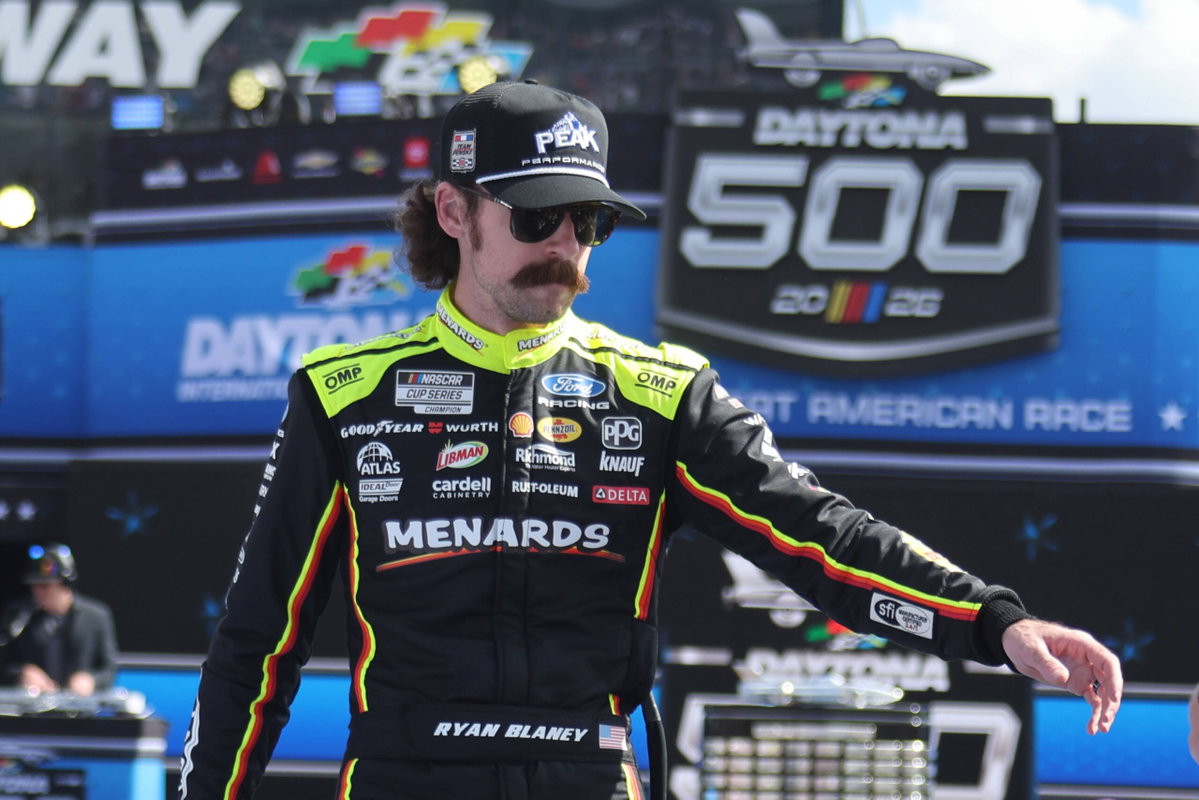
Few debates in NASCAR run as long or as loud as this one. Which races actually count as the sport’s biggest? In golf and tennis, the majors are official, written into the rulebook, governed by international bodies, and universally agreed upon. NASCAR has never done that.
Watch What’s Trending Now!
The concept grew out of fan culture, media conversations, and legacy sponsorship programs, so the argument never really ends. Now a current Cup Series driver has thrown his list into the mix, and the fanbase has split straight down the middle.
In order, Ryan Blaney’s five Crown Jewels, as per Joseph Srigley, are the Daytona 500, the Coca-Cola 600, the Brickyard 400, the Southern 500, and the Bristol Night Race.
The Daytona 500 is the sport’s most prestigious event, full stop. The Coca-Cola 600 at Charlotte is the longest race on the calendar at 600 miles, on every Memorial Day weekend. The Southern 500 at Darlington is the oldest asphalt superspeedway race in the sport, dating back to 1950. The Brickyard 400 at Indianapolis joined the list in 1994, borrowing prestige from one of the most iconic venues in motorsport.
Talladega could have competed for that fourth spot, had it not been for Indianapolis. From 1985 to 1997, the Winston Million program, a $1 million bonus for winning three of four designated races, officially listed the Winston 500 at Talladega as a crown jewel. The Brickyard replaced it. None of this was ever formally decided.
Winning all four in a career is called a Career Grand Slam. Only four drivers have ever done it: Jeff Gordon, Dale Earnhardt, Jimmie Johnson, and Kevin Harvick. Gordon leads all-time with 17 combined crown jewel wins. Among active drivers, Denny Hamlin has seven, but has never won at Indianapolis, leaving him one race short of the Slam.
The Fanbase Has Thoughts about Ryan Blaney’s List
Some fans backed Ryan Blaney without hesitation. “Going to hard agree with Blaney on this. This is the correct list,” one wrote.
Others came in with a question that gets at the root of the whole problem. “New to NASCAR so maybe this is dumb, I feel like this should be a unanimous thing otherwise it isn’t really accurate. Like the grand slams in golf and tennis.”
The Bristol debate pulled the most reaction.
“He is correct,” one fan wrote. “Not Bristol’s fault it went from having its own weekend in August to only a couple people realizing it’s on, due to college football.”
That is the core of it. The Night Race used to own the final weekend of August. No competition, full national attention, consistently pulling 2.5 to 3 million viewers. When NASCAR moved it into mid-September as a playoff elimination race, it landed directly against prime-time college football and ratings dropped below 1.5 million.
“Bristol Night only became an event when folks started wrecking and fighting each other,” another fan argued. “Take that away, like we do now, and it’s just another race.”
The sharpest divide was over Indianapolis.
“It’s still a no for me on the Brickyard. It’s a crown jewel track but not a crown jewel race. Five is too many and someone has to go and it’s Indy.”
The argument behind that view is straightforward: Indianapolis Motor Speedway was built in 1909 for open-wheel IndyCars. Stock cars have historically produced single-file racing on its flat, rectangular layout. NASCAR added it for the venue’s history, not because stock car racing organically belonged there.
Then came the move that many feel settled the argument entirely. From 2021 to 2023, NASCAR had the race move from the oval to the road course.
“Any small amount of crown jewelry it had left died when NASCAR moved to the road course,” one fan said flatly.
When a race’s format can be temporarily downgraded because the oval racing was not good enough, it is hard to call it untouchable. Ryan Blaney kept it anyway. That is his list, and that is why the debate is still going.