
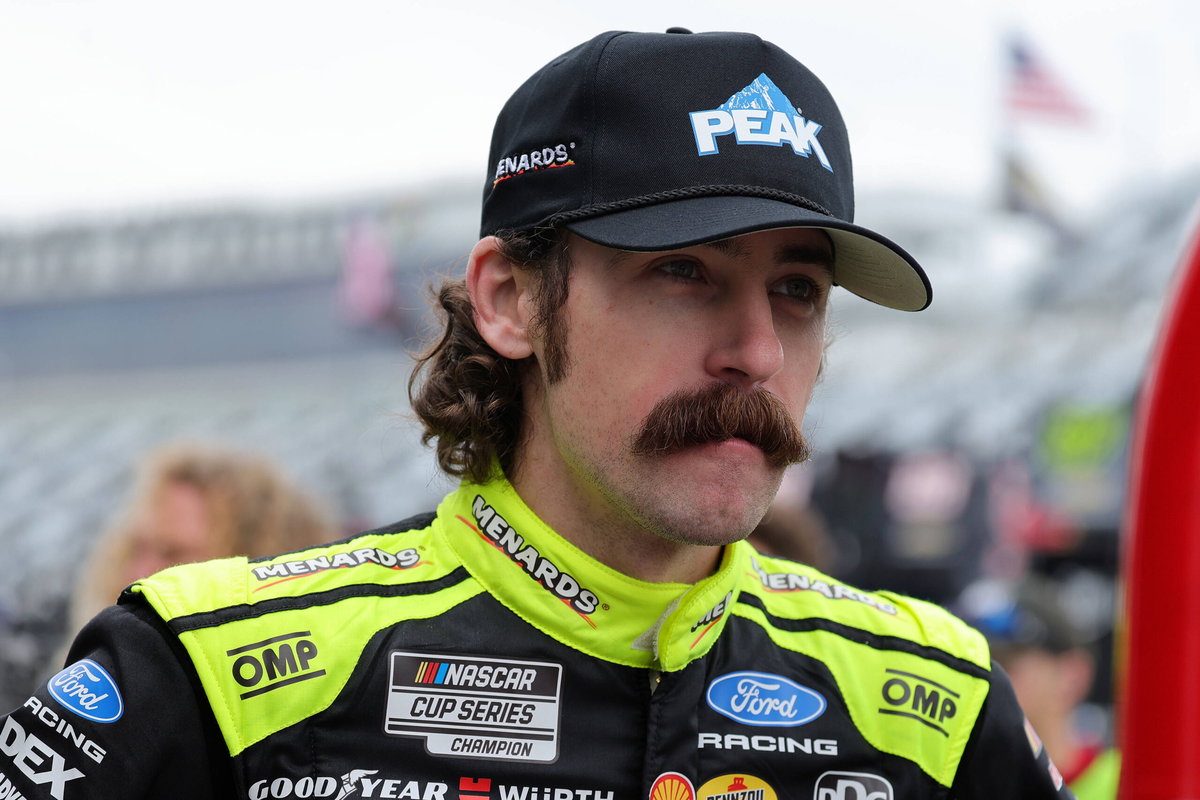
Ryan Preece learned an expensive lesson at Texas Motor Speedway in May. He threatened Ty Gibbs over the radio, saying he’d be “done with him” when they met on track. Then he did exactly that. Lap 101, rear bumper contact, Gibbs into the wall. NASCAR saw the audio. They saw the wreck. They connected the dots. Fifty grand and 25 points gone. But here’s what’s really bothering drivers now: everyone’s wondering if they’re one angry radio transmission away from the same fine. That’s what’s got Ryan Blaney fired up.
Watch What’s Trending Now!
A Way for NASCAR Drivers to Vent It Out Ft. Ryan Blaney
Blaney gets it. He’s been in the car long enough to know you can’t just bottle everything up for three hours.
“You gotta hit the button, man,” he said on Sirius XM, and he wasn’t being cute about it. “If you just say it to yourself, you’re talking to yourself. You need someone to hear it. It’s like therapy, you can’t do therapy in a mirror.”
So what does a driver do when frustration builds? You radio your spotter. You vent. You get it out of your system. Your team understands. They acknowledge it. Then everyone moves on. Except now there’s a recording of you venting. Blaney’s solution sounds half-joke, half-serious: a dummy button.
A radio that goes to one person on the team, someone who hears it but never talks back, never records it, never lets it go public. Dale Earnhardt Jr. had mentioned something similar before. But yeah, logistically it’s a mess. Too many buttons. Too much confusion.
So Ryan Blaney works around it instead. His spotter and crew chief know the deal. Talking about his personal experience with the team radio, he referred to his team saying, “They get that completely,” Blaney said.
“If I say something, it’s just me venting. Not that I have some huge issue. I’m getting it out there. 10-4, bud. We move on.”

When things go awry on the track, Ryan @Blaney 𝙣𝙚𝙚𝙙𝙨 to hit the radio button...venting to nobody doesn't really help. 🪞 "It's like going to therapy. You can't do therapy looking in a mirror." More with the @Team_Penske driver from #TMDNASCAR → sxm.app.link/NASCARIntervie…
This is not an isolated Ryan Preece incident, though. NASCAR is riddled with such penalties. Kyle Busch was in the same race. Wrecked someone. No penalty for Kyle Busch. Why? He didn’t say anything first. He made no admission of alleged guilt before or after the incident. Therefore, his move was simply called aggressive racing, given a warning, and then everyone moved on.
If you look back far enough, the pattern repeats itself. Cole Custer’s crew chief in 2022 radioed something about a flat tire. Everyone knew what it meant. Custer blocked cars. $100,000 fine. Indefinite suspension for the crew chief.
As for Clint Bowyer in 2013, his spotter said, “itch it” at Richmond. Code for spinning the car. That cost $300,000 and helped tank Michael Waltrip Racing. They lost their sponsor and the team folded.
Matt DiBenedetto got hit with $50,000 for coded language at Homestead. Ross Chastain’s teams paid $600,000 combined when radio logs showed they’d coordinated blocking at Martinsville last year. Every single one came down to the same thing: someone said something on a recorded line.
How NASCAR’s Recording System Creates a Penalty Trap
Ryan Blaney’s never been hit with a behavioral penalty for his radio comments. Never. He’s faced technical violations instead. This included a shock that didn’t meet minimum length at Las Vegas, wheel issues at Bristol, and ballast problems at Darlington. But nothing where his words came back to bite him.
That cannot be attributed to luck. It’s merely him being careful, that too for good reasons. NASCAR’s rulebook under Sections 4.3 and 4.4. A gives officials something simple: they don’t have to prove what you (the driver) were thinking. They just need what you said and what happened next.
The radio is the smoking gun. Audio plus action equals behavioral penalty. Minimum $50,000. Minimum 25 points. Preece had that audio.
“When I get to that 54, I’m done with him.” Then contact happened.
Thus the penalty. However, NASCAR racing cannot be set apart from its radio interactions. They’re as important as pressing that accelerator. On the other hand, though, it is also a permanent record that NASCAR can use against the drivers.