
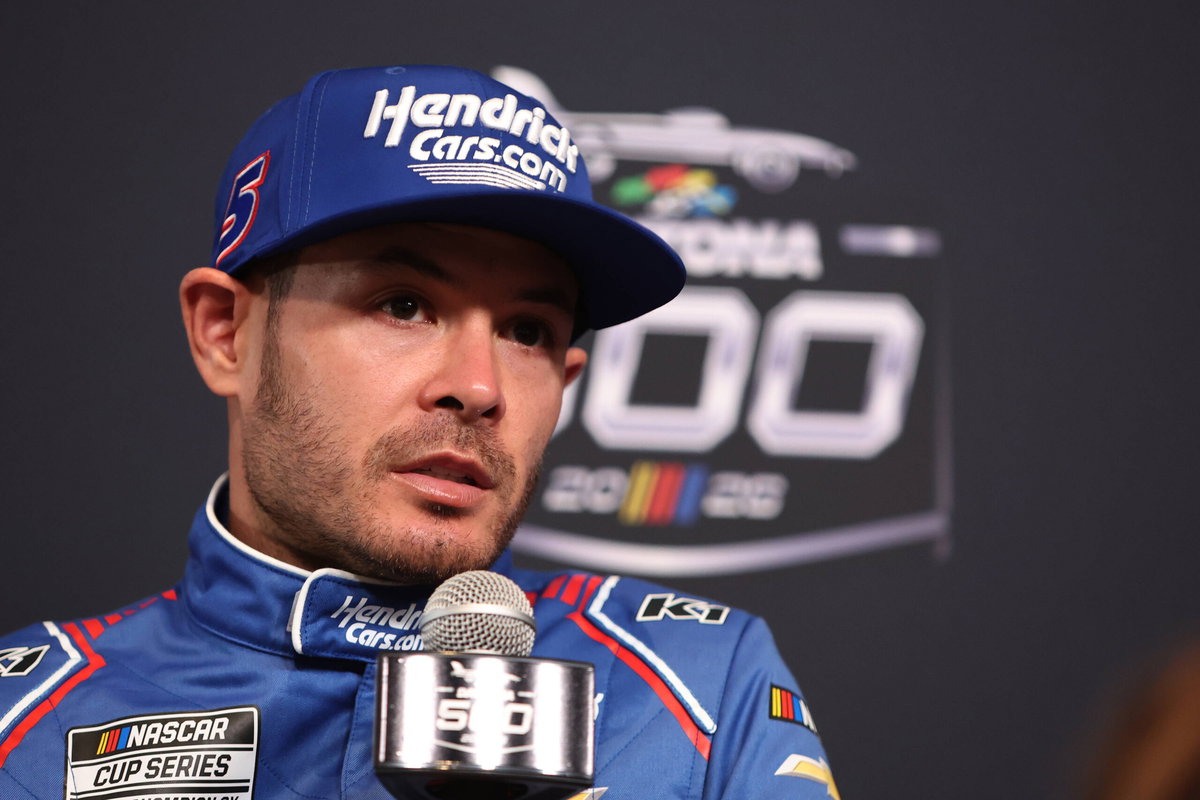
The second race of the Chase at Gateway was entertaining for the fans. But some of the Chase drivers found themselves in trouble after the mechanical failures. Ryan Blaney, Chase Elliott, and Chris Buescher all had to deal with brake failures in a race that caught the yellow fever, and even featured two red flags. While it might seem like a mechanical issue, Kyle Larson has aired his concerns, warning NASCAR against a potential serious incident.
Watch What’s Trending Now!
“So yeah, I think we have to try to, and I’m not an engineer by any means, but I feel like we got to keep these cars from exploding rotors because eventually there’s going to be a brake rotor that ends in the stands and seriously hurt somebody.” Kyle Larson voiced his concerns on the Rubbin Is Racing podcast.
The brake rotor failures at Gateway were not simply the result of drivers pushing their cars too hard. The 2026 technical package created a combination that placed enormous demands on the brakes. The high-horsepower, low-downforce setup increased straightaway speeds while giving the cars less aerodynamic resistance to help slow them down. That meant the physical brakes had to handle more of the work when the cars entered the heavy braking zones.
Teams also had another challenge to manage. To make the cars handle better, crew chiefs aggressively taped up the front brake cooling ducts. While that could provide an advantage on the track, it also restricted airflow reaching the brakes, particularly when cars were running in traffic. The problem became even more severe during the race’s 18 cautions and two red flags.
The constant stop-and-start motion of the race didn’t allow the pads to cool down. And at a track like Gateway, where restarts are aggressive and corners are tight, the brake pads couldn’t take up the beating.
A brake rotor breaking apart at high speed can send large pieces of debris away from the car. Larson warned that it may only take one failed rotor reaching the grandstands to cause a potentially devastating injury to a spectator. For him, preventing that scenario should be part of the conversation around the track’s future.
The brake failures were not the only safety issue that caught Larson’s attention. “And then also as we saw in the O’Reilly race, the pit road can be very very dangerous.”
Gateway’s pit road leaves very little room for error. The pit stalls are tightly packed, while the lane available for cars moving through pit road is exceptionally narrow. When a large group of cars enters together, drivers have to navigate through the confined space while pit crew members are already working around stationary cars.
That danger became clear at the end of the first stage of the O’Reilly race, when a 10-car crash unfolded on pit road as the field came in for fresh tires. The incident began when Rajah Caruth’s No. 88 spun and quickly turned the narrow pit road into a pileup. Caruth, Brandon Jones, Harrison Burton, Dean Thompson, Jeb Burton, Ryan Sieg, Patrick Staropoli, Jeremy Clements, Nicholas Sanchez, and Anthony Alfredo were all involved, with some drivers suffering race-ending damage.
The incident reinforced concerns about how little space is available when multiple cars converge on pit road. A mistake by one driver can quickly affect several others, while crew members working beside the cars have virtually no room to escape a developing incident.
Denny Hamlin has voiced similar concerns about the layout. “It is so dangerous. I’m telling you, these pit crew members that have their legs out changing tires as cars are trying to merge into each other, leaving the pit stalls.” Hamlin said on the Actions Detrimental podcast.
Larson does not believe Gateway’s racing surface itself needs a major overhaul. He called the track fun and said its ability to produce aggressive restarts and chaotic racing is part of its appeal.
His concerns, however, point toward areas where changes could improve safety without taking away what makes the track race well. For Kyle Larson, the goal is simple: keep the racing exciting while preventing brake failures and pit road incidents from becoming something far more serious.