
I tuned in to watch the Talladega race expecting the usual chaos, bumper-to-bumper action, and drivers throwing everything at each other for every inch of track. Instead, for the entirety of stage 1, I got a race that felt like it was running on fumes long before the cars actually needed fuel. And I wasn’t alone. Millions of NASCAR fans tuned in hoping for superspeedway fireworks, only to watch fuel-saving strategy take center stage. But, as we saw, while most of the field seemed content to play it safe, RFK Racing had other ideas. And now one of the team drivers has made his feelings clear, delivering a blunt message to the Cup stars who failed to react.
Watch What’s Trending Now!
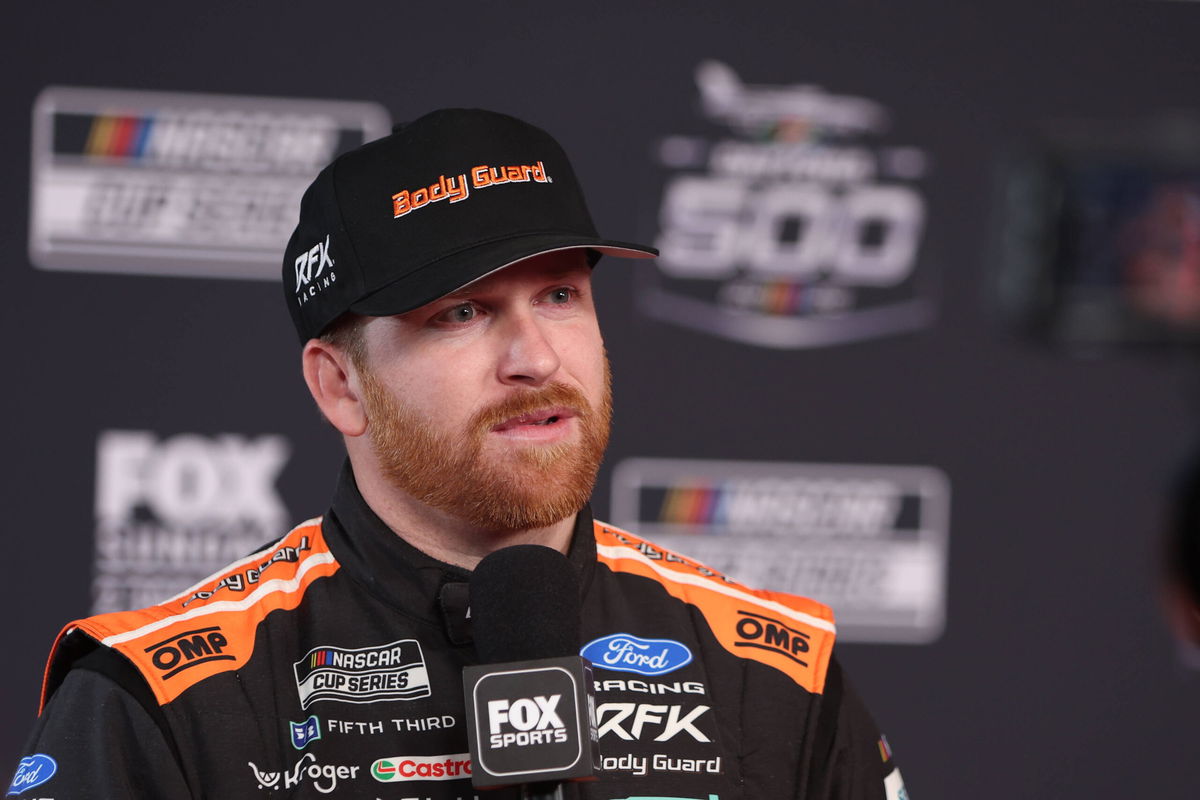
“Getting everybody, you know, on the same page at the same time. And you know what? Shame on the rest of them for not reacting. So, it made it that much more of a story,” Chris Buescher did not hold back after RFK Racing turned Talladega’s fuel-saving procession into a statement of its own.
The October 25 YellaWood 500 began with the field crawling around NASCAR’s biggest oval as teams prioritized fuel mileage over outright speed. Then Buescher, Ryan Preece, and Brad Keselowski decided they had seen enough. The three Fords broke away, built a massive advantage, and swept Stage 1 while much of the field struggled to respond.
The problem was not difficult to spot. Talladega is supposed to deliver high-speed drafting, aggressive lane changes, and drivers fighting to stay connected to the lead pack. Instead, the opening stage became a lesson in conservation. Teams were deliberately lifting off the throttle to burn less fuel, hoping to spend less time stationary during their pit stops and gain track position when the field cycled through pit road.
The pace became so slow that lap times stretched to around 58 or 59 seconds. For context, Chase Elliott had recorded the stage’s fastest lap at 47.546 seconds on Lap 73. The difference showed just how much speed drivers were leaving on the table. At one point, roughly three-quarters of the field was running below NASCAR’s minimum-speed threshold, which officials estimated at approximately 57 seconds per lap.
NASCAR eventually stepped in with a warning. According to NASCAR vice president of racing communications Mike Forde, officials sent a message to teams across pit road, telling them that some cars had not reached minimum speed and that the sanctioning body would have to intervene if the pace did not improve. The field picked things up soon afterward, so NASCAR did not need to black-flag anyone. Still, the intervention underscored how far fuel conservation had pushed the race away from the speed fans expect at Talladega.
RFK Racing, however, saw an opportunity in the situation. Buescher, Preece, and Keselowski lined up together and began pushing at full speed. However, much of the field still continued with saving fuel. Their three-car draft quickly separated from the pack. By around Lap 38, they had opened a lead of roughly 22 seconds. And the gap continued to grow as they maintained a much faster pace than the drivers behind them. At its peak, the advantage over the fourth-place car reached over 40 seconds.
Buescher was stunned by just how far ahead they had moved. Coming off Turn 2 and heading down the backstretch, he spotted cars entering Turn 3 in the distance and asked his team over the radio whether he was looking at the entire field or merely a few stragglers. The answer surprised him: it was the pack. The RFK trio had not only pulled away but had almost caught the back of the field before making its own pit stop.
The strategy paid off in Stage 1. Buescher crossed the line first, followed by Preece and Keselowski, giving RFK a clean sweep of the opening stage. Kyle Larson finished fourth, more than 20 seconds behind the trio. It was Buescher’s first stage win of the season, and the result demonstrated what could happen when a team chose to race rather than simply manage fuel.
The bigger issue extends beyond one Talladega race. Fuel saving has become a recurring feature of superspeedway competition, including the Daytona 500. Teams often run at partial throttle because the Next Gen car makes passing difficult without help from other cars. Saving fuel can reduce the amount needed during a stop, allowing drivers to gain track position without necessarily having to overtake anyone on the track. NASCAR has acknowledged the tension between that strategy and the racing fans want to see. However, changing stage lengths or fuel rules presents its own complications.
Buescher’s frustration was therefore about more than the slow pace. RFK Racing showed the field that a different approach was possible, and the other teams had an opportunity to react once the trio began pulling away. Instead, the gap became the story of the stage.