Imago
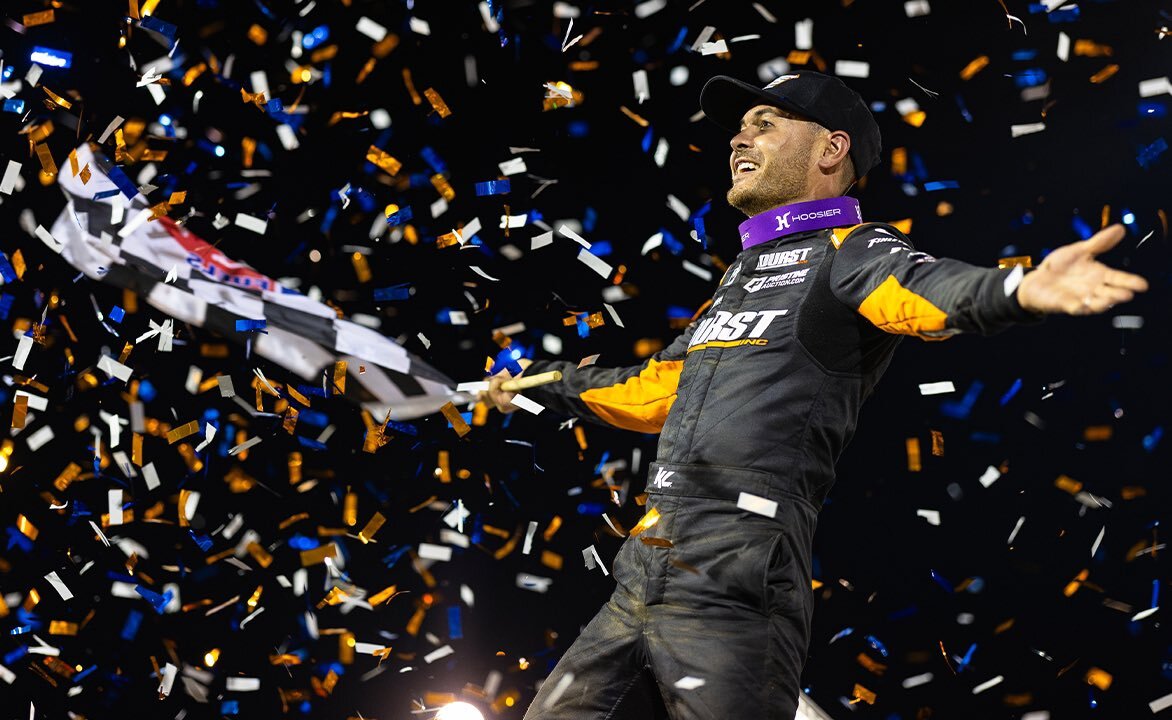
Kyle Larson (via @WorldofOutlaws)
Imago
Kyle Larson (via @WorldofOutlaws)
Essentials Inside The Story
- Should NASCAR drivers be allowed to race in other series from time to time?
- Does racing in other series give NASCAR drivers an unfair advantage when they're performing in their day job?
- Or does it make a NASCAR driver a more versatile race car driver?
It used to be that NASCAR team owners refused to allow drivers who raced under contract for them to compete in another auto racing series or take part in so-called “high risk” activities such as riding a motorcycle or going skydiving.
The reasoning is understandable: the owners didn’t want to run the risk of their driver being injured in extracurricular activity, which in turn would then impact their full-time driving day job in NASCAR. Owners didn’t want to risk the ROI (Return on Investment) of a driver that not only could impact the racing team they own, but also jeopardize multi-million dollar sponsorships and deals.
Watch What’s Trending Now!
So, more often than not, team owners would include a provision in a contract with the driver prohibiting freelance racing in other series.
For example, let’s say a full-time Cup driver wanted to race in sprint cars or other dirt racing rides because they used to do so earlier in their career – or for as simple a reason as they just enjoyed the change of pace.
Nay nay, most owners would say, it’s not happening.
And if a driver were to step out and compete in another series, even if it was for just a one-off appearance, that would be considered a violation of a driver’s contract and the owner had the legal right to fire that driver for breach of contract.
But slowly and surely over several years, in an effort to keep their driver happy and keep the peace, owners slowly began to warm to their drivers racing in other series.
Some owners encourage their drivers to compete in other series
Sure, there would be occasional exceptions that owners (and usually sponsors as well) would agree to, like when a Cup driver would attempt to compete in “The Double” – racing in the Indianapolis 500 and NASCAR’s Coca-Cola 600 on the same day.
Contractual restrictions have been significantly eased in recent years, allowing drivers like Kyle Larson, Christopher Bell, Kyle Busch, and even retired NASCAR Hall of Famers Kurt Busch and Tony Stewart to compete in other series.
Ever since he came to NASCAR, Larson, in particular, has been more or less the poster child of insisting upon having contract provisions that allow him to race in other series. He first convinced Chip Ganassi to grant permission, and then did so when he moved to Rick Hendrick’s team.
Hendrick and Ganassi were among the owners early on who refused to let drivers compete in other series, but they eventually relented and let their drivers do what they wanted.
Four years ago, the now defending and two-time Cup champion Larson took things a significant step further, starting the new High-Limit Racing Series dirt sprint car racing league along with brother-in-law and fellow racer Brad Sweet.
More owners have allowed their drivers to race in other series in recent years
Over the last decade, more owners have been willing to let their drivers race in other series or styles of racing. It’s rare that a driver is injured in an extra-curricular event, so owners are more amenable to letting their drivers have some extra fun in off-hour events.
However, incidents can still happen – and sometimes they’re devastating.
Just this past July, NASCAR Truck Series driver Stewart Friesen had a few days off and decided to return to his dirt racing roots by competing in a dirt modified race in Quebec, Canada.
Friesen had two devastating events that took place literally just a few seconds apart. First, he lost control and hit the outside retaining wall, went airborne, rolled several times, and ultimately his car caught fire.
#NASCAR Truck Series driver #StewartFriesen was involved in a scary accident during Monday night’s #DIRTcar Series #KingOfTheNorth race at #AutodromeDrummond in #Canada. He was alert & talking with officials before being transported to a hospital to be evaluated for injuries.🙏 pic.twitter.com/4ZTJofgv3y
— Last Lap Insider. (@LastLapInsider) July 29, 2025
Then, unfortunately, another competitor couldn’t avoid Friesen’s wreck and plowed into his car. After safety crew members were able to extricate Friesen from the mangled wreck, the real impact hit home as Friesen suffered a serious pelvic fracture and broken right leg. He went through subsequent surgery to correct his injuries, but the real damage was significantly multiplied because Friesen – a legitimate Truck Series championship contender when the mishap occurred – was lost for the remainder of the season, unable to race and having to endure a lengthy and painful recovery.
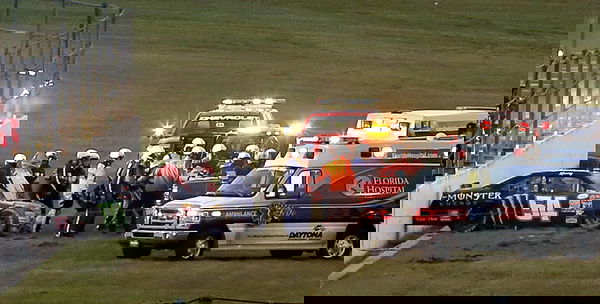
Another example of a crash that significantly sidelined a moonlighting driver occurred in the opening weekend of the 2015 NASCAR season. Competing in the Xfinity race at Daytona International Speedway, one day before he was scheduled to compete in the Daytona 500, Kyle Busch’s car went out of control and crashed head-on into an inside retaining wall, resulting in severe leg injuries.
Imago
NASCAR, Motorsport, USA Sprint Cup Series Kyle Busch is loaded into an ambulance after a crash during the the Alert Today Florida 300 Xfinity Series race at Daytona International Speedway in Daytona Beach, Fla., on Saturday, Feb. 21, 2015. Joe Burbank/Orlando Sentinel/TNS DAYTONA BEACH FL USA EDITORIAL USE ONLY Copyright: xx 1164311 JoexBurbankx krtphotoslive713014
Not only did the crash cause Busch to miss the 500 the following day, but he also missed the first 11 races of the season while enduring a lengthy and painful recovery. Ironically enough, however, Busch – courtesy of a competition waiver from NASCAR that allowed him to eventually compete in the playoffs even though he missed nearly one-third of the season – would in near-miraculous fashion not only return to racing, he wound up winning his first of what would eventually be two Cup championships.
Countless fans, media and several of Busch’s fellow competitors (most who kept their identity anonymous because they didn’t want pushback for their opinion) felt it was unfair that NASCAR gave Busch the competition waiver, exacerbated even more when he wound up winning the championship (he’d go on to win his second Cup crown in 2019 when he ran the full 36-race schedule).
While team owners have become more flexible in letting their drivers race in other series, there are still a number of owners who continue to prohibit their drivers from extracurricular racing. But that refusal isn’t always just for risking ROI, some owners – especially old-school team leaders – don’t feel it’s morally or even ethically correct to let their drivers earn some extra cash racing for someone else’s team in a different style of race car.
Bottom line, are guys like Larson, Bell, Kyle Busch and others wrong for extracurricular racing? Are they cheating their team owners and even their own race fans by not totally devoting 100% of their talent and time to race in another series? Is racing in another series solely about a driver making a few extra bucks?
Larson can be considered the leader of the extracurricular pack, dating back to 2020 during the COVID-19 pandemic. Even though many sports leagues like the NBA and MLB significantly reduced games – if not completely shut down operations – because of COVID, NASCAR and sprint car racing kept operating.
Larson missed all but four Cup races in 2020 not because of COVID, but because he was on suspension for using racial epithets during an online competition. While NASCAR didn’t want him, Larson wound up switching to sprint car racing, which welcomed him with open arms.
He competed in over 50 events that year and reportedly wound up making more money from race purses and selling souvenirs and branded clothing than he would have made in the full NASCAR season (unless he had gone on to win the championship).
Larson continues to race in High Limit events when he can. He usually competes every winter in a series of events in Australia, and of course who can forget that he competed in the Indianapolis 500 for each of the last two years (although he does not expect to continue that in 2026).
Some critics believe drivers who compete in extracurricular events like Larson wind up having an unfair advantage in their regular day jobs in NASCAR because they’re logging significantly more on-track time, even if the racing genre they’re competing in is different than the Cup Series.
Recently, in the annual Chili Bowl in Tulsa, Oklahoma – the largest midget race in the world – nearly a dozen NASCAR drivers took part including Larson, who won the event in 2025, along with three-time Chili Bowl winner Christopher Bell, 2025 NASCAR O’Reilly Auto Parts Series champion Jesse Love, Ty Gibbs, Sheldon Creed, Corey Day, J.J. Yeley and Josh Bilicki, along with NASCAR Regional series drivers Gavan Boschele, Jake Johnson and Ryan Roulette.
While racing in the Chili Bowl is open to anyone with a midget car, all in contention for the fabled Golden Driller trophy and the five-figure first prize, it also presents somewhat of a conundrum.
For each NASCAR driver that makes the field for the main event, it also keeps several regular sprint or midget racers from competing because a NASCAR driver, in essence, is taking a spot away from someone who otherwise might qualify for the main event and potentially have a chance at winning the event.
While some regular midget drivers may feel it’s unfair to them to have NASCAR drivers in the field, event promoters also understand that having NASCAR drivers is somewhat of a necessary evil, so to speak, because names like Larson, Bell, and past entries like Stewart all sell tons of tickets and sell out the arena practically every night.
Without NASCAR drivers in the Chili Bowl, prize money and attendance would likely suffer more than the way it is currently structured.
Should NASCAR drivers be allowed to compete in other series, even if it’s just for an occasional one-off start like in the Chili Bowl? Is it morally or ethically right for NASCAR drivers to take part in other series? On the flip side, is it morally or ethically right to discriminate against and keep NASCAR drivers from competing in other events?
Related Newsletters