
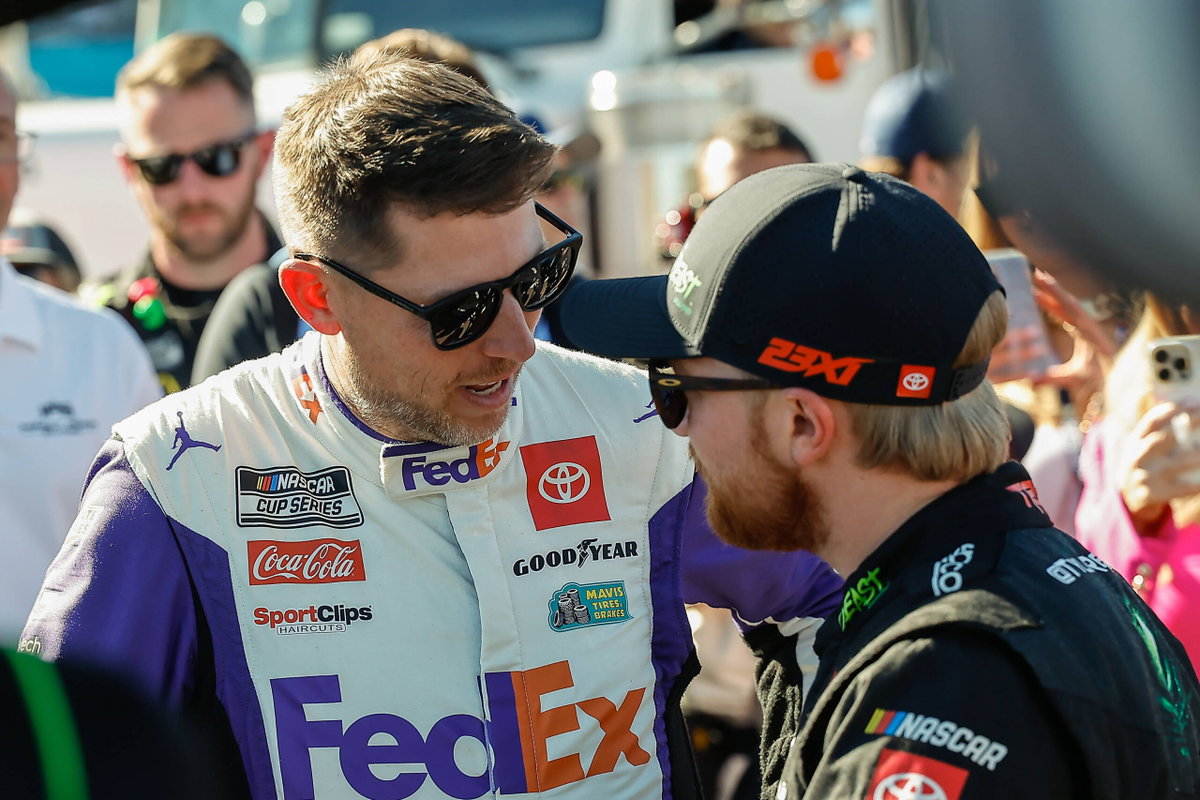
Talladega has turned NASCAR’s championship fight into a manufacturer chess match, with Ford’s RFK Racing trio finding strength in numbers and Chevrolet reportedly organizing support for Kyle Larson. But the biggest drama may be brewing inside Toyota’s own camp. With Tyler Reddick fighting for the title and Bubba Wallace outside the Chase picture, a disputed team order has exposed the tension between helping a teammate and protecting your own race. And Denny Hamlin’s furious reaction to Chase Briscoe’s move has added another layer of intrigue.
Watch What’s Trending Now!
“F**** 19, I’m so sick of this sh*t. He is the f**** worst.”
Denny Hamlin’s furious outburst at Joe Gibbs Racing teammate Chase Briscoe, as reported by Dustin Albino on X, captured the tension inside Toyota’s camp during the YellaWood 500 at Talladega. Briscoe’s decision to move into the top lane and line up with Chevrolet drivers instead of staying with the Toyotas left Hamlin fuming.
The moment came amid another dispute over manufacturer loyalty, with 23XI Racing teammates Bubba Wallace and Tyler Reddick facing their own disagreement over how much help a championship contender should receive.
Hamlin arrived at Talladega needing a strong result to recover ground in the Chase. After Kyle Larson’s disastrous Phoenix race tightened the standings, Hamlin sat fourth, 31 points behind the leader. But Talladega offered a different kind of challenge: raw speed mattered less than finding the right drafting partners and trusting them to stay in line.
That made Briscoe’s lane change particularly frustrating. The No. 19 Toyota driver was one of Hamlin’s closest championship rivals, sitting third in the standings and 24 points behind Larson before the race. Instead of staying aligned with fellow Toyotas, Briscoe moved into the top lane with the Chevrolets.
The Stage 1 results added an awkward twist: Briscoe finished seventh, while Hamlin crossed the stage line in 15th. At a track where a single car leaving a line can weaken the entire group, Hamlin saw the move as another example of a teammate failing to work with the manufacturer’s collective interests.
Bubba Wallace’s refusal creates another Toyota problem
The tension extended beyond Joe Gibbs Racing. During Stage 1, 23XI Racing reportedly wanted Bubba Wallace to help teammate Tyler Reddick push toward the end of the stage. Reddick was short on fuel, and the team wanted to protect the championship contender’s opportunity to collect stage points. Wallace, who was well outside the title fight, reportedly refused, arguing that Reddick’s fuel situation was not his responsibility.
The situation exposed a difficult question for teams with multiple drivers: how much should one competitor sacrifice for another? Reddick entered Talladega 56 points behind Larson, leaving him needing a major points haul to keep his championship hopes alive. Wallace, meanwhile, was 162 points back and had little realistic chance of winning the title.
From the team’s perspective, helping Reddick made sense. But from Wallace’s perspective, sacrificing his own race to solve a problem he did not create was a different proposition. The reported refusal echoed Hamlin’s frustration with Briscoe, though the situations were not identical: one involved a direct request to help a teammate, while the other involved a driver choosing a different drafting lane.
The disputes stood in sharp contrast to Chevrolet’s reported effort to help Kyle Larson. Before the race, reporter Danielle Trotta said the manufacturer had instructed teams to keep Larson from being stranded at stage finishes, maximizing his points haul. Larson is the only Chevrolet driver among the leading championship contenders, giving the wider fleet a reason to support him.
The strategy appeared to pay off early. Larson finished Stage 1 in fourth, collecting valuable points while the Chevrolet and fellow teammate car of William Byron helped Larson maintain a strong presence near the front. That result does not prove every driver followed a coordinated order, but it illustrates why manufacturer support can matter at Talladega.
For Hamlin and Toyota, the problem was not simply Chevrolet having more cars up front. It was that Toyota’s own drivers were not always pulling in the same direction. With the Chase tightening and every stage point carrying weight, the manufacturer battle at Talladega became as much about trust and cooperation as it was about speed.