
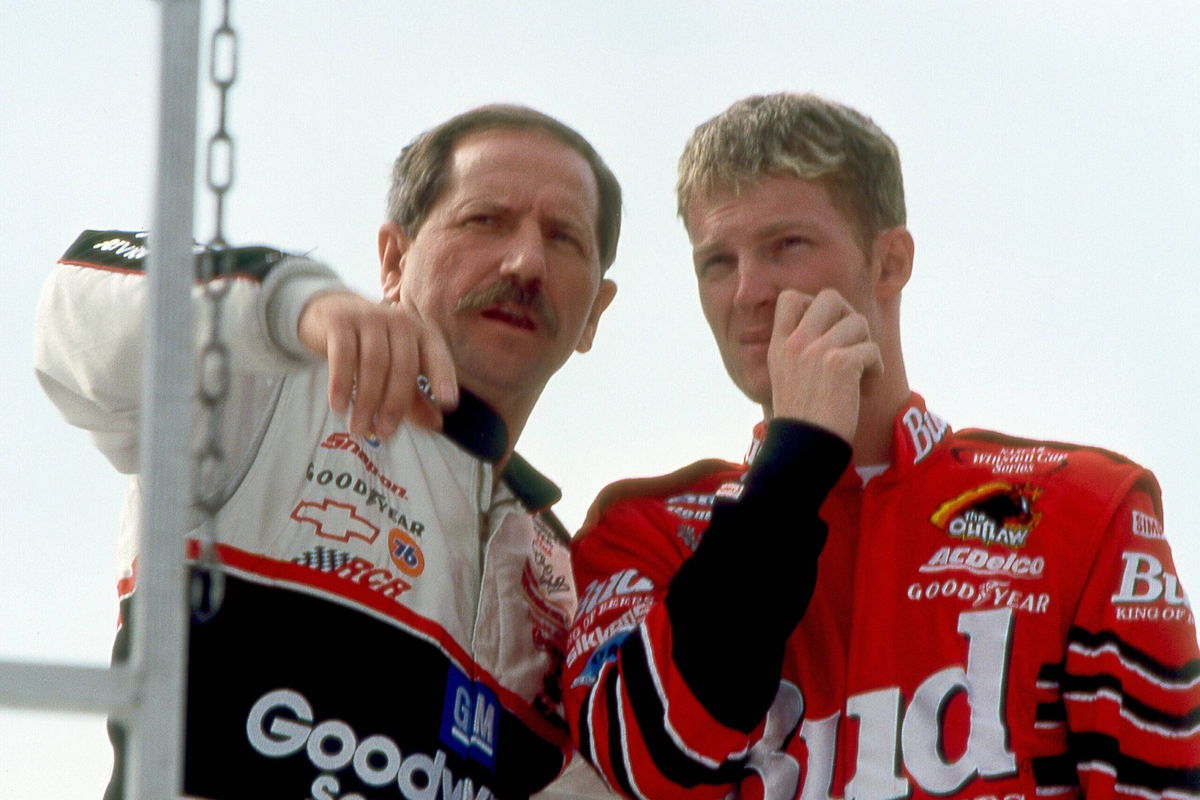
At Myrtle Beach Speedway, a young Dale Earnhardt Jr. was learning that getting alongside an experienced late-model driver did not guarantee room into the corner. One competitor repeatedly forced him into trouble, and the rookie kept paying for it. The encounters were becoming a weekly problem on a track where every position mattered, and few drivers were willing to give ground.
Watch What’s Trending Now!
The next Saturday offered another chance to settle the matter, but the opponent was no easy target. Dale Jr. eventually took the problem to someone who knew the demands of short-track racing better than most. What followed was a lesson in racecraft that would change the way he handled their next meeting when the green flag dropped again.
“The first time that happened, we go down to the corner, and he’s coming down, and I just kind of tensed up, and we hit, and I just spin out,” Dale Jr. said on his Ask Jr. Live podcast. “I get home, see my dad at the shop Monday, tell him what happened. He goes, ‘Man, when that happens, when that guy comes down on you, got to turn the wheel’ and I didn’t touch the brake pedal. He’s like, ‘You got to hold the wheel straight, mash the brakes. Slam on the brakes, hold the wheel straight, and it’ll bop him up the track. It’ll hit when he comes down; he’ll bounce off you and spin out himself.’
“Literally, we’re at the next race the next Saturday night. And I mean, it’s almost a mirror image of the week before. I’m underneath Ed. Me and Ed always kind of ran like third and fourth. So Powells are up there leading, and me and Ed are back there battling for third or fourth with all our friends, and he’s coming down, going down into turn one. Same turn. I mean, it’s like a mirror image, and I just held the wheel straight, slammed on the brake, and we hit, and it spun him out, and I’m like, ‘Sorry, Ed.’ He’s older than me, a lot taller than me, but so that was a good lesson learned, and Ed never was mad about it.”
The story comes from Dale Jr.’s Late Model years, which stretched from 1991 through 1995. Much of that development happened at Myrtle Beach, where he raced on weekends after spending the week working on his cars. He was competing in a demanding regional short-track environment, not simply learning the basics in an entry-level division.
His first NASCAR-sanctioned victory at the facility came on August 20, 1994, when he won the second 40-lap feature of a twin-race program. The two encounters with Ed Ray, however, have not been matched to specific race dates.
There was plenty of established competition to measure himself against. Asked about his biggest rivals from those Myrtle Beach days, Dale Jr. named Robert and Charlie Powell. He also mentioned Sean Graham, whom he considered an excellent driver, and Edward Jordan, a friend with whom he was still in contact decades later.
Robert Powell had already built an impressive short-track résumé. He won the 1988 Winston Racing Series National Championship and collected track titles at Myrtle Beach, Summerville, and Florence. His father, Charlie, was another important figure in the regional racing scene, both as a competitor and promoter.
The family was a formidable presence, which explains why Dale Jr. remembered the Powells running at the front while he and Ray fought over the positions behind them.
Edward Jordan brought a more personal connection to those memories. Dale Jr. described him as a friend and recalled still exchanging messages with him decades after their Myrtle Beach racing days. TJ Majors also joined the conversation, recalling Jordan’s KFC-sponsored car and the nickname Chicken Man. It was a reminder that the friendships formed in those weekly short-track battles often lasted long after the racing stopped.
Ray’s reputation also extended beyond the incident Dale Jr. described. Edison Hugh Ray Jr. began racing at 16 and competed on dirt and asphalt tracks throughout North and South Carolina. He later operated Ed Ray’s Garage for decades before passing away on October 11, 2026.
Dale Jr.’s recollection of Ray never taking the contact personally offers an important glimpse into the relationships that developed among regular short-track competitors. Aggressive racing was part of the job, but it did not have to follow drivers into the pits.
Earnhardt’s own reputation was built on similar toughness
The advice came from a driver who had made a career out of understanding the physical side of stock-car racing. Dale Earnhardt was rarely reluctant to use his Chevrolet’s bumper when an opponent stood between him and a victory. One of the clearest examples came at Rockingham in February 1996, when he moved Bobby Hamilton’s No. 43 Pontiac out of his path with contact in Turn 4.
Hamilton was leading when Earnhardt nudged him into the wall with 49 laps remaining in the Goodwrench 400. The contact damaged Hamilton’s car, and he eventually finished 24th after a subsequent crash. Earnhardt won the race, his first victory of the 1996 season. Hamilton was furious, but Earnhardt defended the contact as part of close racing.
Bristol supplied an even more memorable example in August 1999. Battling Terry Labonte on the final lap, Earnhardt made contact with the No. 5 Chevrolet, sending Labonte spinning.
Earnhardt took the victory amid a furious reaction from the crowd. His explanation that he had only intended to rattle Labonte’s cage became one of the defining lines associated with his aggressive racing reputation.
There was a difference between those Cup Series confrontations and the lesson he gave his son. At Myrtle Beach, Earnhardt was explaining how to respond when another driver crowded him into the corner.
Rather than panic, turn into the opponent, or surrender the position, Dale Jr. needed to remain composed and understand how to control the contact. It was a lesson in positioning as much as aggression.
Dale Jr. would develop his own understanding of when contact could make the difference. At Martinsville in 2014, he used a bump-and-go move against Tony Stewart with three laps remaining in the Goody’s Headache Relief Shot 500.
The move opened the door for his first victory at the Virginia short track, earning him the grandfather clock he had long wanted. It wasn’t an exact recreation of his father’s Myrtle Beach advice, but it showed how Dale Jr. learned to use controlled contact as a racing tool.
For Dale Jr., the lesson began on a Saturday night against a competitor who never made things easy. Earnhardt’s advice was blunt, practical, and rooted in years of racing experience. Ray’s response afterward mattered just as much. The two could settle their differences on the track and move on, which is perhaps the most enduring lesson from those Myrtle Beach nights.