
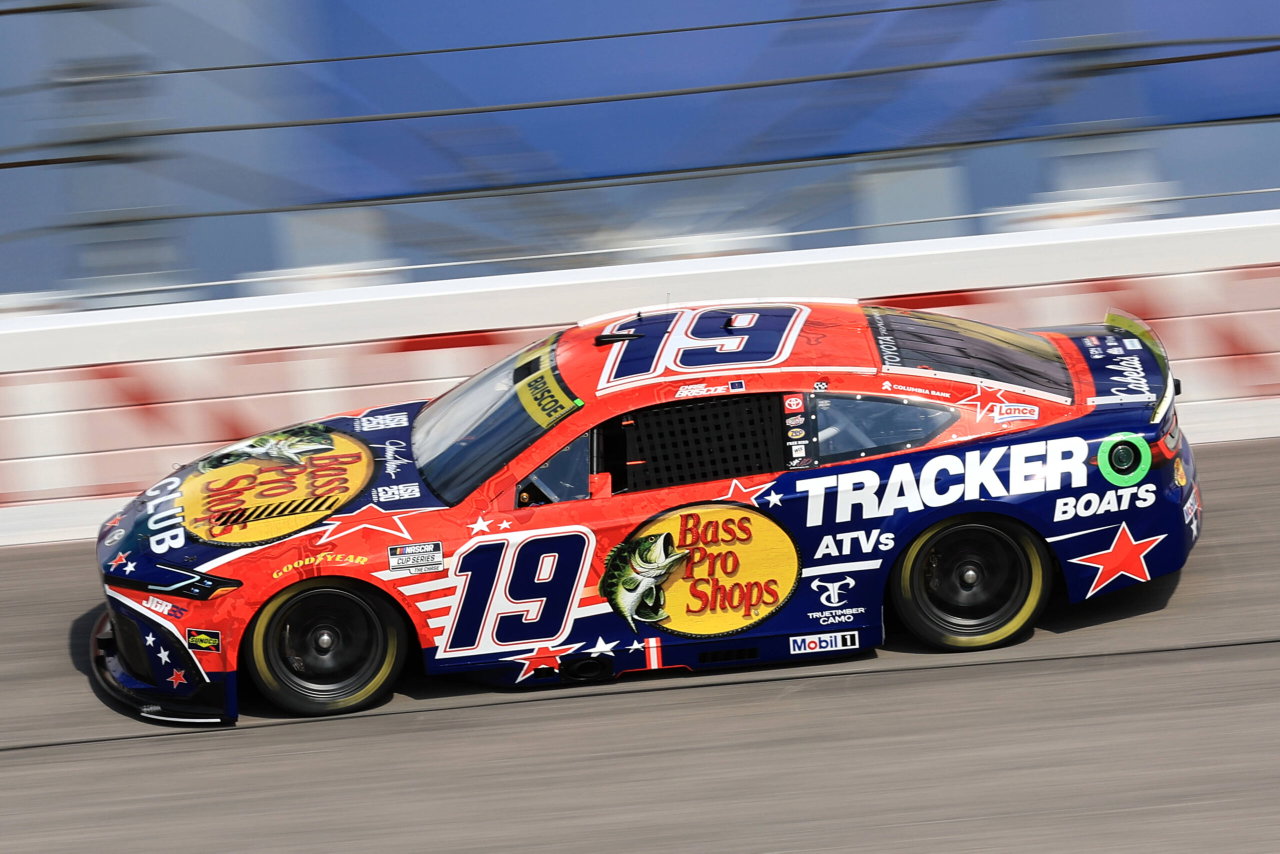
Few go to Darlington Raceway expecting an incident-free afternoon. The track is old, narrow, and absolutely merciless on tires, making it the perfect venue to open the 2026 NASCAR Cup Series Chase. The revived 10-race championship run keeps all 16 drivers in contention, with points accumulating all the way to Homestead-Miami Speedway in November.
Watch What’s Trending Now!
There are no eliminations, meaning every point counts. All 16 drivers walked into Sunday’s Southern 500 still mathematically alive in the championship fight, but not all of them remain in the realistic title conversation after this race.
Eighth time’s the charm for Christopher Bell
Let’s start with the obvious. Christopher Bell winning a race in 2026 was a long time coming. Seven second-place finishes this campaign. Nothing in Victory Lane since Bristol Motor Speedway in September 2025. Bell’s No. 20 Joe Gibbs Racing Toyota had been fast enough to win races all season. He just kept coming up short at the end.
Weather canceled Saturday’s practice and qualifying, so NASCAR set the grid through its metric formula. Bell started 11th and made the most of it, leading 46 laps, winning Stage 2, and waiting for the right moment. Kyle Larson gave him one when crew chief Cliff Daniels kept Larson’s No. 5 Hendrick Motorsports Chevrolet out during the final pit sequence, betting that track position was worth more than fresh tires. Bell pitted, came out on newer rubber, tracked Larson down, and got through with 12 laps left.
Ty Gibbs finished 1.038 seconds back in second. Bell scored 73 points and jumped from sixth seed to second in the championship standings. Denny Hamlin had walked into Darlington with a 25-point reseeding cushion as the regular-season champion, and it’s now down to 12.
Here’s what gets overlooked in the celebration. Bell didn’t suddenly become a better driver on Sunday. The speed was already there, since seven runner-up finishes don’t happen without it. Darlington gave him the finish that finally matched the pace, and that combination is a much harder championship problem for the rest of the field than a one-time fluke winner.
The organizational picture around Bell makes this a bigger feat. All four full-time Joe Gibbs Racing Cup drivers won races in 2026, with Hamlin, Bell, Chase Briscoe, and Ty Gibbs combining for eight through Darlington. Toyota had won 15 of the season’s first 27 races, and after Sunday, JGR drivers sat in positions 1, 2, 5, and 6 in the championship standings.
Bell compared this JGR group to the 2019 version of the organization, when all four cars were capable of winning any week. It was the year the late great Kyle Busch won his second Cup Series championship, finishing ahead of Martin Truex Jr. Hamlin finished fourth that year.
“We’ve got four great drivers, great teams… I mean, I go back to, when was it, 2019 when all four of the JGR cars were incredible. This is right there with it,” he told Fox Sports in a media availability.
For the teams in contention with JGR, the real problem isn’t Bell. It’s that even when Denny Hamlin has a rough Sunday, the other three JGR drivers are still completely unstoppable.
Ty Gibbs and Chase Briscoe are not just supporting cast
Ty Gibbs starting 28th and finishing second should not just get a quick mention and a move-on. He worked through the entire field in a race where track position is one of the hardest things to recover once it’s gone, crossing the line ahead of Tyler Reddick, Ryan Blaney, Larson, Briscoe, Hamlin, William Byron, Chase Elliott, and Joey Logano.
Only Bell was better. This masterpiece drive was a flawless execution through the field, leaving Gibbs sitting pretty at second in the championship standings and officially putting himself forth as a formidable, championship-caliber threat
Before the Chase, though, Gibbs had already made a case as an underrated championship threat after wins at Bristol Motor Speedway and Iowa Speedway. He improved enough to shake off the ‘nepo-baby’ allegations from several corners of the racing community.
His average finish at the upcoming Chase venues, based on 2026 results at tracks already visited, sat at 8.6. Sunday added another piece of evidence to that case.
Still, Gibbs dropped two places to sixth in the standings. He’s now 39 points behind Hamlin, but gained ground on the championship leader. That sounds like bad news only if you look at the position without the context. A driver who starts 28th and finishes second in a Chase opener is not a driver with a points problem. He’s a driver who hasn’t gotten the attention he deserves yet.
Briscoe’s sixth place is a similar story. He won this race in 2024 and 2025, and a third straight Southern 500 would have put him in elite company, trailing only Jeff Gordon’s record of four consecutive wins in the event. Running near the front and leading 30 laps, Briscoe’s bid for a historic three-peat fell just short when a late-race restart cost him track position, forcing him to settle for a 6th-place finish.
He still led 30 laps and cut his points deficit to Hamlin from 45 down to 37. In 2025, Briscoe owned this track, leading 309 of the 367 laps. Sunday wasn’t dominant, but he was still in the mix at the venue he knows very well, which is exactly what a title contender needs from a Chase opener at their strongest track.
Kyle Larson’s 99 laps led tells a different story than fifth place
Hendrick Motorsports had a rough 2026 regular season. Two wins all year, both from Chase Elliott, and Larson remaining winless in 50 consecutive Cup starts, a long drought for the defending champion. The organization was underperforming by almost any measure heading into the Chase. Then Larson went out and led 99 of 367 laps at Darlington, the most on the field that day, and his car seemingly had the pace that could get him a win.
But NASCAR’s not all about pace, is it? At this point, the decision for the No. 5 team came down to a critical late-game crossroads when a final yellow flag flew. Rather than playing it safe, crew chief Cliff Daniels’ late call to stay out was based on a specific read of the situation.
Giving up track position for fresh tires would have dropped Larson deeper into traffic, and Daniels believed staying out gave them their best chance to win. He backed the decision afterward, but Bell had fresher tires and got through before the laps ran out.
Finishing fifth after leading 99 laps through a calculated gamble is not the same as finishing fifth because the car wasn’t fast enough, and those are two completely different situations. Hendrick finally had a car capable of controlling a Chase race, and that’s the real takeaway from Sunday, not the number next to Larson’s name in the results.
Elliott ending up 14th and Byron finishing 37th complicates the full Hendrick picture a little. This wasn’t a team-wide revival. It was Larson reminding people what he’s capable of when the car is underneath him, and whether the other three Hendrick entries can get to that level is still an open question.
Byron’s result deserves its own explanation. He was running ninth on Lap 316 when he spun through Turns 3 and 4 and stopped at pit entry. The car restarted briefly, then started smoking, and a mechanical failure ended his night. He was credited with 37th, the lowest-finishing driver among the 16 Chase contenders.
Byron came in as the 13th seed, 85 points behind Hamlin. That gap was already manageable across 10 events in a format with no eliminations, but that’s a much harder sell after one race. Recovery isn’t impossible, but what makes it possible is zero more nights like Sunday.
From race leader to damage control for Hamlin
Now coming to Hamlin. He had the car to win the Southern 500, leading 68 laps, and his No. 11 Joe Gibbs Racing Toyota was genuinely capable of ending the day in Victory Lane. Then a slow stop after Stage 2 dropped him 13 positions, and he restarted the final stage in 16th.
Coming off Turn 4 shortly after, Michael McDowell made contact with the No. 11. Hamlin hit the outside wall, his right-front toe link bent, and the car may have taken control-arm damage as well. He fell a lap down before working his way back onto the lead lap through late cautions, and ultimately finished 18th.
He still leads the championship, and that matters. But the 25-point reseeding cushion he earned over the entire regular season dropped to 12 points in a single afternoon. His car wasn’t the problem on Sunday. Pit-road execution and contact with McDowell took a potential win away from him.
Under a format built on accumulating points across 10 straight races, losing that kind of ground through execution problems is the one type of deficit that’s difficult to overcome. Fast cars can fix a lot of things, but they can’t give back points that were already spent.
Brad Keselowski incident overshadows Carson Hocevar’s otherwise solid outing
With qualifying canceled by weather, NASCAR’s metric formula placed Carson Hocevar 34th on the starting grid, and he finished 11th, second-highest among all Chevrolet drivers behind Larson’s fifth-place finish. Gaining 23 positions in a Chase opener from the back of the field is genuinely solid work, and Hocevar made the point afterward that finishing second among Chevy drivers from that far back was probably close to the ceiling for his team that day. He wasn’t wrong about that.
On Lap 107, though, he washed up the racetrack and collected Brad Keselowski’s No. 6 RFK Racing Ford in Turn 4. Keselowski, the 2012 Cup Series champion, spun and finished 23rd. Post-race, Keselowski said there would be consequences.
“His day is coming, and it’s coming hard. Watch out, Carson,” the RFK Racing driver said with an ominous grin in a post-race interview.
Hocevar was blunt, saying the contact wasn’t intentional and making clear he wasn’t planning to dwell on it. He somewhat half-heartedly dismissed Keselowski’s moment as “just a spin,” which, not for the first time this season, made him public enemy No. 1 in the garage.
His aggressive instinct is what creates those incidents, and it’s also what creates 23-position gains on a Sunday afternoon. The same quality drives both outcomes. The question for his championship run is straightforward: can the performance start making more noise than the controversy before the points picture gets away from him?
The scoreboard after one race
Darlington didn’t settle anything. What it did is give everyone a first real look at what each contender actually brought into this Chase. Bell brought speed that can now close. JGR showed that its four-driver depth is its actual competitive weapon. Larson brought the most encouraging Hendrick performance of the season, even without a win to show for it.
Gibbs and Briscoe both made cases to be taken seriously over the next nine races. Reddick finishing third from pole and leading 74 laps looked like the driver who held a 129-point lead earlier in the season, not the one who stumbled through summer. Blaney finishing fourth after starting 24th is worth noting too. Team Penske swapped the No. 12 and No. 2 pit crews before the Chase after Blaney’s previous crew ranked 32nd in pit-road performance through the regular season, and a clean top-five result in the opener gave the team an encouraging start after the change.
Hamlin still leads, but one race chipped dramatically into his cushion. Byron needs nine clean Sundays with no margin for another wasted night. Hocevar needs the driving to start generating more conversation than the incidents.
The new Chase format keeps all 16 drivers alive, and nobody is done after Darlington. What the race made pretty clear is who is already inside the championship fight and who is going to have to earn their way back into it. Bell has a win, 73 points from one race, and three teammates sitting in the top six of the standings. The rest of the Chase field is chasing all of that at once.