
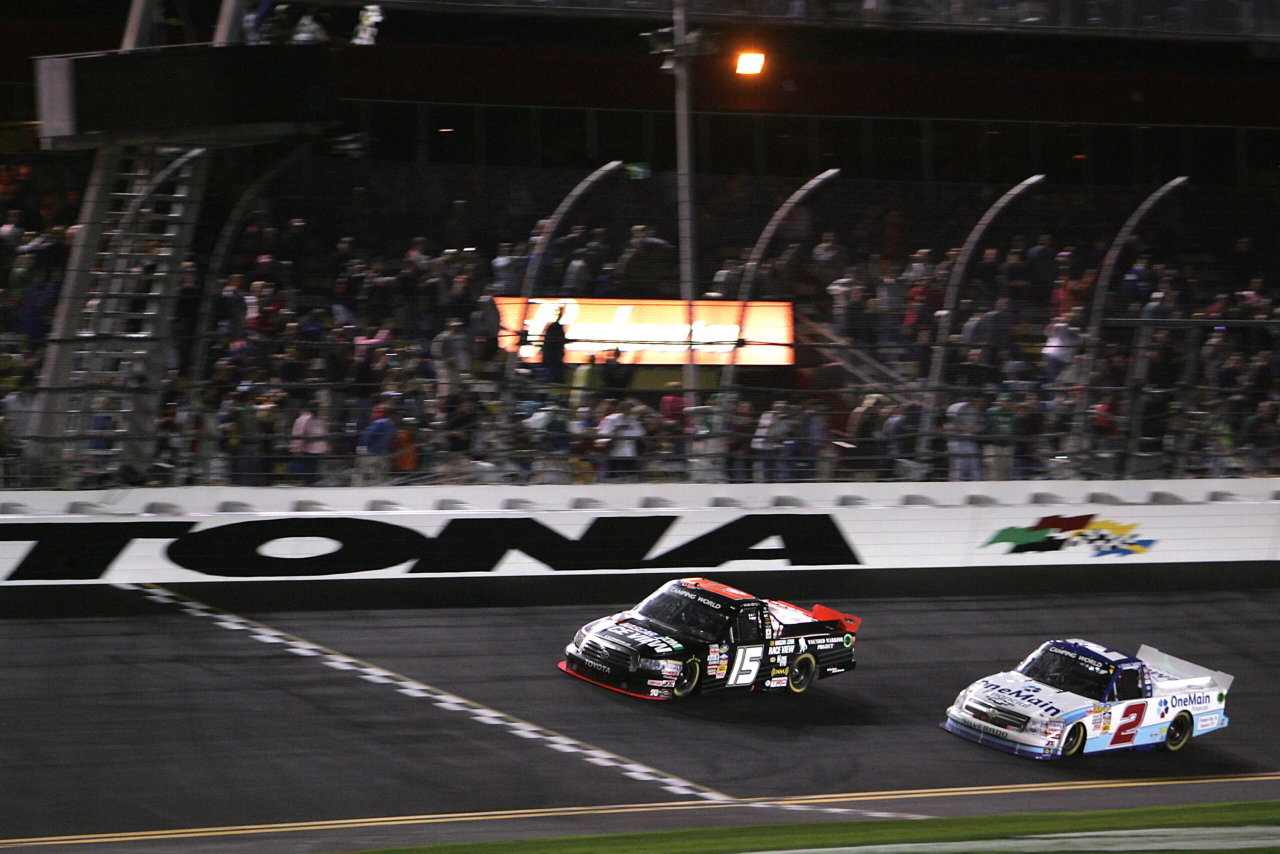
The Coke Zero 400 will bring the regular season to a dramatic close at Daytona International Speedway. Yet this time, NASCAR is not simply preparing for another superspeedway showdown. The sanctioning body has introduced a major package change, cutting the rear spoiler and reducing horsepower. With no practice session before qualifying, teams will have little opportunity to understand how their cars behave. For Spire Motorsports, that uncertainty could make an already high-stakes race even more unpredictable.
Watch What’s Trending Now!
“I imagine qualifying is going to be faster for sure because drag is your predominant issue, but I don’t know that we are going to know until middle of stage two what we really got and that one is like, if I could pick, i’d be like we probably need some practice here because if you just go run exactly what you’re going to run from the past and you take all that spoiler off, you could be crazy loose or it could not be because you’re so far from the limited Daytona doesn’t matter,” Spire Motorsports crew chief Travis Peterson told PRN Live.
The organization is heading into the regular-season finale with a completely different set of variables. NASCAR has shortened the rear spoiler from seven inches to four inches for the Aug. 29 race.
The four-inch spoiler matches the height used at intermediate tracks. The goal is to reduce drag and create more opportunities for drivers to move through traffic.
At the same time, NASCAR has reduced horsepower from 510 to 465. That change is intended to compensate for the reduction in downforce created by the smaller spoiler.
NASCAR expects single-car qualifying runs to be roughly three mph faster under the new package. However, cars running in a pack are expected to maintain approximately the same speeds seen with the previous configuration.
This in theory is expected to break the pack racing at superspeedway track. There’s a lot of focus on fuel saving and pit cycle, rather than gaining position while on track. But with the new package, there’s another element of uncertainty that Peterson highlighted. And that too without any practice time.
The summer night race at Daytona adds another layer of uncertainty. The track traditionally becomes more handling-sensitive in the heat, making the package change particularly intriguing.
Still, there is at least some optimism coming from Austin Hill. Hill said simulations indicate the Cup car should race “as close as it can possibly get” to the O’Reilly car this weekend.
That suggests NASCAR’s extensive preparation could pay off. But simulations can only reveal so much. The real answers will come once dozens of cars enter the draft.
And with the Chase on the line, Daytona may not be the easiest place to learn.
NASCAR sees Daytona as the perfect testing ground
NASCAR’s decision to introduce the new package at Daytona is hardly accidental. The track provides the perfect environment to test whether reduced drag can encourage more aggressive racing while maintaining the close competition expected at a superspeedway.
Denny Hamlin has also played a central role in shaping the experiment. He was a part of the group that helped develop the package, giving him a direct voice in NASCAR’s approach. Hamlin explained that the goal is essentially to bring Atlanta’s current racing style to Daytona and Talladega.
At Atlanta, drivers are forced to remain on offense throughout a run because the cars are grip-limited. That prevents the fuel-saving strategy that can dominate traditional superspeedway races.
Hamlin believes the new Daytona package could create a similar dynamic. More importantly, NASCAR’s simulations have reportedly shown encouraging results.
“From the numbers that I’ve seen, it’s going to be roughly a 33% gain in the right direction,” Hamlin explained.
The experiment, then, is about more than simply making cars faster. NASCAR wants drivers to have greater freedom to leave the main draft, attack and pass without needing a massive group behind them.