
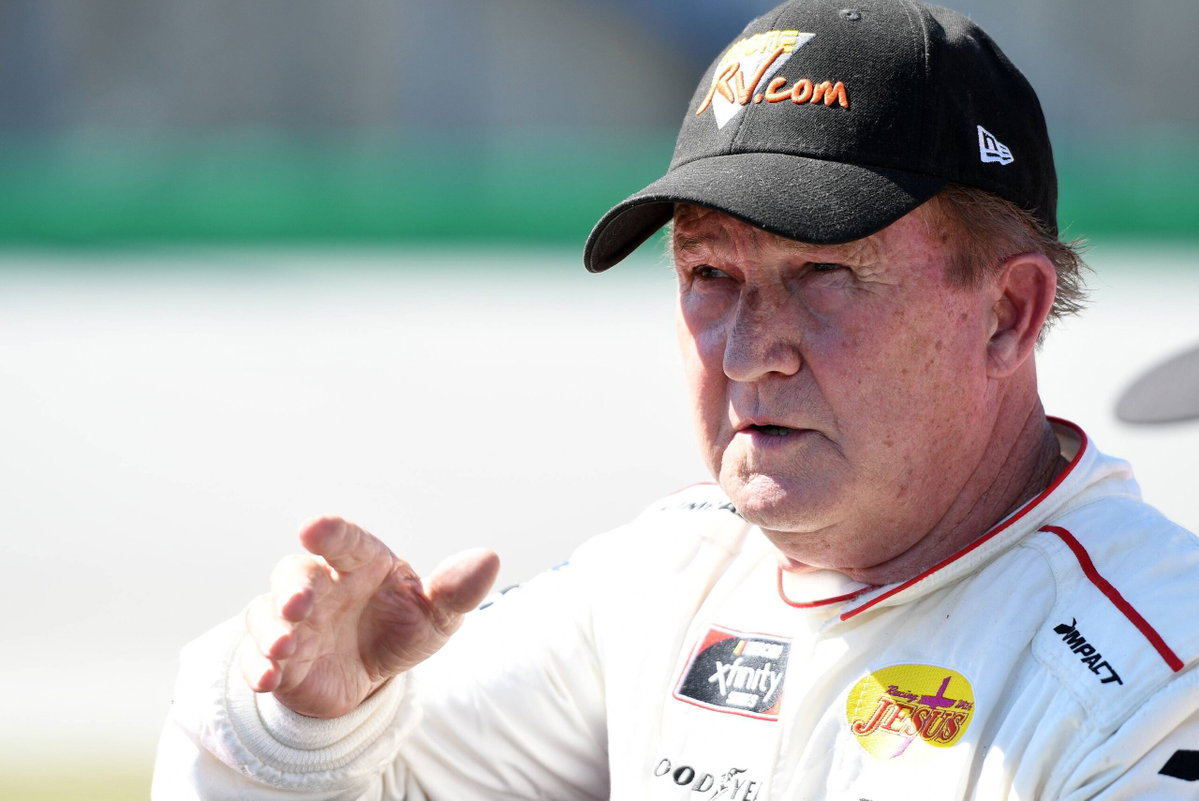
Before NASCAR became a sport of engineers, of million-dollar data rooms and more, some of its earliest drivers learned speed in a very different environment. That’s the world Morgan Shepard grew up in.
Watch What’s Trending Now!
He didn’t grow up around the go-karts or the simulators. He grew up in a time when racing was something people learned from life instead. And for the four-time NASCAR Cup winner, that life makes him one of the last living links to NASCAR’s moonshine roots.
“My father. I had him till I was about 12 years old. But over in Ferguson, North Carolina, there are only two places you can buy gas. My dad never had a new vehicle or whatever. We were making some deliveries, and look at the seat here; there was a Pepsi bottle. It had moonshine in it.” Shepherd said on The Dale Jr. Download the podcast.
That was his father, Clay Jesse Shephered, a moonshiner working out of the woods, like many in parts of the country at that time. And much like the rest of the stories go, it didn’t really end all that well.

It helps to have the police on your side when you're runnin' shine. 😂👮🏼
“They came and caught him and came and got his brand new truck,” Shepherd said. And eventually he himself was on the other side of the same world, running deliveries with his friend Clifford Baker.
“Oh yeah, we were going up to pick up some so we could make a delivery. This was on the old Highway 70, just a mile from the racetrack. “Must’ve been 25 or 30 ABC people in all,” the 84-year-old said. But even then he didn’t get caught. It turns out that he simply had help from law enforcement.
“We had police officers that helped us with this stuff,” Shepherd said. Dale Earnhardt Jr. then asked if that meant they were tipping them off or paying off officers. Turns out he was right.
“We would go out and raid their watermelon patch. “They were good,” Shepherd continued. “And whenever they called us there, uh, later on I got with them and I said, ‘Why didn’t y’all tell us?’ They said, ‘Morgan, we, uh, they were going to get in bad trouble.’”
That close call, however, stuck with Shepherd, and that was the end of the moonshine chapter. It’s hard to imagine, but this story shows that NASCAR didn’t stand with data, sponsors, and strategy meetings. Moreover, this is a story from a time when transporting alcohol in the country wasn’t for the faint-hearted. Bootleggers had to use fast cars to outrun police officials while making their deliveries. Ad for Shepherd: without those tip-offs, he could have faced a similar fate to what happened to Junior Johnson’s family in 1935.
The 50-time Cup Race winner’s father was arrested during a raid at their family farm, where 7,000 gallons of alcohol were seized, making it the then-largest bust of illegal booze in America.
Win races on Sunday, escape chases on Monday
Much like many other boys and future NASCAR drivers of the post-Prohibition era, Shepherd became a part of the trade early on. He was inspired by his father, who introduced him to the business before Shepherd turned 12. But in those days, it was nothing to be ashamed of. It was more of a legacy passed down through generations of bootleggers. Take Junior Johnson, for example; after becoming a stock car racing star in 1955, he would often return to moonshining, continuing the trade his family had started.
“Moonshining was part of my growing up, but it was also part of my training in auto racing,” Johnson said in a 1990 interview. “Being in that business, you had to have a very fast car, and you had to be able to outrun the revenuers or highway patrol or sheriff or whoever tried to pursue you to try and apprehend you.”
As NASCAR Hall of Famer Curtis Turner admitted, the era of the Great Depression and the crippling poverty faced by family farms forced many to resort to illegal methods. For these families, brewing and selling illegal whiskey was the only way to get by. And they weren’t willing to share a dime in taxes with the government they felt was responsible for their condition.
“Those were hard times back in the hills, and you did things you shouldn’t have to get by,” Turner said.
What started off as an illegal trade soon evolved into competition between bootleggers. Back then, Ford V-8s helped them during police chases and local track events alike. Today’s NASCAR is miles away from its origins. Denny Hamlin and Kyle Larson don’t have to run with bottles of illegal liquor in their trunks.
But the connection to its history still remains through the naturally aspirated, growling V8 engines powering the ‘Next-Gen’ cars.