
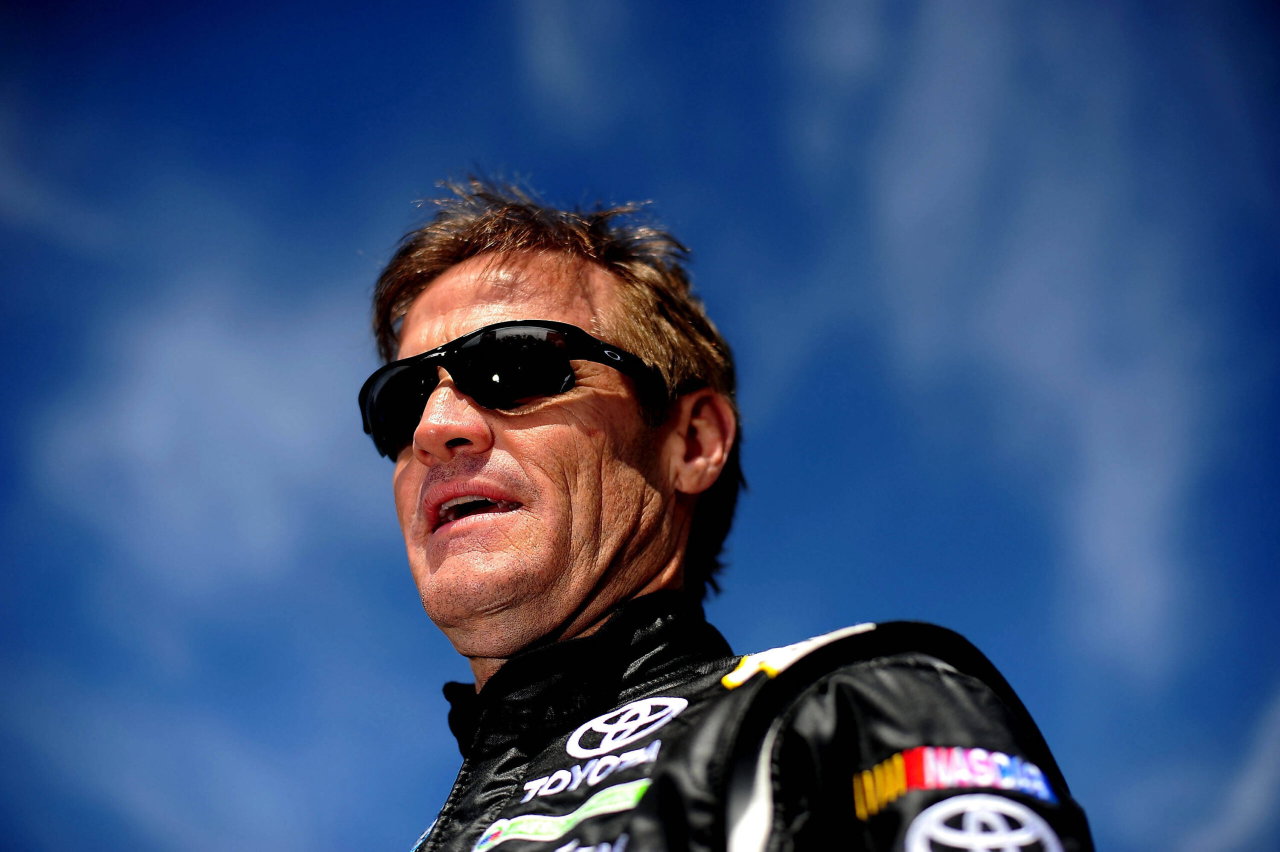
Kenny Wallace had done everything a substitute driver could dream of doing. He stepped into an unfamiliar situation, took a competitive NASCAR Cup Series car to the front, led more than 100 laps, and came within reach of a victory. Yet, when the checkered flag dropped, he was left wondering whether a decision made inside his own pit box had cost him the biggest opportunity of his career. More than two decades later, a conversation with a former NHL enforcer brought an old frustration back into focus. What began as a recollection of one of Wallace’s finest performances soon turned into a rather uncomfortable question: was somebody on his own team actually trying to prevent him from winning?
Speaking on the Bare Knuckle Nation podcast, Wallace recalled the afternoon at Rockingham when he filled in for Steve Park in the No. 1 Pennzoil Chevrolet.
“The most famous one was when Steve Park got hurt in the Pennzoil car. I jumped in his car and against the greatest, I set fast time, led the whole damn race, and got beat at the end on pit stop strategy and run second.”
The result was particularly frustrating because Wallace believed he had the pace to win. However, the pit-stop strategy left him wondering whether something other than racing performance had decided his afternoon.
Wallace’s NASCAR Cup Series opportunity with Dale Earnhardt Inc. (DEI) came after Steve Park suffered a serious accident during the Busch Series race at Darlington Raceway on September 1, 2001. Park’s car veered into Larry Foyt’s machine under caution, sending both drivers into a violent crash. Park suffered a concussion, brain bruising and injuries around his collarbone, forcing him out of competition while he recovered.
Should NASCAR Stop Sharing SMT Data to Protect Elite Drivers’ Secrets?
The NASCAR Busch Series driver was initially brought in to drive the No. 1 Pennzoil Chevrolet, beginning with the Southern 500 at Darlington. The choice was not entirely unexpected. Crew chief Paul Andrews already knew the Wallace family, having worked with Kenny’s older brother Rusty Wallace earlier in his career.
Andrews personally recommended Kenny after Park’s accident. He later explained that he had pulled out his NASCAR Busch Series rundown and started going through available drivers. Wallace was the first name that stood out. He considered him qualified to compete at the Cup level and capable of staying with the team for the remainder of the season if necessary.
At the time, Wallace was still working to establish himself in the NASCAR Cup Series while maintaining his Busch Series commitments. The opportunity with DEI gave him access to a competitive operation and a chance to demonstrate what he could do with stronger equipment.
His initial results were mixed, but the performances improved. Across 12 Cup starts in Park’s No. 1 car during 2001, Wallace recorded two top-10 finishes, secured a pole position and finished second at Rockingham. He did not win a Cup race, although he did claim a Busch Series victory during that same Rockingham weekend.
The NASCAR race in question was the Pop Secret Microwave Popcorn 400 at North Carolina Speedway on November 4, 2001.
Wallace arrived at Rockingham with a fast car and backed that up by securing pole position. Starting from the front, he led the opening 61 laps and remained a major contender throughout the afternoon.
He eventually accumulated 101 laps led across the 393-lap event. However, Joe Nemechek, driving the No. 33 Oakwood Homes Chevrolet, emerged as the winner, with Wallace finishing 6.285 seconds behind in second.
The crucial moment, according to Wallace, came through the pit-stop sequence.
The NASCAR racer explained that the driver running behind him had pitted approximately 10 laps earlier. Once that competitor received fresh tires, the difference in performance became apparent.
Jamie Rivers, who was part of the conversation, immediately understood the problem.
“Because he has better grip, right?” Rivers asked.
“He’s got better grip,” Wallace replied.
The decision to bring Wallace in later left him at a disadvantage against a competitor who had already benefited from fresh rubber. That difference was particularly important at Rockingham, where tire management was a major part of the race.
The track’s location in North Carolina’s Sandhills region contributed to its abrasive surface. Sand and the rough asphalt effectively worked against the tires, making grip deteriorate quickly over a run. Fresh tires could therefore provide a substantial advantage, particularly when a driver was trying to maintain pace against a rival who had already stopped.
Wallace’s frustration was not simply about losing track position. He believed the timing of the stop had taken away a genuine opportunity to win.
That was where Twist began pushing the conversation in a different direction.
Wallace initially identified the crew chiefs as those responsible for the pit-stop strategy. Twist then raised a possibility that the driver had apparently not fully considered.
“Is he jealous? He doesn’t want you to, this is where I’m going. He doesn’t want you in because you’re a sub?”
Wallace dismissed the suggestion initially.
“No, and that’s another story.”
However, the question opened up an alternative explanation for the decision. Wallace began considering whether somebody within the team might have been uncomfortable with what a victory from a substitute driver would represent.
He wondered whether winning in Park’s car could have shifted the conversation around the team’s performance. If Wallace could immediately jump into the No. 1 Chevrolet and win, it might suggest that the machinery itself was capable of winning regardless of who was behind the wheel.
“Maybe that strategist didn’t want me to win because he felt so bad for Steve Park. Kenny cannot jump right in this car and win because then it will show it’s the car.”
Twist agreed with the distinction Wallace was making.
“Right. Not the other racer.”
Wallace’s frustration at the convincing theory was rather immediate.
“That son of a b*tch.“
The discussion did not end with speculation. The group decided to investigate the decision by reaching out to someone who had been part of the operation.
That meant contacting Paul Andrews, the crew chief responsible for the No. 1 team and someone Wallace had known long before his time at DEI.
The conversation brought another name into the picture: Dave Charpentier. According to the explanation given during the call, Charpentier had made the strategic call that determined when Wallace would pit.
That detail gave the discussion a more concrete direction. The decision Wallace had attributed to the crew chiefs was apparently made by someone else within the team’s technical operation.
It also brought the story back to the relationship between Wallace and Andrews. Andrews had personally recommended him for the seat after Park’s accident, making the suggestion that his own team might have deliberately compromised his race an especially uncomfortable one.
Still, identifying who made the call was not the same as establishing why it was made.
For Wallace, revisiting the incident meant confronting a possibility that had remained in the back of his mind for years.
The Rockingham performance was one of the strongest demonstrations of his ability in a Cup car. He had qualified on pole, led 101 laps and finished second against an established field. The result also helped secure his future with DEI, which signed him to a one-year contract in November 2001 to continue driving the No. 1 car while Park recovered.
There was no Cup victory to show for the opportunity, but the performances had clearly made an impression. The NASCAR veteran had earned the team’s confidence and established himself as a capable replacement.
Despite the renewed discussion and the phone call, Wallace did not turn his suspicion into a formal accusation. The possibility that the decision was influenced by concerns about Park’s position remained just that: a possibility. He ultimately chose to leave the matter behind rather than continue pursuing an explanation he could not conclusively establish.
More than 20 years later, however, Twist’s questions managed to bring the frustration back to the surface. And while Wallace may have moved on from the result, his reaction to the possibility of being denied a victory by a decision made inside his own pit box says plenty about how much that afternoon at Rockingham still means to him.