
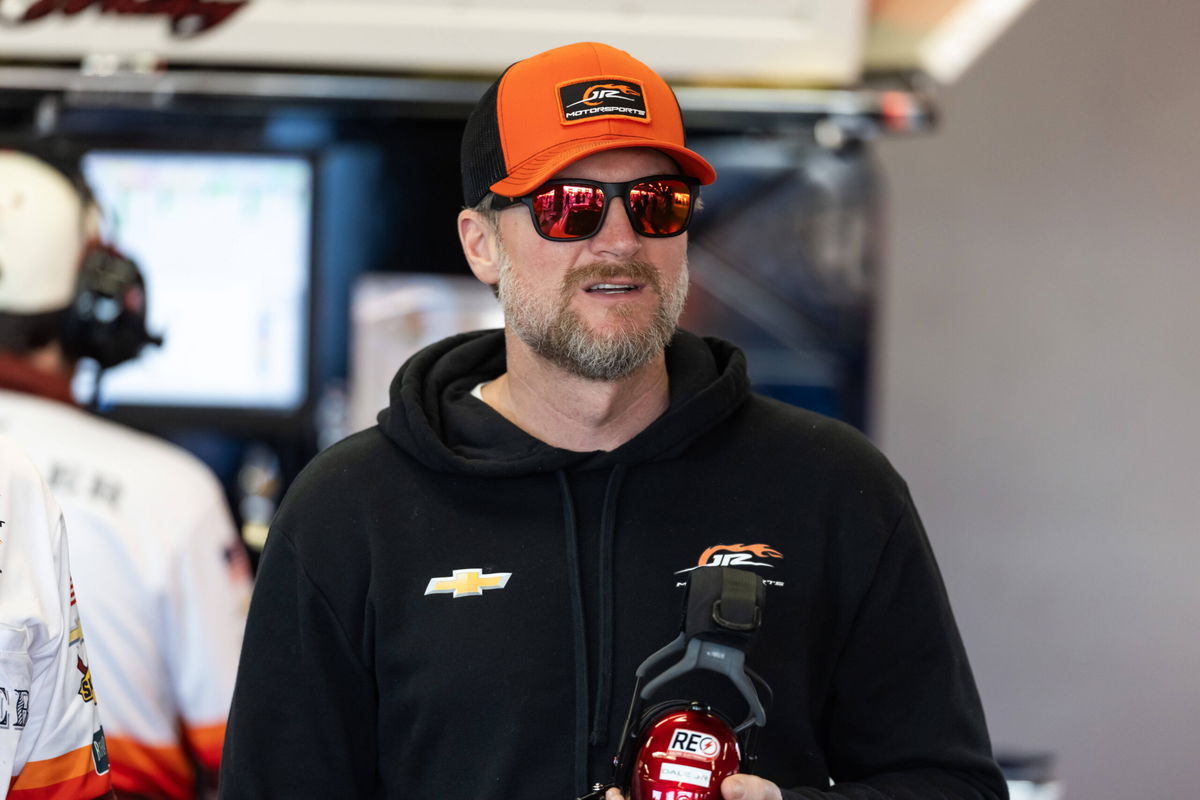
Justin Allgaier went into the Homestead-Miami finale with a 22-point cushion, the kind of lead that looks comfortable on a scoreboard and feels paper-thin at speed. As he kept brushing the wall, his team co-owner, Dale Earnhardt Jr., was sitting on the one sentence that could have calmed him down. Saying it out loud was the part that worried him.
Watch What’s Trending Now!
“NASCAR doesn’t like you to talk about the points to the driver, and they’re a little touchy about what you say. So I wanted to come on the radio; I badly; I was literally finger on the button, wanting to tell Justin, You got 15 points. All right? Calm down,” Earnhardt Jr. revealed on ‘Dale Jr Download’ via Instagram.
Dale Earnhardt Jr. had a reason to hold back. He believed Allgaier had enough room to settle down, but he feared NASCAR would read a points update the wrong way. The information was accurate. The risk was how it might look mid-title fight.
“And but you, you can’t. Like, NASCAR will be like, Oh, you can’t be telling him that. That’s manipulation,” Dale continued.
The interviewer then asked whether Freddie Kraft had faced consequences. Kraft, who spots for Bubba Wallace at 23XI Racing, answered directly.
“I can, I can confirm,” he said. “I got suspended.”
So Dale Jr. looked for a side door. Rather than speak on the team channel, he switched to Channel Two and asked the spotter to carry the message.
“But I got on Channel Two to the spotter, and I said, Hey. Can you tell him we’re in good shape? He can calm down, damn it.”
The roof camera explained his growing urgency. Allgaier was running through Turns 3 and 4 and repeatedly touching the wall.
“And I’m like, Get him off the damn wall,” Dale recalled.
The spotter was already working on it, but the delivery was too gentle for Dale’s liking. He flipped back to Channel One and heard a measured message that the team was in good shape.
He wanted far more than that.
“And I’m like, God damn. Tell him. Scream at him, you know?” he said.
The sensitivity traces back to Martinsville in 2024. After
NASCAR’s history of scrutiny over points-related communication
The sensitivity traces back to Martinsville in 2024. After the Round of 8 finale, NASCAR found that the Trackhouse, Richard Childress Racing, and 23XI teams of Ross Chastain, Austin Dillon, and Wallace had manipulated the finish.
Each team and driver was fined $100,000 and docked 50 points, with Wallace’s 23XI group among them. NASCAR also suspended nine people for the Phoenix finale, including crew chiefs Phil Surgen, Justin Alexander and Bootie Barker, and spotters Brandon McReynolds, Brandon Benesch and Kraft.
Even then, the penalties drew pushback from inside the garage. Amy Earnhardt said the whole episode felt like policing children, while Dale argued that fines would not change behavior and that driver suspensions might.
The radio issue returned at the 2025 Charlotte Roval. NASCAR warned two Xfinity Series teams that had already clinched a spot in the next round about discussing points that did not involve their own cars. Dale revealed on his podcast that Connor Zilisch’s No. 88 JR Motorsports team was one of them.
Amanda Ellis, NASCAR’s senior director of racing communications, said the line was drawn at other cars still in the fight, not a ban on points talk. Mike Forde, NASCAR’s managing director of communications, added that the chatter came early and was never problematic.
The gray area cuts both ways. Denny Hamlin said he was driving blind on the Roval’s final lap because no one told him Chastain held a one-point edge over Joey Logano for the last transfer spot.
Dale said Hamlin’s team should have been allowed to share it, and argued that NASCAR cannot truly police it anyway, since conversations happen all week. He likened the judgment calls to baseball umpires, each seeing the same play differently. Forde, for his part, said talk about points paired with questionable moves would put a team in hot water.
Dale’s position has been consistent. He has said he has zero problem with a spotter laying out the points picture, and he reserves his objection for obvious schemes, such as a driver heading down pit road to blow his own race or spinning on purpose, the kind of thing Spingate made unmistakable.
His preference is simple: give the driver the information and let him choose. Under today’s approach, he suggested, a few officials decide afterward whether a message went too far.
That is where Dale’s frustration lands. A message meant to settle a driver on a night when his title was within reach sat in the same gray area as one designed to rig a finish.
Allgaier eventually got his reassurance through the spotter, finished seventh and clinched his second O’Reilly Series championship, but the workaround stayed with Dale. Telling a driver he has a cushion, he believes, should never feel like a potential rules violation.