
Talladega has a way of turning one split-second decision into a nightmare, and Joey Logano knows just how terrifying that can be. With five laps remaining in Sunday’s YellaWood 500, the three-time Cup Series champion’s No. 22 Ford suddenly went sideways before slamming into the outside wall and flipping onto its roof.
Watch What’s Trending Now!
The frightening wreck brought the race to a halt and left fans wondering how things went so badly wrong. Carson Hocevar was at the center of the chain of events, and his post-race explanation offered a revealing look at the moment everything unraveled.
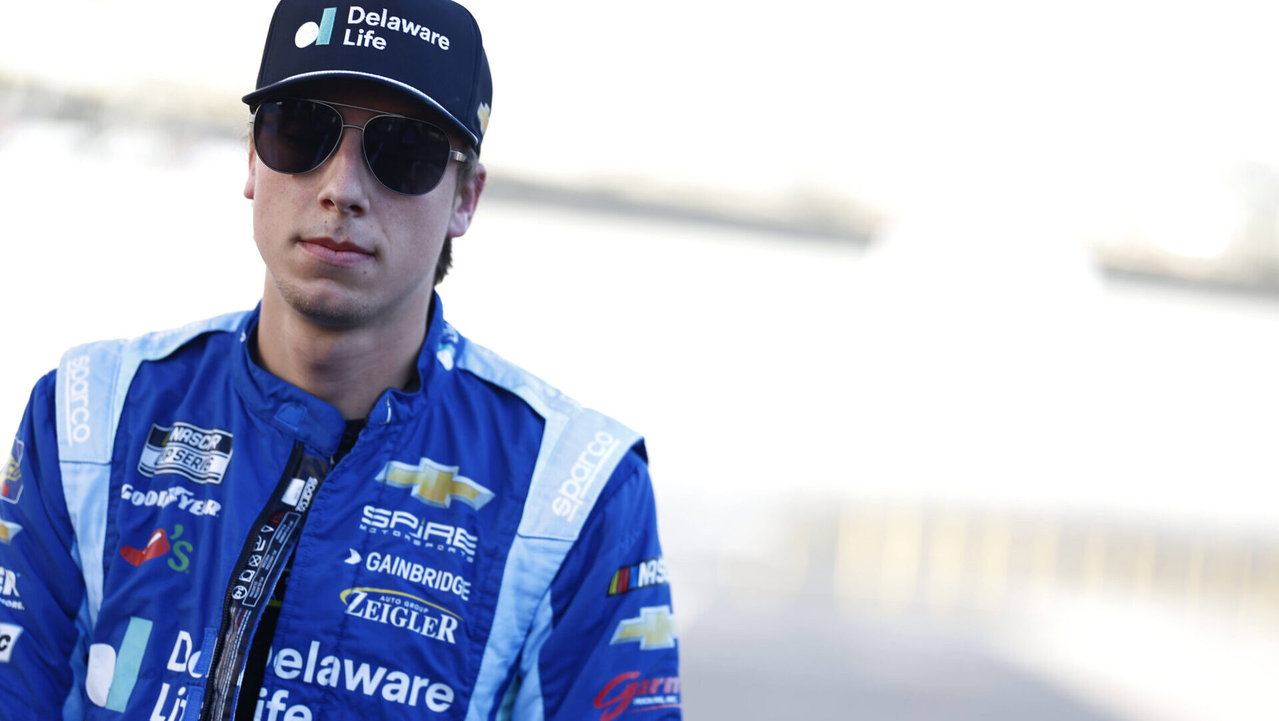
“I was inching at him in the tri oval, ’cause obviously we need to, we have to do that in the third lane. And, I just spun him, but I was more so looking at my rear view, so that’s on me for that. But yeah, that’s my fault,” Carson Hocevar told Frontstretch in a post-race interview.
The Spire Motorsports driver admitted that he hit the No. 22 Ford at the wrong moment while trying to make progress in the third lane. That contact helped send Logano into a violent chain reaction that ended with Logano upside down. Hocevar’s admission was striking, especially given the controversy surrounding his aggressive driving and his responses to other incidents earlier in 2026.
The incident unfolded on Lap 183. Logano was running near the front in the outside lane, with Ross Chastain ahead and Hocevar pushing from behind. Meanwhile, the inside lane was gaining ground, creating a scramble as drivers tried to merge into the middle and maintain momentum.
Hocevar explained that he was watching his mirrors to judge where the lanes would converge. By the time he looked forward, he had already felt contact. His push caught Logano at the wrong angle, sending the No. 22 Ford sideways. Logano tried to correct the car, but Hocevar struck the right rear again, sending Logano toward the outside wall.
The impact redirected Logano into oncoming traffic, where Chase Briscoe’s Toyota hit the front of his Ford and launched it into the air. Logano’s car landed on its roof and slid along the track as debris scattered across the frontstretch.
The wreck collected 15 cars, including Hocevar’s No. 77 Chevrolet, Brad Keselowski, Austin Cindric, Chris Buescher, Riley Herbst, and several other drivers. NASCAR stopped the race under a red flag for approximately 13 minutes while safety crews attended to the drivers and worked to upright Logano’s car.
The Team Penske driver eventually climbed out under his own power and later thanked the safety crew for helping him escape.
“Yeah, just happy to be alive,” Logano said after the frightening ride.
What made Hocevar’s response particularly notable was how differently he approached this incident compared with some of his other controversial moments this season.
At Darlington in September, Hocevar turned Keselowski around after contact in Turns 3 and 4. Keselowski accused him of running into him and warned that their disagreement would not end there. Hocevar, however, offered little sympathy in his immediate reaction.
“He spun,” he said, later adding, “I don’t know what happened. He spun.”
Hocevar also said he had no particular interest in speaking with Keselowski about the incident.
The tension continued at Bristol, where Hocevar’s late contact with Ryan Blaney ended the Team Penske driver’s race. Blaney had led 202 laps before the incident sent his No. 12 Ford into the wall. Hocevar defended his own view of the move, saying he was trying to cross Blaney over and that he had been braking hard. He questioned whether Blaney had made a poor decision, rather than accepting sole responsibility. The disagreement escalated into a physical confrontation on pit road after the race.
Against that backdrop, Hocevar’s Talladega admission stood out. He did not simply describe the contact as a racing incident or shift the focus to Logano’s attempt to recover. He acknowledged that he had been looking in the wrong direction and directly accepted responsibility for the push. Logano himself was less interested in assigning blame, describing the incident as part of the unpredictable nature of superspeedway racing.
Yet the wreck did not end Hocevar’s day. After starting 26th and losing ground earlier because of a pit-road speeding penalty, he had worked his way toward the front before the late crash. Following the red flag, his team made repairs in the damaged vehicle policy (DVP) area, and Hocevar returned to the track for the green-white-checkered finish. He survived the final scramble to take sixth for Spire Motorsports.