
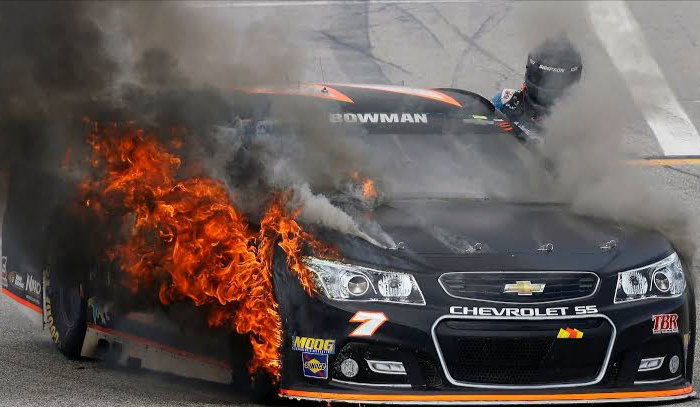
For all the glamour surrounding NASCAR’s All-Star Race, Dover was quickly met with a terrifying sight on Sunday night.
Watch What’s Trending Now!
In a race usually built around aggressive late-lap restarts, big money, and entertainment mixed with outright chaos, a massive Turn 1 pileup left the crowd at Dover Motor Speedway stunned. It triggered a rare red-flag situation, left multiple cars destroyed, and saw one driver’s car burst into flames after a violent impact.
Ryan Preece accepts blame for multi-car wreck
“I don’t know what happened there. I thought I was going to be able to clear open by the time we got to turn 1, and obviously I didn’t. That’s my fault, and I’m sorry to whoever got caught up in that,” Preece said after being released from the infield care center following one of the scariest crashes of the season.
The incident unfolded on just the second lap when Ryan Preece, Kyle Larson, and Todd Gilliland made contact entering the first corner. What started as a squeeze on the frontstretch instantly turned into a chain-reaction pileup that collected some of the biggest names in the sport. Among the drivers involved were Larson, Daniel Suarez, Chase Elliott, Ryan Blaney, Gilliland, Cole Custer, John Hunter Nemechek, Preece, and Michael McDowell.
But the most alarming moment came after Preece slammed into the outside wall driver-side first. As his car slid down the banking, flames suddenly erupted from the rear section of the car, immediately triggering concern across pit road and in the broadcast booth.

Ryan Preece just went out in flames 👀🔥 #
Thankfully, Preece climbed out of the car under his own power before safety crews fully arrived at the scene.
The fire itself drew instant attention because it marked one of the first major rear-end fire incidents involving NASCAR’s Next Gen car platform. One of the major safety upgrades introduced with the Next Gen design was the repositioning of the fuel cell. Instead of sitting vulnerable behind the rear axle as in older NASCAR generations, the fuel cell was moved ahead of the rear axle to better protect it during rear-end impacts.
The car also includes upgraded onboard fire suppression systems, with strategically placed nozzles aimed at the cockpit, engine compartment, and fuel cell area. In this case, there were speculations that the fire may have started after the fuel fill hose was ripped off during the impact, suggesting residual fuel trapped in the line ignited as the car slid down the banking.
Following the cleanup, NASCAR eventually lifted the red flag, but the aftermath created an unusual situation under the All-Star Race’s new format. Because Larson, Elliott, and Blaney were already locked into the main event through previous wins and championship eligibility, teams were allowed to repair their damaged cars and continue competing. However, NASCAR rules prevented teams from switching to backup cars, forcing crews into frantic garage repairs.
The crash also immediately reignited debate around NASCAR’s revamped All-Star structure. For 2026, NASCAR eliminated the traditional “Open” preliminary race entirely. Instead, all 36 chartered cars compete together in two aggressive 75-lap opening segments before the field is trimmed down to 26 drivers for the final 200-lap showdown.
That format change meant desperation racing started immediately from Lap 1, with drivers aggressively fighting for position, knowing elimination loomed later in the event. Looking at the size of Sunday’s wreck, many fans and insiders quickly questioned whether removing the Open race had unintentionally created a far riskier environment early in the race.
The concern now is simple: when every major star is thrown together immediately in an exhibition race under elimination pressure, the margin for patience disappears. And on Sunday at Dover, it only took two laps for chaos to erupt.