
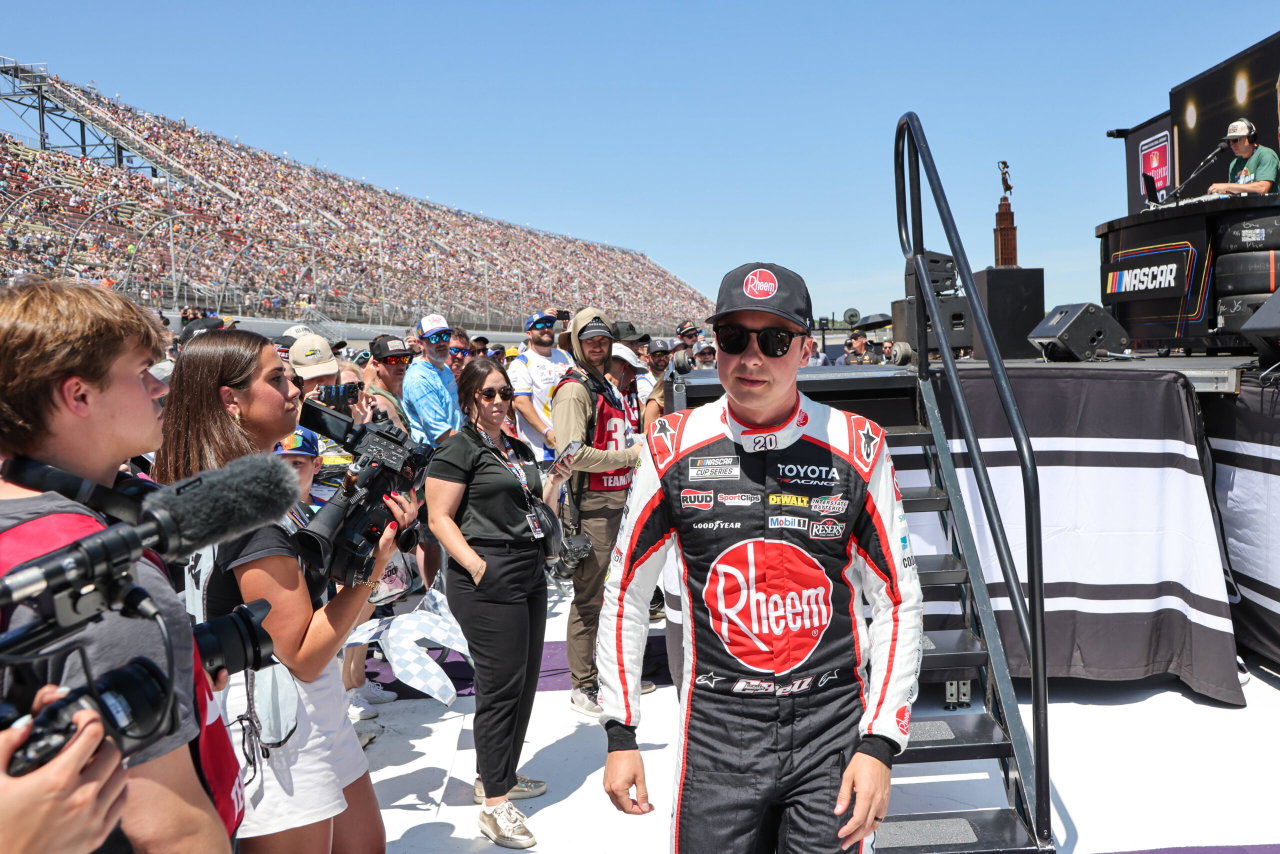
Team Joe Gibbs Racing has a rather unique problem in the final stages of the Cup Series Chase. Three of its drivers find themselves among the top four, which could potentially create a problem in the championship battle against Kyle Larson.
Watch What’s Trending Now!
As Denny Hamlin, Christopher Bell, and Chase Briscoe are keeping their title hopes alive, helping a teammate could mean giving up many opportunities to win. This was particularly noticeable at the Charlotte Motor Speedway, where Bell narrowly lost to Briscoe in a thrilling final-lap battle.
When asked about his thoughts on racing a teammate, Bell was quite blunt on his priorities, which caught the attention of The Teardown hosts Jeff Gluck and Jordan Bianchi.
“No, that’s not my teammate. I’m just racing for the win. I’m not even thinking about that,” Bianchi paraphrased Bell’s post-race comments while discussing if having three title contenders under the same roof could actually hurt the team’s, and Toyota’s ambitions.
According to Gluck, JGR benefits from having three drivers operating at a high level, as their combined experience, preparation and resources gives the team a strong chance of challenging Larson throughout the Chase.
However, those advantages do not necessarily translate into teamwork when the green flag drops.
“Resource-wise and prep-wise, it probably helps them to have all these guys operating at a very high level,” Gluck explained. “But when they’re in the moment, and they’re like, ‘We have got to have these spots, I’ve got to win this,’ it’s every man for themselves.”
Hamlin, Bell and Briscoe can share information and benefit from the same organization’s preparation, but they cannot all win the same race, especially when every point counts at this final stage of the racing series.
The drivers also have their own reasons to take risks rather than protect a teammate’s result. Hamlin is still seeking his ever-elusive first Cup championship, Bell has come close to victories multiple times, and Briscoe seems to have had a sudden comeback after winning back-to-back races.
For these reasons, expecting one driver to sacrifice his own opportunity for another becomes complicated.
The finish at Charlotte offers clearer insights to what Gluck and Bianchi were discussing on The Teardown.
Briscoe and Bell spent the closing laps fighting for the victory, with Briscoe eventually holding off his teammate by just 0.029 seconds. It was the closest finish of the ongoing Cup season, and the second-closest in Charlotte’s history. Bell led 93 laps, while Briscoe led 62, including the final portion of the race after gaining the lead during a pit stop.
The stakes were high for both drivers, as Briscoe was chasing his second consecutive victory, while Bell needed a win to improve his position against Larson.
Additionally, Bell entered Charlotte 55 points behind Larson and left 51 points back after finishing second. According to the post-race NASCAR analysis, Bell would have been only 31 points behind the championship leader, had he won the race.
Meanwhile, Briscoe’s victory has also strengthened his position. He moved into fourth place, 65 points behind Larson, after winning at Las Vegas the previous weekend and then repeating the result at Charlotte. He gained 58 points on Larson across those two races.
For Bell, helping Briscoe would have meant sacrificing his chance to narrow his own points gap. For Briscoe, allowing Bell through could have cost him another victory and valuable championship points. The photo finish showed exactly why the three JGR contenders cannot always afford to put the team’s wider interests ahead of their individual goals.
Meanwhile, Bianchi believes other organizations may have an easier time deciding when teamwork should take priority.
He particularly cited the example of Team Penske, where Ryan Blaney and Joey Logano are the serious championship contenders. While Austin Cindric has been running well, he is much farther behind in the standings, and as for Josh Berry, despite a string of strong performances, does not find himself in contention for the Chase.
This is why teams like Penske have the opportunity to use other drivers as support when the situation calls for it. At superspeedways such as Talladega, drivers can push a teammate through the field, work together to gain track position or help a title contender stay near the front.
“Those guys are effectively wingmen. Their mission is to help Logano and Blaney,” Bianchi said of the Penske situation.
Further in the discussion, Bianchi also highlighted a similar situation at Hendrick Motorsports, where Larson is leading the championship, while its other drivers find themselves further behind.
For JGR, however, things are far more complicated. If Bell has an opportunity to win, should he help Hamlin move forward instead? If Briscoe is battling for the lead, should he give up track position to benefit Bell?
Bianchi is not suggesting that the three JGR drivers will refuse to help each other. His concern is that the team’s three championship contenders may hesitate when cooperation could directly benefit a rival for the title. He feels that the drivers eventually have to draw a line and decide when they are no longer acting as teammates on the track.
So why all the chatter around this phenomenon to watch out for at Talladega? Because races on superspeedways usually depend on pushes, drafting partners and split-second decisions, but it serves as a double-edged sword; a driver can help a teammate gain several positions, but it also risks putting another championship contender ahead of him.
The points situation makes the conflict harder to ignore. Following Charlotte, Hamlin sat 49 points behind Larson, Bell was 51 back and Briscoe was 65 behind. With four races left to go, all three are still close enough to the leader to believe a strong run could change their championship prospects.
Hamlin, in particular, is also dealing with the pressure of another championship campaign. He recently explained that after painful results, he tends to withdraw and switch off from racing for a while.
“I unplug. I just go silent,” Hamlin said, describing how he handles disappointment.
That pressure further brings to light another layer to JGR’s situation. Each driver is well aware of how high the stakes are, hence one simply cannot assume that a teammate will put his own title ambitions second, even if that means Hamlin is at the highest risk of losing potentially his final shot at a world title.
To sum it up, JGR’s depth remains an advantage. The organization, and Toyota, have three strong chances to challenge Larson, Hendrick, and Chevrolet. However, if the Charlotte finish is not enough evidence of drivers competing against one another, then what is?
More importantly, can JGR find a way to turn its depth into a championship advantage, without asking one of its contenders to sacrifice their own opportunity?