
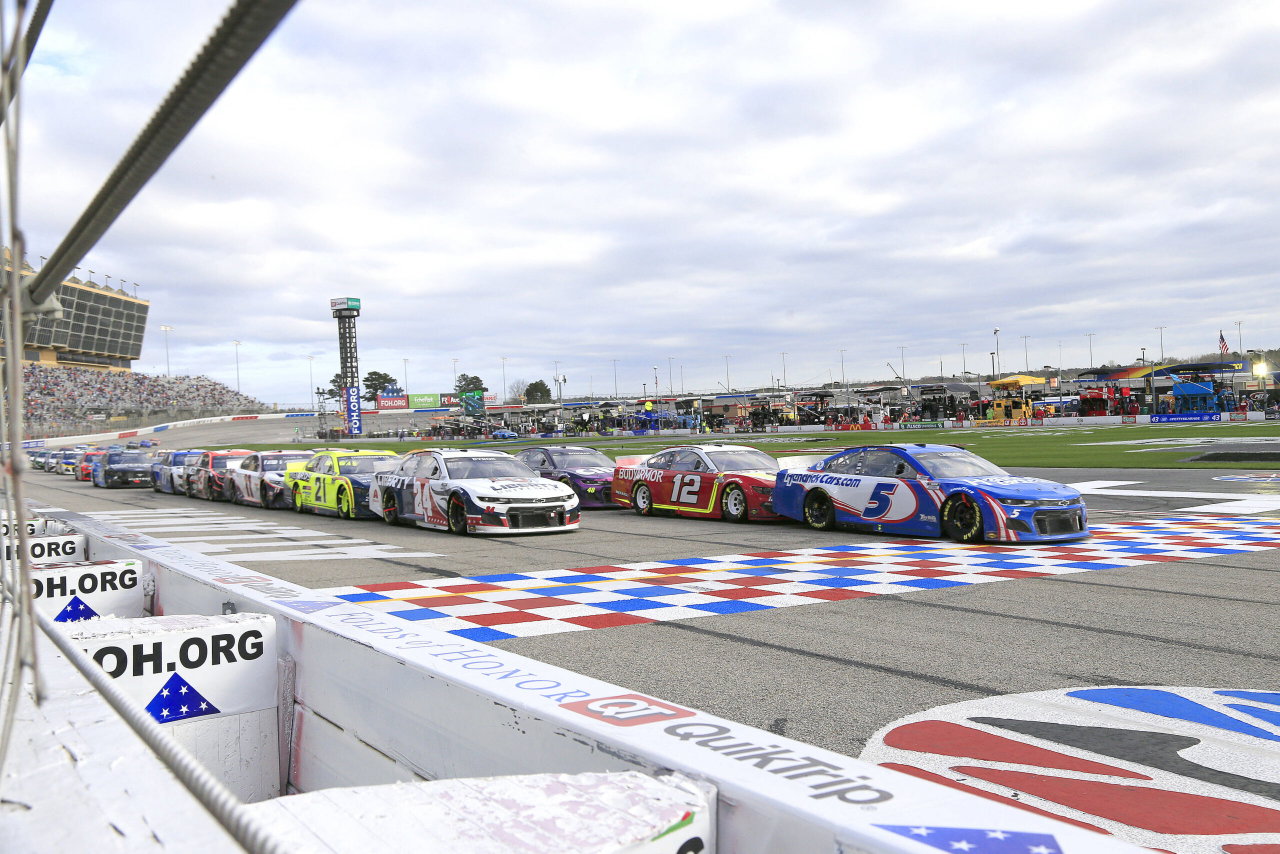
The Quaker State 400 at EchoPark Speedway on Sunday turned into one of the longest nights of the NASCAR Cup Series season after lightning and heavy rain forced a 3-hour, 9-minute delay. As the stoppage stretched well into the night, NASCAR officials faced a difficult decision: Should they restart the race and complete the scheduled distance, or invoke the adverse conditions rule and end it early?
Watch What’s Trending Now!
NASCAR Managing Director of Racing Communications Mike Forde has now revealed just how seriously officials weighed shortening the race before ultimately deciding to run all 400 miles.
Why NASCAR chose the fans over an early finish at EchoPark Speedway
“After more discussion, we decided that if we could get back to racing, we should run the full distance. That’s what the fans want to see. If they’re willing to stick with us, we’ll stick it out.”
According to NASCAR Managing Director of Racing Communications Mike Forde, the sanctioning body spent much of the weather stoppage evaluating every possible scenario after lightning was detected within eight miles of EchoPark Speedway. The race was red-flagged on Lap 109, leaving officials to determine whether there was enough time to safely complete the remaining laps.
Speaking on Hauler Talk, Forde explained that NASCAR relied on a predictive model to estimate how long the remainder of the race would take after the restart.
“We have a predictive model that estimates how the race is progressing and when it is likely to end. At that point, there had only been one caution, and that was for the Stage 1 break. Based on that, the model estimated we had about an hour and 34 minutes of racing left.”
However, officials believed that the projection was too optimistic because it reflected only the relatively clean opening half of the race.
“We didn’t fully believe that estimate because it only accounted for the first 109 or 112 laps. We knew there would likely be more cautions later in the race as things became more hectic and chaotic. So we estimated it would probably take another two hours once we went back green.”
With drivers battling for stage points, playoff implications, and the race victory, NASCAR anticipated a far more caution-filled finish than the model predicted. That meant the event could stretch to nearly 2 a.m. ET, making safety and logistics an increasingly important part of the discussion.
According to Forde, officials had to consider everyone involved in staging the race, not just the drivers.
“It’s not just the drivers we have to think about. There are teams, officials, firefighters, medical personnel, and many others who had already been at the racetrack for a long time. We had to ask ourselves, ‘When is too late?'”
At one stage, NASCAR even discussed using the adverse conditions rule and ending the race around 1:30 a.m. ET.
Before making a final call, Senior Vice President of Competition Elton Sawyer and Cup Series Managing Director Brad Moran spoke with several respected drivers and team representatives to gather their perspectives. Forde said the conversations were largely supportive of whatever decision NASCAR believed was appropriate.
“The feedback was, ‘I’m good with it. If that’s how you guys want to play it, that’s fine by me.'”
Forde made it clear that those conversations were part of NASCAR’s decision-making process rather than the deciding factor. After weighing the operational challenges, safety considerations, and the ability to race under the lights with no local curfew, officials concluded that if conditions allowed, completing the scheduled distance remained the best outcome.
“After more discussion, we decided that if we could get back to racing, we should run the full distance. That’s what the fans want to see. If they’re willing to stick with us, we’ll stick it out.”
The race resumed shortly after midnight and ultimately concluded at 1:45 a.m. ET following an overtime finish. The decision ensured that the full race distance was completed, preserving stage points, championship implications, and the integrity of the event.
Ryan Blaney capitalized on the late-night restart by leading a race-high 171 laps and winning for Team Penske. Blaney later revealed he “took a nap and ate a little food” during the lengthy weather delay before returning to Victory Lane.
The marathon finish has also reignited discussion around NASCAR’s Cup Series start times. While the full-distance race delivered a dramatic conclusion, it also highlighted the challenges of weather-delayed events that extend into the early hours of a workday.
For many blue-collar supporters who make up NASCAR’s core audience, staying awake until nearly 2 a.m. ET on a Sunday night simply isn’t practical. Whether the series should move to earlier start times remains an ongoing debate, but in Atlanta, NASCAR ultimately decided that safely completing the race was preferable to ending it short.