
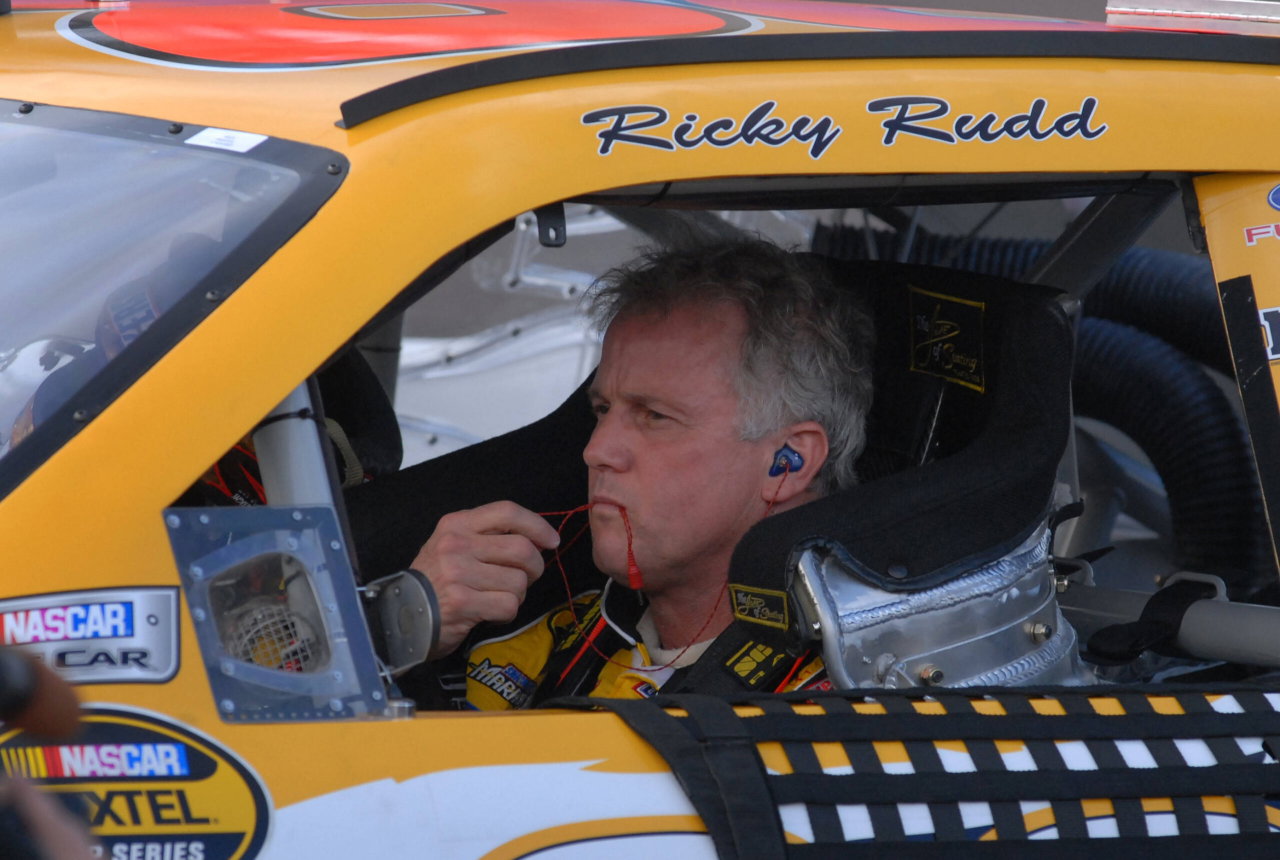
“Messing with Dale Earnhardt is like messing with a hornet’s nest,” said TV Commentator Ned Jarrett. But Ricky Rudd wasn’t one to back down from a fight. When Earnhardt spun him at North Wilkesboro in 1988, the Rooster decided to return the favor, setting off an exchange that would land him in trouble with NASCAR’s top boss. A $10,000 fine was waiting for him the next morning, but the consequences of crossing Earnhardt wouldn’t end there. A year later, Rudd would find himself sneaking out of the speedway under a blanket in his crew chief’s truck.
Watch What’s Trending Now!
The Scene Vault Podcast revived a clip from its July 2024 episode with Ricky ‘Rooster’ Rudd on November 19. The NASCAR Hall of Famer revisited his interaction with NASCAR Boss Bill France Jr. after the 1988 Holly Farms 400 race at North Wilkesboro.
“I come into the pits, in the stall, everybody is getting out, the net gets down, I get out of the car. And Bill (France Jr.) is right there like, ‘What was all that going on out there? What was that with you and the 3 car? What was that about?’ Rudd recalled. “I said, ‘Uh, you mean when he spun me early in the race? When he turned me around?’
‘No, no, I’m not talking about that. I’m talking about late in the race, when you turned him around.’ France Jr. asked, ‘What do you think about that?’ And he said, ‘What do you have to say for yourself?’
“And I looked at him and said, ‘Bill, I’m really disappointed in myself. I really am.’ And he looked at me like, ‘Well, okay…’ and then I said, ‘I’m disappointed because I didn’t run that son of a b*tch through the wall.’ And I think that’s when I made my mistake.”
Who Is the Poster-Child of Modern-Day NASCAR?
Although his response caught the NASCAR CEO off guard, as he walked away with a smirk, the $10,000 fine waiting on his fax machine the following morning made it clear NASCAR wasn’t laughing. The Rooster admitted his big mouth landed him in trouble the following day. But little did he know his on-track retaliation was subtly foreshadowing a bigger fallout the following year.
The 1988 Holly Farms 400 race at North Wilkesboro saw the two drivers start from very different positions. While Ricky Rudd was eyeing a race win from 4th, Dale Earnhardt had most of the field ahead of him, in 22nd. Rudd also led for 154 laps, compared to Earnhardt’s 107.
Dale Earnhardt closed in on Rudd and spun him first, costing him crucial positions in the race as he tumbled down the order with 41 laps remaining. Rudd made his way back up the order and closed in on the No. 3 Richard Childress Racing driver, but with the intention of returning the favor.
The No. 26 King Racing driver retaliated with five laps to go and spun his longtime foe, despite NASCAR penalizing both drivers by sending them towards the end of the grid after the first contact. Rudd caught up with Earnhardt again, and the two got into another fender-banging exchange. This time, Rudd returned the favor, turning Earnhardt around without causing major damage.
Both drivers completed the race as Rudd finished seventh, while Earnhardt finished sixth. However, Rudd wasn’t in contention for the championship win; Earnhardt was. This means his retaliation had greater consequences for the title contender’s campaign.
“He wrecked himself and he wrecked me. It hurt him worse than it did me because he’s in a race for the championship,” said Rudd post-race. “But if this is the game he wants to play, he can forget the championship.”
Dale Earnhardt shared his side of the story too by saying, “(The race) was his or mine to win, but he got rough. He turned me sideways, then I got into him a little. I backed off, but he went on around. He got into me again, but NASCAR didn’t penalize him.”
North Wilkesboro was never the same for Rudd after his on-track altercation with Dale Earnhardt. The following year brought more consequences for the rivals as a controversial final-lap move revolted fans. And rightly so, as there was a championship on the line for Dale Earnhardt, who was within striking distance of the title lead had he not had that infamous contact with Rudd’s No. 26 car yet again. Only this time, the move was a rather unexpected one for both the drivers.
The 1989 Holly Farms 400 saw Dale Earnhardt start from the pole while Ricky Rudd started fifth. The RCR driver was 35 points behind championship leader Rusty Wallace and knew he had to close that gap. Earnhardt led the race for 343 laps before a caution on lap 394 brought the field together with just six more laps to go. By then, Earnhardt led, Rudd was second, and Geoff Bodine third. With only three laps remaining, Rudd had a genuine opportunity to challenge for the win.
On the final lap, Rudd attempted to pass Earnhardt on the inside of Turn 1. Earnhardt held the outside line; the two cars made contact, and both spun into the retaining wall between Turns 1 and 2. Bodine avoided contact and went on to win the race as the two rivals were out of contention.
Dale Earnhardt was furious. “I gave him the whole (expletive) bottom lane and the (expletive) knocked the (expletive) out of me. They ought to fine that son-of-a-b*tch and make him sit out the rest of the year. We had a good run going and could have been back ahead of Rusty (Wallace) in the points, but then this (expletive) comes along and deliberately wrecks me.”
On the contrary, the No. 26 driver blamed his rival for the contact. “I guess he didn’t want to give up the lead. It’s a shame, too, because I got under him cleanly. He pinched me off and tried to wreck me. I really don’t know what he was doing but I hate it happened.”
Tempers flared on pit road as crew members from both teams had to be restrained by NASCAR officials. Fans began throwing beer cans onto the track. Rudd, meanwhile, was met with a mix of cheers and boos as he made his way down pit road, eventually having to leave the track concealed beneath a blanket in a van driven by Larry McReynolds to avoid the hostile crowd. NASCAR ultimately classified the collision as a racing accident and announced that it would take no further action.
“I mean, it was like a mixed crowd. It was a close thing to a riot,” the NASCAR Hall of Famer reflected during his appearance on Dale Earnhardt Jr.’s The Dale Jr. Download podcast episode in 2019.
The 1989 incident became the most famous flashpoint of their longstanding feud that had been simmering for a while since 1983-1984 before finally reaching its boiling point in the 1988 and 1989 seasons. But the Intimidator was not always a rival for the Rooster. The duo were once close friends, and Rudd believes Earnhardt was the only driver he ever trusted with his friendship.
The duo spent a lot of time together off track and were comfortable in each other’s company as friends. Rudd had revealed that, coming from a karting background, he always had friends who knew when to switch hats—to be rivals on track but how to maintain a good bond off track. Rudd believed he had found a similar friend in Dale Earnhardt. But the biggest blow to his confidence came when his best friend replaced him at Richard Childress Racing in 1984.
Rudd, who had arrived at the RCR team as a replacement for Earnhardt in 1982, lost his seat at the team he was beginning to feel at home in when his friend decided to return in 1984. Earnhardt left RCR to join Bud Moore in 1983 but returned to RCR the following year. Rudd was bothered by how Earnhardt kept him in the dark about his efforts to return.
“We had some success in the No. 3, but Richard and Dale were big buddies. They hunted together and were close friends. I didn’t know it, but all along (while driving for Moore) Dale had been working to get my deal with Richard. That really disappointed me because I thought Richard and I had been good for each other. I’m still trying to figure out how that happened.”
Rudd knew he couldn’t be friends with Earnhardt after the big betrayal. He learned a lesson and never trusted another driver to be his friend, as he turned cold towards the field. As he transitioned to Bud Moore in 1984, he relentlessly worked on proving he belonged in the big leagues. As years went by, the duo got into multiple on-track battles as neither backed down whenever the opportunity to fight presented itself. But things had never looked as bad as they did in 1989.
After years of being at a tiff with his foe, Rudd was finally getting back to being friends with Earnhardt just six months before his passing in 2001. Rudd recalled that he left a race one evening when he noticed Earnhardt driving alongside him in traffic. Earnhardt rolled down his window and asked Rudd whether he wanted to go out for dinner. Rudd accepted. The two went to dinner, talked through their differences, and finally put the resentment behind them.
Rudd and Earnhardt ultimately found their way back to friendship, but his relationship with NASCAR’s leadership was less straightforward. His clashes with Bill France Jr. at North Wilkesboro in 1988 and Sears Point in 1991 left him questioning whether the sport’s leadership always treated him fairly.
Yet Rudd’s career stood on its own merits: 23 Cup wins, a championship runner-up finish and a place among NASCAR’s most enduring competitors. Earnhardt, meanwhile, left behind seven championships and 76 victories, becoming one of the defining figures in the sport’s history. Their careers took different paths, but their story was never simply about who won more races. It was also about friendship, betrayal, rivalry and, eventually, reconciliation.