
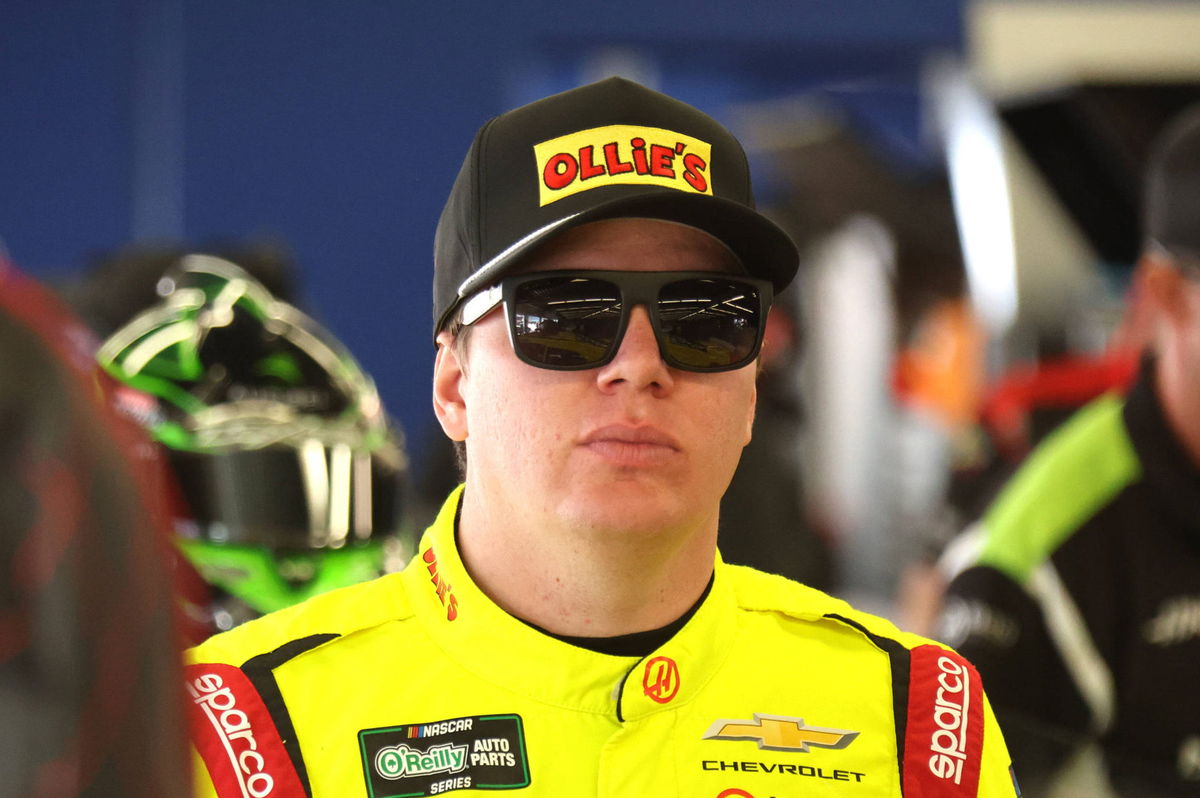
There was something almost fitting about the way Sheldon Creed announced his 2027 plans. On October 3, Creed arrived at Las Vegas Motor Speedway as the NASCAR O’Reilly Auto Parts Series championship leader and confirmed that he would leave Haas Factory Team at the end of the season. A few hours later, he climbed into the No. 00 Chevrolet and went back to doing the thing NASCAR has spent years telling drivers like him is supposed to settle everything: racing for a championship. He finished 13th at Las Vegas, but still extended his points lead to 19 with five races remaining. The strangest part of the weekend was not that Creed had a new team lined up. It was that he had one while sitting on top of the championship standings.
Watch What’s Trending Now!
The story has an uncomfortable arc to it. Creed is not leaving Haas because he suddenly forgot how to drive. He is not being pushed out of NASCAR, and he has not abandoned the Cup dream. He is 29 years old, has three wins in 2026 after entering the season with 15 career O’Reilly runner-up finishes and no victories, and is now fighting for the biggest championship of his national-series career.
Yet his next move is a multiyear contract with Sam Hunt Racing, a smaller Toyota organization, where he says he can build something for the long term and, crucially, make a good living. Listen to Creed explain the decision and the whole story becomes less about a driver losing an opportunity and more about a professional finally deciding what an opportunity is worth. He said leaving Haas was not his first choice, but
“business has to make sense” because sometimes business “overrules results and performance on track.”
That sentence is the real story here. The championship standings tell you how well Creed is driving. His decision tells you what NASCAR’s driver market is actually asking him to sacrifice to keep doing it.
Sheldon Creed Has Finally Done Everything NASCAR Asked
Creed’s career is difficult to dismiss as a case of a driver who simply did not do enough. He won the 2018 ARCA Menards Series championship, followed that with the 2020 NASCAR Craftsman Truck Series title and has eight Truck Series wins. He then moved through Richard Childress Racing, Joe Gibbs Racing and Haas, spending years trying to establish himself in the O’Reilly Series. Before 2026, he had already finished second 15 times, a remarkable number that became almost a running joke around his career. The problem was that all those strong runs kept producing the same frustrating result: somebody else was standing in Victory Lane.
Then 2026 finally changed the conversation. Creed won at EchoPark Speedway, then Darlington, then Bristol, with all three wins becoming the first O’Reilly wins of his career. The timing could hardly have been better from a competitive standpoint. He entered the Chase with the sort of momentum every championship contender wants, won two of the first three postseason races and moved into the points lead. After Las Vegas, he remained first with 2,259 points, 19 ahead of Carson Kvapil, with five races still to run. This is not a driver desperately trying to save a career. This is a driver having the breakout season people had been waiting years to see.
That makes the financial side of the story impossible to ignore. Creed’s 2024 season with Joe Gibbs Racing is especially revealing because it showed that the problem was never simply a lack of performance. He finished sixth in the championship, recorded 16 top fives and 23 top tens, finished second six times and posted an 11.67 average finish. He still could not win a race. At Darlington that year, after leading 30 laps and finishing third, Creed openly said he had “taken a chance” on himself and brought all the money they could, adding that he was “literally not even making a dollar” that year.
That quote should not be twisted into a claim that Creed personally paid for his entire JGR seat. The public evidence does not establish precisely how every dollar in that arrangement moved, and there is no reason to invent a figure that has never been disclosed. What the quote does establish is far more useful: Creed was willing to put financial resources behind his own racing opportunity while not drawing a conventional driver salary from that arrangement. Two years later, he has reached the point where that model appears to have run its course.
There is a tendency in NASCAR to treat a driver’s career as a simple progression. Win in ARCA, move to Trucks. Win in Trucks, move to Xfinity. Win enough in Xfinity, get the Cup call. That is the clean version of the story, and it makes for great developmental brochures. The real version is much messier. A driver can win championships, finish second over and over again, race for elite organizations and eventually lead the championship, only to discover that the next step depends on whether the business arrangement works. Creed has now become one of the clearest examples of that gap between sporting merit and economic reality.
And the most revealing part is that his Haas departure comes during his strongest season with the organization. In 2025, Creed finished ninth in points with eight top fives and 16 top tens. In 2026, he is first in points with three wins, 12 top fives, 19 top tens and a 9.52 average finish through Las Vegas. Whatever else is happening behind the scenes, this is not a driver leaving because his performance has fallen off a cliff. His performance has gone in the opposite direction.
The Money Problem Was There Long Before Haas
The most important distinction in Creed’s story is one that gets lost whenever NASCAR fans start throwing around the phrase “pay driver.” Having sponsors on a race car does not automatically mean the driver is receiving a salary. Those are two completely different pieces of the business.
Creed has not been without sponsorship. His Haas program has carried Friends of Jaclyn Foundation, Road Ranger, Pit Boss Grills and Ollie’s Bargain Outlet, with Ollie’s serving as a primary partner for 15 races in 2026 and Road Ranger for 13. So the argument cannot honestly be that nobody wanted to associate with Sheldon Creed. Companies and organizations clearly did. The more accurate point is that sponsorship support for a team and personal compensation for a driver are not interchangeable. A driver can have a full schedule of partners and still not have the sort of guaranteed salary that turns racing into a financially secure profession.
That distinction makes Creed’s October move considerably more significant. According to Bob Pockrass’s reporting on Creed’s comments, the 2027 Sam Hunt Racing deal will be the first time Creed has received a salary from a race team to drive a race car. That is an extraordinary sentence when you put it next to his résumé. This is a driver who has won an ARCA championship, won a Truck championship, collected eight Truck victories, finished second 15 times in the O’Reilly Series and is now leading that championship. Yet the first team salary of his career is coming from the smaller organization he is joining after leaving Haas.
That should tell us something about the structure of the sport. It is not that Creed has spent his career doing nothing and suddenly found a team willing to take a chance on him. He has spent years being competitive enough to remain in the conversation while navigating a system in which the driver’s commercial value and the driver’s sporting value do not always move together. Sometimes they overlap. Sometimes they do not. When they do not, a driver can find himself in the strange position of being good enough to win but not secure enough financially to make the career sustainable.
Even the O’Reilly Series’ performance bonuses illustrate the difference. The 2026 program gives race winners a $5,700 bonus, with an additional $26,000 going to the driver who earns the most such bonuses over the season and a $57,000 bonus for the series champion. Creed’s three victories have therefore produced $17,100 in those specific O’Reilly bonuses. That is meaningful money, but it is not a substitute for a salary, nor should it be presented as Creed’s total earnings. It simply shows the difference between being rewarded for a result and being paid to make racing your profession.
Creed has also never really stopped wanting the Cup opportunity. That is another misconception worth killing before it gets started. When he announced the Sam Hunt Racing deal, he specifically said Cup remained his end goal. What changed was his willingness to define his entire career around whether that phone call ever comes. He said that if it does not, Sam Hunt Racing is somewhere he could race for the next 15 years, make a good living, raise his family and build a good life. That is not surrender. That is a 29-year-old driver finally putting a deadline on how long he is willing to treat financial uncertainty as part of the price of ambition.
There is something very NASCAR about that contradiction. Drivers are told from the time they are children that sacrifice is part of the deal. They sleep in haulers, travel every weekend, spend years chasing sponsors and accept that one bad season can change everything. But eventually, a driver has to ask whether the sacrifice is buying something tangible. Creed has reached that point while sitting first in the championship. That may be the most powerful evidence yet that the traditional NASCAR ladder is not nearly as simple as its mythology suggests.
Haas Was Never Really a Straight Road to Cup
There is another misconception around this story that needs to be cleared up: Haas did not have a spare Cup seat sitting above Creed’s No. 00 Chevrolet.
Haas Factory Team has one full-time Cup entry, the No. 41 Chevrolet driven by Cole Custer. When Haas announced Dean Thompson for 2027 in August, the organization also announced that its O’Reilly program would expand from two full-time entries to three. Joe Custer made clear that Haas was not planning to sell its Cup charter or expand beyond one Cup car. That means Creed was never operating inside a traditional lower-series-to-Cup pipeline where winning enough races would naturally put him into the organization’s next available car. There was no second Haas Cup entry waiting for him.
That matters enormously when judging his departure. If Haas had opened a second Cup car and then passed over Creed for someone else, the argument that he had been rejected would carry considerably more weight. But that is not what happened. Haas is keeping Custer in its lone Cup seat while expanding its O’Reilly operation. Creed could be championship leader and still have nowhere to go within the organization. That is a structural problem, not a talent evaluation.
The August announcement makes the picture even more interesting. Haas signed Dean Thompson from Sam Hunt Racing to become its third O’Reilly driver for 2027. Thompson had 57 career starts at the time of the announcement, with one top five and 10 top tens, and his career-best finish was fifth at Charlotte in May 2025. He is also coming to Haas with Thompson Pipe Group and MCM Transportation as primary partners throughout the 2027 season. None of that proves Haas chose Thompson because of sponsorship, and it would be irresponsible to say it does. What it does show is that the driver market involves much more than simply comparing current championship positions.
And then the rest of the Haas picture shifted. Sam Mayer, who had been the other full-time O’Reilly driver alongside Creed, is returning to JR Motorsports for 2027. Mayer is an eight-time winner in the series, with seven of those victories coming for JR Motorsports, and he finished third in the championship in 2023. So Haas is not replacing a failed Creed program with a superior driver while shrinking around him. It is losing its two established 2026 drivers, including the current championship leader, while adding a third car.
That is a reconfiguration. It is a business decision. It is a different thing from saying Haas looked at Sheldon Creed’s résumé and decided he was not good enough.
In fact, Haas has publicly treated Creed and Mayer as drivers capable of being ready for Cup. That does not mean either man was guaranteed a Cup opportunity. It means the organization itself complicates the idea that Creed’s departure is a verdict on his ability. Haas can believe Creed is Cup-ready and still decide that its current Cup structure, sponsorship model and organizational plans do not make another year together work. Creed can believe Haas is a championship-caliber team and still decide that another year there does not make sense for his life.
That is exactly why his own explanation is more useful than speculation. “Business has to make sense,” Creed said. He did not say Haas was a bad organization. He did not say he was angry. In fact, he said leaving was not his first choice. He simply acknowledged something every veteran driver eventually learns: the fastest car in the garage is not necessarily the best contract on the table.
Sam Hunt Racing Offers Creed Something Haas Couldn’t
The easiest way to describe Creed’s 2027 destination would be to call Sam Hunt Racing a step down. That would be technically understandable from a pure competitive standpoint, but it would miss the point of the decision.
Haas is fighting for the championship with Creed right now. Sam Hunt Racing is still trying to build itself into a consistent front-running organization. Creed knows that. His stated goal for 2027 is not to arrive at SHR and immediately dominate the series. He wants to make the Chase. That is a much more modest target than the one he has in 2026, and the fact that he is comfortable saying it tells you he understands the competitive trade he is making.
What he is gaining is something different. Sam Hunt Racing has been building year by year, remains tied to Toyota and is expanding its own ambitions. Sam Hunt has described Creed as the kind of driver he believes the organization needs to take its next step. Kris Bowen is also returning as crew chief, giving Creed some continuity as he enters the new program. This is not Creed being sent away to disappear. It is a team deliberately bringing in an established national-series driver because it believes his experience can accelerate its development.
There is a subtle but important difference between those two situations. At Haas, Creed is part of a championship-caliber operation where the expectation is to win now. At Sam Hunt Racing, he can become part of the process of making an organization better over several seasons. One offers a higher immediate competitive ceiling. The other potentially offers a longer professional runway.
For a 22-year-old prospect, the first option would probably be more attractive. At 29, after years of moving through major organizations, the calculation changes. Creed has already spent enough time proving that he can perform in good equipment. What he appears to want now is somewhere he can put down roots without having to wonder every offseason whether his ability to keep racing depends on finding another commercial arrangement.
That is why his “15 years” comment is so revealing. It was not the language of a driver who had lost interest in Cup. It was the language of someone thinking beyond the next contract. Creed was talking about being able to make a living, raise his family and build something that lasts. Those are not things you usually hear in the middle of a traditional prospect story because prospects are expected to think about the next rung of the ladder. Creed is starting to think about what happens after he has climbed as high as the ladder allows.
There is also a bigger irony here. Sam Hunt Racing is getting the driver Haas is losing while Haas is getting the driver SHR is losing. Dean Thompson goes to Haas. Creed goes to SHR. One organization adds a younger driver and expands to three cars. The other gets an established championship contender who has finally figured out how to win. It is almost too neat a swap to be a coincidence, but it is not really about one organization winning and another losing. It is about two teams solving two completely different problems.
Haas needs to build a larger O’Reilly program. Sam Hunt Racing needs to accelerate its competitive development. Thompson fits what Haas is building. Creed fits what Hunt wants to build. And Creed himself needs a contract that makes racing financially sustainable. Every side can get something it wants without the situation requiring one side to be the villain.
That is the uncomfortable maturity of Silly Season. Fans naturally want every driver move to have a winner and a loser. The people signing the checks are usually thinking about something much less dramatic: does this arrangement work?
The NASCAR Dream Was Never as Simple as “Be Good Enough”
Creed’s story becomes even more interesting when you look above him at the Cup market.
On September 29, Brad Keselowski and RFK Racing announced they would part ways at the end of 2026. Keselowski is a 2012 Cup champion, a 36-time Cup winner and a driver who has spent the last five seasons helping build RFK as both driver and co-owner. He is not a developmental prospect waiting for somebody to notice him. He is one of the most accomplished active drivers in the sport. Yet when NASCAR examined the 2027 free-agent market a day later, the conclusion was blunt: there was little to no room left, with most of the Cup seats already occupied.
That is the market Creed is trying to enter.
It does not mean he has no Cup future. It means winning the O’Reilly championship does not magically create a Cup seat. He would be competing against drivers already under contract, younger manufacturer prospects, drivers with established sponsor relationships, veterans looking for another opportunity and organizations that may have very specific ideas about what their next driver needs to bring. Creed can control how fast he drives. He cannot control when a charter becomes available, whether an organization wants to expand, or whether a sponsor is willing to support a particular driver.
That is where the NASCAR dream starts to look very different from the version sold to young drivers. The dream says that if you are good enough, eventually you will get your chance. Reality says that being good enough gets you into the conversation. The rest depends on timing, money, equipment, relationships, manufacturer politics, sponsorship and whether somebody has a seat to put you in.
Creed has already encountered almost every version of that reality. He won ARCA. He won Trucks. He became a consistent O’Reilly contender. He raced for RCR. He moved to JGR. He finished sixth in the championship there. He moved to Haas. He finished ninth. Then, after 137 O’Reilly starts, he finally won. In 2026, he won three times and took the championship lead. Now, with five races remaining, his future is already settled somewhere else.
That is the part that should bother NASCAR more than the fact that Creed is leaving Haas. A driver can finally reach the point where he is doing everything right and still have to ask whether the career itself is financially viable. Creed’s answer is yes, but only because he has found a different structure. He is not walking away from racing. He is changing the terms under which he is willing to participate in it.
And perhaps that is the most important distinction of all. Creed is not choosing Sam Hunt Racing because he has stopped believing he belongs in Cup. He is choosing it because he has stopped believing that Cup has to be the only proof that his career worked. If the Cup call eventually comes, he will take it. If it does not, he wants to spend the next 15 years racing somewhere that allows him to make a living and build a life.
There is something almost refreshing about that honesty.
For years, NASCAR’s developmental system has treated every driver as if the only acceptable destination is the Cup Series. ARCA is supposed to lead to Trucks. Trucks are supposed to lead to O’Reilly. O’Reilly is supposed to lead to Cup. But Creed’s career exposes the flaw in that model. Racing is not a video game where winning one level automatically unlocks the next one. It is a business where the next level has to have an available seat, the right sponsor, the right manufacturer relationship and enough money behind it to make the entire arrangement work.
Creed has not failed the ladder. The ladder has simply stopped being the only thing he cares about.
And maybe that is why the Haas departure feels bigger than one driver changing teams. It is a warning about what happens when the sporting side of NASCAR tells a driver one thing while the business side tells him another. The sporting side says: keep winning. Creed did. The business side says: make the numbers work. Now he is.
He has spent years proving he can belong in the best cars. He is spending 2027 trying to prove he can build a career that belongs to him.
That may ultimately be the smartest move Sheldon Creed has ever made.
But if he wins the 2026 championship from the Haas seat he is already leaving, NASCAR will have to answer a rather awkward question: when exactly does being good enough become good enough?