
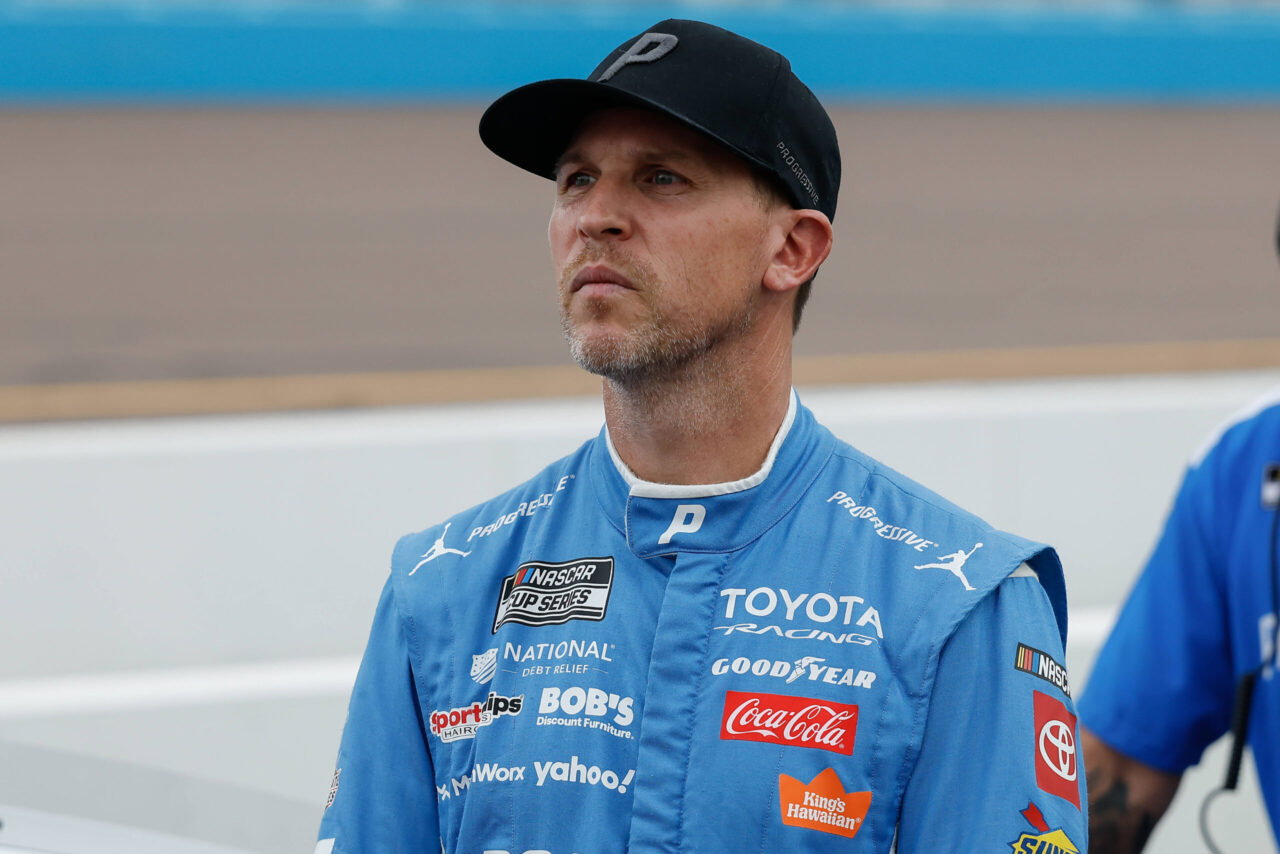
NASCAR can deliver three hours of racing, dramatic last-lap finishes and rivalries that spill beyond the track. However, for someone discovering the sport for the first time, there is a problem: the cars are easy to recognize, but the people driving them can remain strangers.
Watch What’s Trending Now!
Denny Hamlin feels that this gap is costing NASCAR an opportunity to turn casual viewers into committed fans.
The three-time Daytona 500 winner recently discussed NASCAR’s visibility challenge with Front Office Sports, drawing comparisons with Formula 1 and its approach to introducing audiences to the personalities behind the competition. Hamlin, who also drives for JGR and co-owns 23XI Racing, has an understanding of both the competitive and business sides of the sport.
“There’s so many people that when they actually go to a NASCAR race, they enjoy it so much and it’s, you know, they become hooked on it. And, but how do you get the eyeballs when we’re all fighting for them, right? And like you said, the big four, what makes us a little bit different is that there is no face,” he said in a clip of the interview shared on X.
His argument is not that NASCAR lacks compelling personalities. Rather, he believes the sport needs to do a better job of putting those personalities in front of people who have not yet developed a reason to care about its drivers. He cited the example of Netflix’s Drive to Survive to show how storytelling can change the way audiences perceive motorsports.
“What made Drive to Survive, in my opinion, so popular is that you got to know the personalities,” he explained.
Formula 1’s appeal to an unfamiliar viewer can initially seem tied to its machinery, technology and international venues. But the documentary series, which debuted in 2019, brought newer audiences inside the paddock, showing the people behind the results and the pressures shaping their decisions.
The show did not limit itself to drivers battling for victories. Team principals, owners and other figures became part of the narrative, giving viewers characters to follow between race weekends.
Hamlin specifically highlighted that wider cast, adding, “And sometimes it wasn’t even the personalities of the drivers. It was the CEOs, the principals of the race team.”
This could be a lesson for NASCAR. A driver can become familiar through repeated television appearances, but understanding the person behind the helmet requires more than a race broadcast. The rivalries, family backgrounds, ambitions and disappointments that shape a season can give viewers another reason to tune in, even when their preferred driver is not winning.
Formula 1’s own retrospective on Drive to Survive and its influence on fan culture describes how the series has helped audiences connect with drivers and team principals beyond the action on track. That is the model Hamlin wants NASCAR to learn from, rather than simply imitate the show’s format.
To be fair, NASCAR has not entirely ignored the value of personality-driven content, having already invested in projects designed to take viewers beyond the race results.
NASCAR: Full Speed, released on Netflix, followed Cup Series drivers through the 2023 playoffs in its first season and returned in 2025 to cover the 2024 championship campaign. The series included personal moments away from the track, alongside the pressure, conflict and uncertainty of the playoff fight. Its second-season coverage featured drivers including Joey Logano, Ryan Blaney, William Byron, Christopher Bell and Daniel Suárez.
NASCAR also introduced RISING, a five-part documentary series released on YouTube in November 2025. It followed Carson Hocevar, Jesse Love and Rajah Caruth through their campaigns and personal journeys, offering a closer look at three emerging drivers across the Cup, Xfinity and Truck Series.
The project was explicitly designed to introduce audiences to the people behind the competition. As NASCAR explained in its announcement of RISING, the series explored the pressure, sacrifice and ambition involved in building a racing career.
These efforts show that the sport understands the value of a closer look at its competitors. The bigger question is how consistently it can bring those stories to audiences who may never seek out a documentary or follow a driver’s social media accounts.
Hamlin acknowledged that NASCAR can win over people who actually attend its events. In his view, spectators often leave having enjoyed the experience and become hooked on the sport. The difficult part is getting their attention in the first place when so many other forms of entertainment are competing for the same audience.
That is where storytelling becomes more than a promotional exercise. A viewer who knows a driver’s journey has a personal reason to follow the next race. Someone who understands a team principal’s decisions or a driver’s struggle can become invested in the outcome before the green flag drops.
Hamlin elaborated on the importance of understanding a person’s background: “That’s where people get attached is to know the life story of someone. And then you start to pull for that person for whatever that reason is.”
The commercial implications are worth considering, although Hamlin did not specify any financial losses in his comments. Stronger personal connections can give fans more reasons to keep following the sport, while creating opportunities for teams, broadcasters and sponsors to build relationships with audiences beyond race day.
NASCAR does not need to manufacture characters or conflict to achieve that. Its drivers already bring different backgrounds, personalities and ambitions to the garage. The challenge is making those differences visible to people who currently see only the cars.
Hamlin’s warning ultimately comes down to a simple distinction: attracting someone with the spectacle of racing is one thing; giving them a driver to root for is another. NASCAR has begun investing in the stories behind its competition. Turning those efforts into a lasting connection with new fans may be the more difficult race.