
At 190 mph, a few feet of asphalt can separate a winning move from a wreck that takes half the field out of contention. On NASCAR’s drafting tracks, drivers are constantly searching for clean air, a run from behind, and the smallest opening that might carry them past the leader. Sometimes, that opening appears where the sport has spent years telling them not to race.
Watch What’s Trending Now!
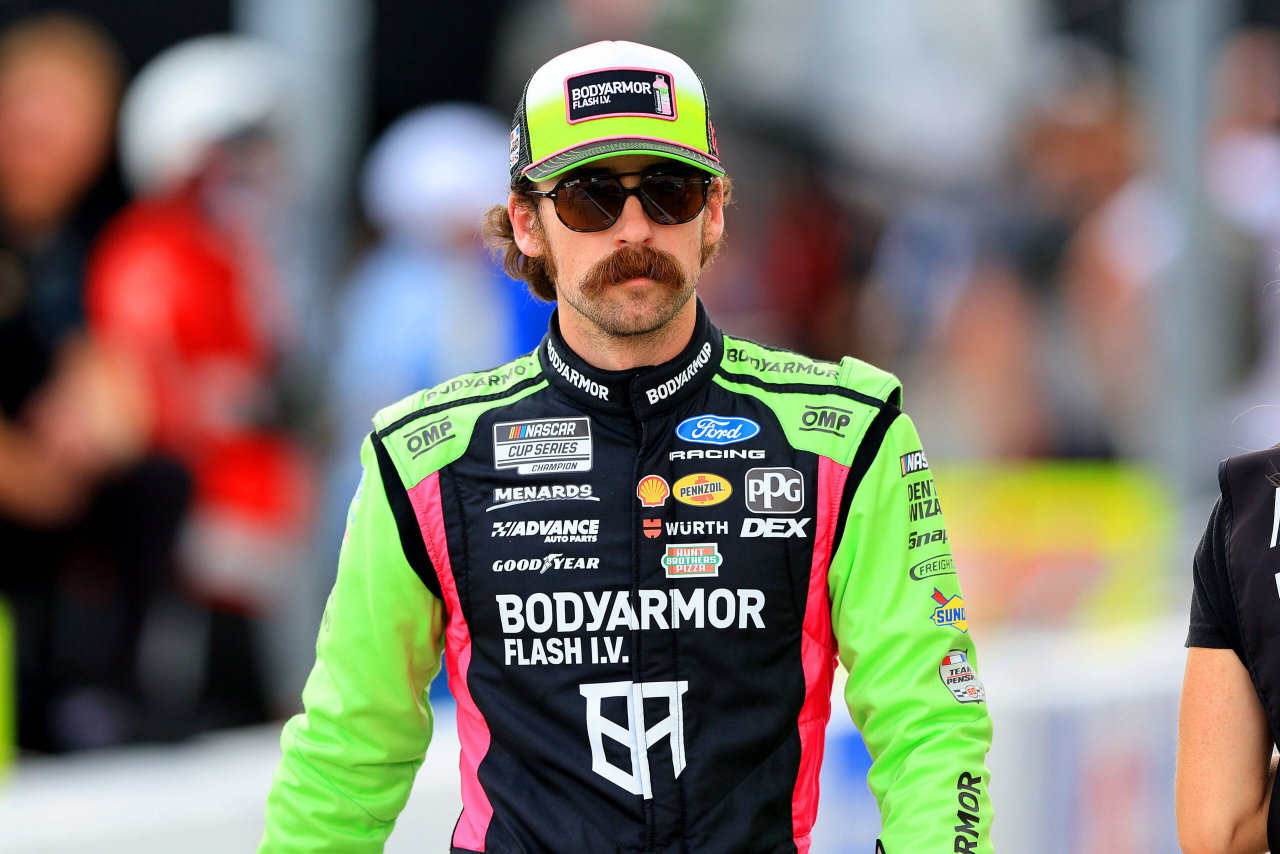
The debate over the yellow line has returned to the spotlight after another controversial call at Atlanta, where the boundary can become a deciding factor in a tight finish. Some fans believe NASCAR’s restrictions can punish drivers for making aggressive moves, but Ryan Blaney sees a bigger problem with throwing out the rule altogether.
“I think it happened; it was Atlanta, and there was a big discussion. Some folks were like, ‘Well, let’s just get rid of the yellow line.’ I was like, ‘No, you cannot,’” Blaney said on the Door Bumper Clear podcast. “They don’t remember back when there was no yellow line rule. I mean, that was a disaster waiting to happen, and you never knew when.”
Blaney’s concern is rooted in the risks of racing below the designated boundary. On a superspeedway, a driver who dives onto the apron must contend with a surface that differs from the main racing groove. If the car loses grip or gets unsettled while rejoining traffic, the consequences can extend well beyond that single driver. With cars running inches apart at high speed, there is little time or room to avoid a collision.
NASCAR introduced the yellow-line rule at Daytona and Talladega in 2001 after incidents in which drivers used the apron to pass, lost control in the infield grass, and triggered multi-car pileups. The restriction was designed to keep racing on the primary track surface and prevent dangerous attempts to gain positions underneath the field. It was not introduced in response to Dale Earnhardt’s fatal crash at Daytona that year, although the broader safety concerns surrounding superspeedway racing were unmistakable.
The rule has never meant that every trip below the line automatically brings a penalty. NASCAR’s standard focuses on whether a driver goes beneath the double-yellow lines to improve their position. Officials can also penalize a driver who forces another competitor below the boundary to stop a pass. That distinction leaves room for judgment, particularly when several cars are fighting for the lead.
The 2008 fall race at Talladega remains one of the clearest examples of how contentious those calls can become. Regan Smith appeared to win after passing Tony Stewart below the yellow line on the final lap. NASCAR ruled that Smith had improved his position illegally, relegating him to 18th and awarding the victory to Stewart. Smith’s supporters questioned whether Stewart had forced him onto the apron, but NASCAR stood by its decision.
The controversy has resurfaced at Atlanta, where the current drafting-style layout produces the close-pack racing associated with Daytona and Talladega. In July, Bubba Wallace crossed the finish line second in the Quaker State 400, only to be penalized afterward for advancing his position below the yellow line on the final lap. The ruling dropped him to 29th, wiping away a runner-up finish and costing him 27 points.
Wallace disputed the call, arguing that he had tried to give back the position rather than gain an advantage. NASCAR maintained the penalty. The incident exposed the precise disagreement at the heart of the rule: Wallace believed he had not advanced his position, while officials determined that his move below the line had improved his track position.
That is where Blaney’s defense of the rule and the frustration surrounding its enforcement intersect. A boundary intended to prevent dangerous passing attempts can still produce difficult decisions when cars are three-wide and drivers are reacting in fractions of a second. Determining whether a driver crossed the line, gained an advantage, or was forced out of bounds is not always straightforward from a single camera angle.
Blaney has also questioned how precisely officials can determine whether a car’s left-side tires have crossed the line. That is a legitimate concern in a sport where inches matter. Drivers need a clear understanding of what constitutes a violation, particularly when a split-second decision can turn a potential victory into a damaging points loss.
Still, the answer is not necessarily to remove the restriction. Allowing unrestricted use of the apron could encourage more aggressive dives beneath the field and leave drivers attempting to merge back into traffic with even less room to recover. The rule exists because those moves can endanger more than the two competitors involved in a pass.
The better solution is to clarify the standard and apply it consistently. NASCAR must distinguish between a driver deliberately gaining ground below the line and one reacting to contact or avoiding a wreck. It must also make clear when a driver has been forced out of bounds and what, if anything, can be done to surrender an advantage.
Blaney’s warning is a reminder that the yellow line was introduced for a reason, and that reason has not disappeared. The debate over individual calls is understandable, but it should not obscure the safety purpose behind the rule. NASCAR does not need to choose between competitive racing and a clear boundary. It needs to define the rule precisely enough that drivers know where they stand and fans can understand why a penalty was issued.
The yellow line is not beyond criticism. Its enforcement deserves scrutiny, especially when a race is decided by a judgment call. But removing it would risk bringing back the very problems it was designed to prevent. The issue is not whether the boundary should exist. It is whether NASCAR can enforce it with the clarity and consistency the sport demands.