
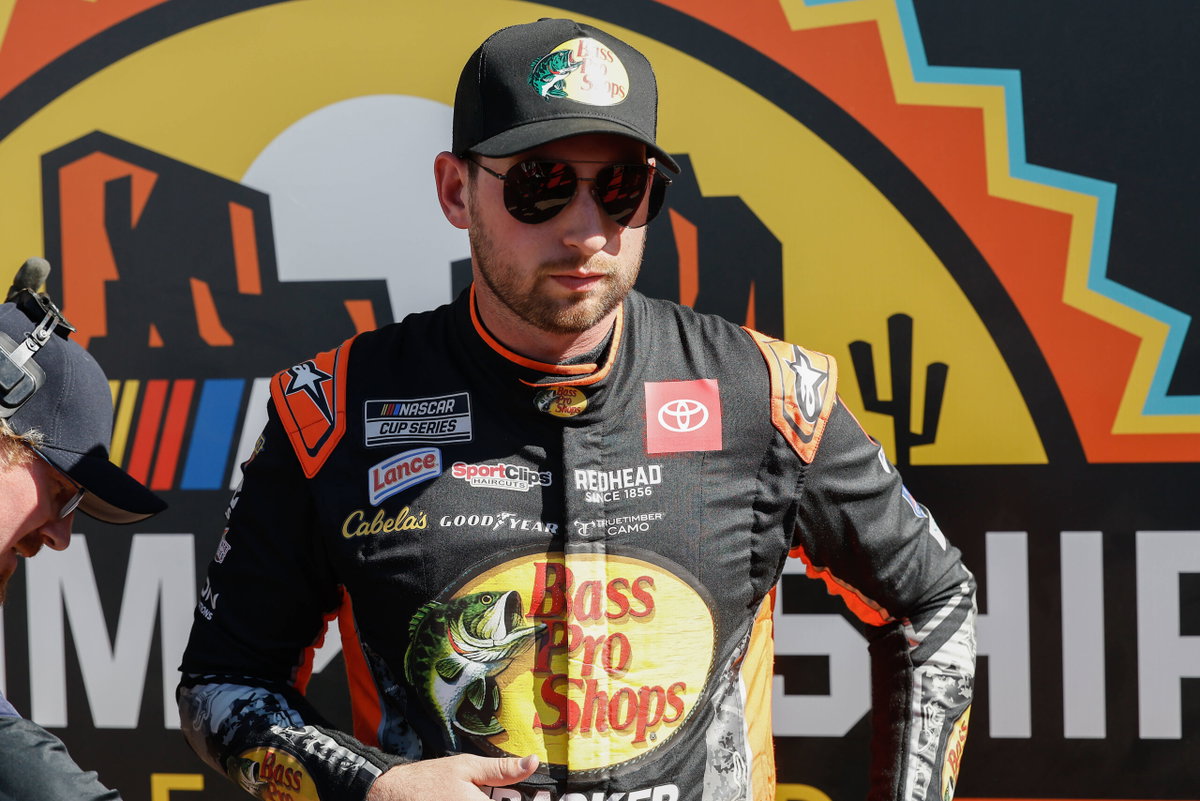
At Kansas, Chase Briscoe had 30 laps to change the entire championship. He had finally caught Kyle Larson, driven past him, and put his No. 19 JGR Toyota in position to win a race he badly needed. But just as Briscoe took control, his tires gave up, the handling worsened and a dominant Larson came roaring back. Briscoe slipped to fourth, watching the Chase leader take the checkered flag and extend his points lead to 123 points with six races left.
Watch What’s Trending Now!
For Briscoe, it felt like the moment the championship had slipped out of reach. He lamented the same in an availability with SiriusXM NASCAR Radio on X.
“Truthfully, when, you know, we weren’t able to win Kansas there at the end, I thought that our chance at a championship was over. You know, it’s just such a far ways back and, you know, it just put it to where I thought it was, you know, honestly kind of out of the question.” Briscoe said.
That is what makes Las Vegas so interesting. Briscoe did not simply need a win. He needed the kind of points haul that could repair the damage Kansas had done. And he got almost all of it.
Chase Briscoe swept both stages, led 175 of 267 laps and won the South Point 400 by 1.376 seconds. The 75-point haul cut 39 points from Larson’s lead and moved Briscoe from eighth to sixth, leaving him 84 points behind with five races remaining.
More importantly, this was not a lucky points day. Briscoe had already shown at Kansas that his Toyota could run with Larson’s Chevrolet. He led 23 laps after taking the lead on Lap 238, only for the handling to deteriorate late. Vegas was the other side of that story. This time, when the field came back at him, Briscoe had enough car to hold them off to take the win.
“Going to Vegas and having a 75-point day and, I mean, look, it’s still going to be a very uphill battle, but you at least still have an iron in the fire,” Briscoe said. “The other guys might have way more, but, you know, we still gave ourselves a chance.”
Focus on that last part, because Briscoe’s comeback did not happen in a vacuum. Larson had a messy afternoon by his standards and still finished second.
The No. 5 team spent a long time on pit road making adjustments and dropped a lap down. Larson worked his way back through the field, got onto Chase Briscoe’s bumper in the closing laps, and still came home second after contact with the wall and Tyler Reddick on the final lap.
That is why the championship picture did not suddenly flip in Vegas. Larson still leads Denny Hamlin by 40 points, Christopher Bell by 55, Joey Logano by 71, and Briscoe by 84.
There is another reason Chase Briscoe can feel encouraged without pretending he has solved his championship situation.
The first five Chase races have been unusually good at exposing how expensive one bad afternoon can be. NASCAR’s current cumulative format does not reset the field after each round. Points keep accumulating across all 10 races, and a maximum 76-point day means a driver can make a serious move, but only if the leader gives him something to work with.
Through five races, Larson has five straight top-five finishes and a 2.2 average finish. He has also increased his scoring rate from 27.85 points per race during the regular season to 54.6 in the Chase. Briscoe has improved too, from 29.27 to 35.8, but not nearly as dramatically.
“So it allowed you to really kind of cut into the cut line. So yeah, it was just a massive day, obviously on Sunday, and then, yeah, looking back on it on Wednesday, just glad that, you know, we were able to get it done, just to kind of giving our team, I think, kind of another breath of life here.”
That may be the best way to describe what Vegas actually did. It did not suddenly put him in control of the Chase, it just gave Briscoe much-needed momentum and kept him in the conversation.
While the 84-point gap might look nearly impossible to come back from, NASCAR history might offer Briscoe some respite. In 2005, during the 2006 Chase, Jimmie Johnson found himself in a similar situation. After fuel-mileage issues in Kansas and a crash in Talladega, Johnson had dropped to eighth in the standings and faced a 156-point deficit.
That is when Johnson went on a historic run. He put together five consecutive top-two finishes, won his first title, and then went on one of the greatest runs in NASCAR history.
Briscoe’s 123-point deficit after Kansas is not the exact same situation, but the Johnson comparison shows that a title-winning run from the eighth position is possible.
And the schedule gives him at least something to work with. Charlotte is next, closing a run of three straight 1.5-mile tracks. Chase Briscoe has won twice this season, at Chicagoland and Las Vegas, and both victories came on 1.5-mile layouts. He also has a Phoenix win and won the 2025 playoff race at Talladega. Homestead, another 1.5-mile track, closes the Chase.
That does not make 84 points disappear. It simply means Briscoe no longer needs a miracle to stay in the conversation. He needs more Sundays like Vegas and fewer like Kansas.
“I’m really excited about these next five weeks. I mean, I was looking forward to them regardless. I just felt like they were all great opportunities for us. But yeah, this gives us something to continue to race for, which is really exciting.”
A week earlier, Chase Briscoe thought the championship was over. After Vegas, he has five races left to prove himself wrong. In NASCAR, that is about as close to a second chance as the points sheet will give you.