
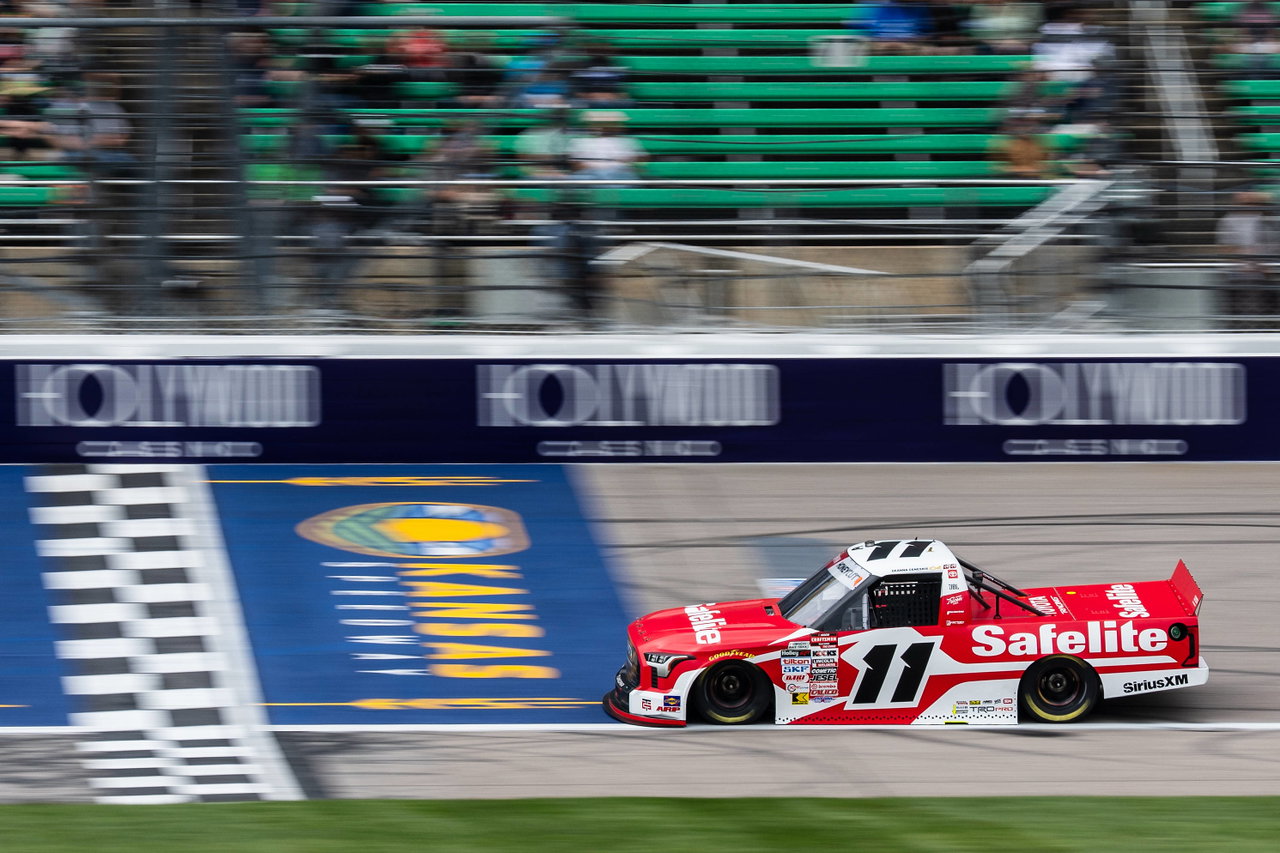
The 20-point lead Kaden Honeycutt carries into Homestead is not enough to make the NASCAR Craftsman Truck Series finale comfortable. But the Tricon Garage driver is not prepared to let the possibility of winning the title without winning the race become a debate about whether he deserves it.
Watch What’s Trending Now!
Asked what people might say if Corey Heim won Friday’s race and Layne Riggs finished second, leaving Honeycutt to claim the title without taking the checkered flag, he brushed the question aside.
“Nope, because the championship trophy will be held whether he wins or if I win or anything else,” Honeycutt said in a clip shared by Bob Pockrass on X.
He offered another scenario: “If Christian won the race and I run third and Layne runs second, I mean, what are they going to say then?” His point was straightforward. Much like the Cup Series, the Truck Series uses the Chase format to decide its champion, and Honeycutt believes his No. 11 team has done enough to justify the trophy.
That confidence comes after a difficult night at Martinsville. Honeycutt entered the penultimate Chase race with a 43-point advantage, but finished 14th after late contact with 16-year-old rookie Tristan McKee sent his Toyota up the track. He had been inside the top 10 for much of the evening before the incident cost him positions.
Riggs, meanwhile, delivered the performance he needed. The Front Row Motorsports driver led 156 of the 200 laps and swept both stages. He looked set to take control of the championship, but lost the lead to teammate Chandler Smith on the final restart and finished third. Had Riggs won, he would have left Martinsville with a one-point lead. Instead, he cut Honeycutt’s advantage by 23 points, leaving a 20-point gap for Homestead.
Afterward, Riggs delivered his own assessment of the title leader: “He showed his weakness today and we showed our strengths.” He referred to the No. 34’s long-run pace and tire management, which he felt repeated restarts and dirty air had prevented him from fully using.
That result explains why the finale has been described as almost winner-take-all. A race win pays at least 55 points, 20 more than second place, and Riggs has made it clear that he needs to chase victory. He has also warned that Honeycutt is not as dominant as some believe.
Honeycutt is not arguing that Riggs lacks the speed to take the championship. He is rejecting the idea that the race winner should automatically be viewed as the more deserving champion. His numbers support the consistency argument. Through 24 races, he has four wins, 15 top-five finishes, and 18 top-10 finishes, with a 7.9 average finish. Riggs has more victories, seven, but has 13 top fives, 15 top 10s and a 10.0 average finish. The No. 11 has produced the stronger overall record, even if Riggs has been more prolific in Victory Lane.
The Chase record adds to that case. Honeycutt has won twice in the six postseason races, while Riggs has one Chase victory. The No. 11 team has also finished eighth or better in five of those six events. NASCAR’s clinching scenarios show Honeycutt can secure the title with 55 points and wins the tiebreaker if he finishes inside the top three. Riggs needs 75 points to clinch regardless of what Honeycutt does.
He is also refusing to treat his first Homestead weekend with this Tricon group as a weakness. Riggs has raced at the track with Front Row Motorsports, but Honeycutt said he has had to prepare with his current team at unfamiliar venues throughout the year.
“We’ve had to do it every race this year,” he said in another short clip on X, pointing to Kansas and Charlotte. Honeycutt recalled winning at Kansas the first time with the group and said they had been competitive at Charlotte on both visits. Even when they did not have a winning truck, he believed they improved a second-place package.
The preparation time at Homestead should help. Bob Pockrass reported that Truck teams had a 50-minute practice session with two sets of tires and an opportunity to make adjustments before qualifying. Honeycutt believes the track time can help build a baseline, particularly because the team has been running well at intermediate venues.
There is still pressure on the No. 11. Riggs has seven wins this season, the most in the series, and his Martinsville pace showed how quickly he can turn a race into a points opportunity. Honeycutt cannot afford another difficult finish.
But his response to the legitimacy question was not an attempt to diminish Riggs or the importance of winning Homestead. It was a reminder that the championship is not a one-race award. The No. 11 team has built its position through wins, top-five finishes, top-10 results and reliable pit work. If that consistency carries it to the title, Honeycutt sees no reason to apologize for the way it happens.
“The best team wins,” he said. At Homestead, he is determined to make sure that argument is settled on the track.