
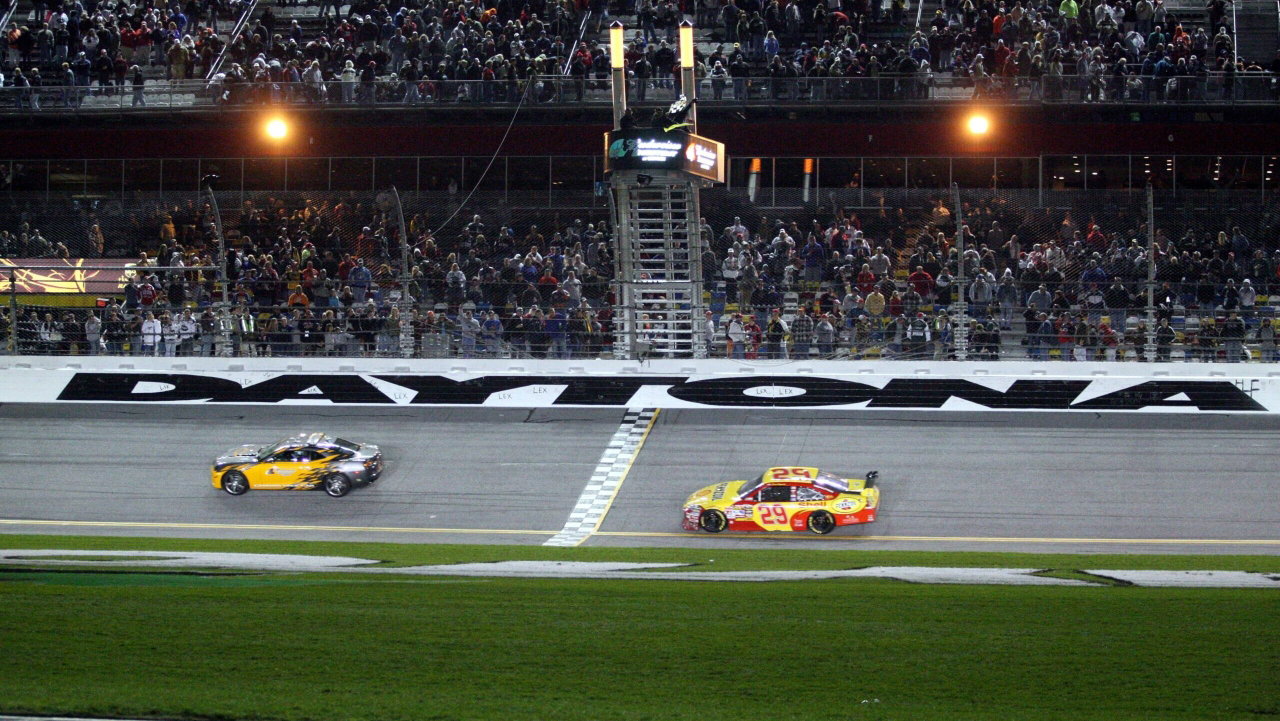
Five NASCAR teams were pushed out of the Daytona starting grid in 2010, but the controversy had little to do with illegal parts or technical violations. The sport has seen plenty of cheating scandals over the years, from engine tricks to questionable aerodynamic modifications that gave teams an unfair advantage. This time, however, the dispute unfolded behind closed doors, where money and influence shaped who got to race. At the center of it was Paul Menard and a financial arrangement that sparked anger among several smaller teams.
Watch What’s Trending Now!
Paul Menard’s No. 98 Ford was nowhere near securing a place in the 2010 Nationwide Series season opener on qualifying order alone. When rain washed out Friday’s session at Daytona International Speedway, he faced an almost certain exit from the field. What followed was one of the more unusual behind-the-scenes arrangements in NASCAR history. Jack Roush reportedly used financial incentives, engineering assistance and equipment support to persuade five teams to withdraw, clearing a path for Menard to take the 43rd and final starting spot.
The situation stemmed from NASCAR’s rules for setting the grid when qualifying was canceled. The top 30 positions went to teams based on the previous season’s Nationwide Series owner points, with provisionals and other guaranteed entries also accounted for. The remaining positions were determined by the qualifying draw. Menard’s newly formed No. 98 team drew 49th, leaving him outside the 43-car field. The rainout meant he would not get another opportunity to improve that position on track.
That left Roush looking for a way to move the No. 98 up the list. Four entries ahead of Menard were not otherwise guaranteed starting positions: Donnie Neuenberger’s No. 52, Dennis Setzer’s No. 96, Mark Green’s No. 49 and Parker Kligerman’s No. 42. A fifth withdrawal was also necessary, despite Jeff Fuller’s No. 97 having drawn a position that would have put it safely inside the field. Fuller was reportedly expected to run only a handful of laps before parking, making his starting spot particularly valuable to the arrangement.
Roush’s offers reportedly included direct financial payments, engineering assistance and additional equipment. No team publicly confirmed the exact amounts, but Frontstretch estimated that the total value of the incentives approached $225,000. That figure was based partly on the $45,585 last-place payout available in the race and the support reportedly promised to the withdrawing operations. It was an extraordinary amount to secure one starting position, especially when several smaller teams were already struggling to finance their seasons.
The arrangement also exposed how difficult it was for smaller organizations to turn down help from one of NASCAR’s most powerful owners. Brian Keselowski, who owned the No. 96 entry, acknowledged that his team needed financial and engineering support to remain competitive. He explained that the offer gave the operation something it desperately needed, particularly after a 10% reduction in race payouts. His comments reflected the uncomfortable position facing underfunded teams: refusing the deal would not necessarily get them into the race, but accepting it could help them survive beyond Daytona.
Kligerman was particularly frustrated by how the situation unfolded. The rookie had been looking forward to competing in the season opener, but his Team 42 Racing entry ultimately withdrew. He later clarified that he had no personal issue with Menard, recognizing that the driver needed to make the race to pursue his championship ambitions.
His frustration was directed at the circumstances that kept him from competing. Kligerman also described efforts to negotiate a deal involving another team, but said the proposed arrangement eventually fell apart because the other party wanted too much. He hoped NASCAR would reconsider its qualifying procedures before the following Daytona season.
NASCAR, meanwhile, did not intervene. Spokesman Ramsey Poston said the arrangement did not involve the sanctioning body and described it as a unique situation. Since the teams formally withdrew, the No. 98 moved into the field under the existing rules. Menard started 43rd but made the most of the opportunity, avoiding several incidents and bringing the car home sixth. Tony Stewart won the 120-lap race, with Carl Edwards and Kevin Harvick completing the podium.
The episode brought back memories of another Daytona controversy, this time from 2007. Ahead of that year’s Daytona 500, NASCAR penalized five Cup Series cars across three teams for technical violations. Matt Kenseth and Kasey Kahne lost 50 points each, while Scott Riggs and Elliott Sadler were penalized 25 points apiece.
Michael Waltrip’s Toyota then became the center of a separate investigation after officials discovered a suspicious substance in its intake manifold. Waltrip lost 100 points, and crew chief David Hyder received a record $100,000 fine. Six crew members and officials were ultimately ejected from the speedway.
The two Daytona controversies were fundamentally different. The 2007 incident involved technical violations and NASCAR’s enforcement of its rulebook, while the 2010 dispute exposed how financial leverage could influence who made the field without breaking an explicit rule. Both, however, left NASCAR answering uncomfortable questions about fairness at its biggest season-opening event.