
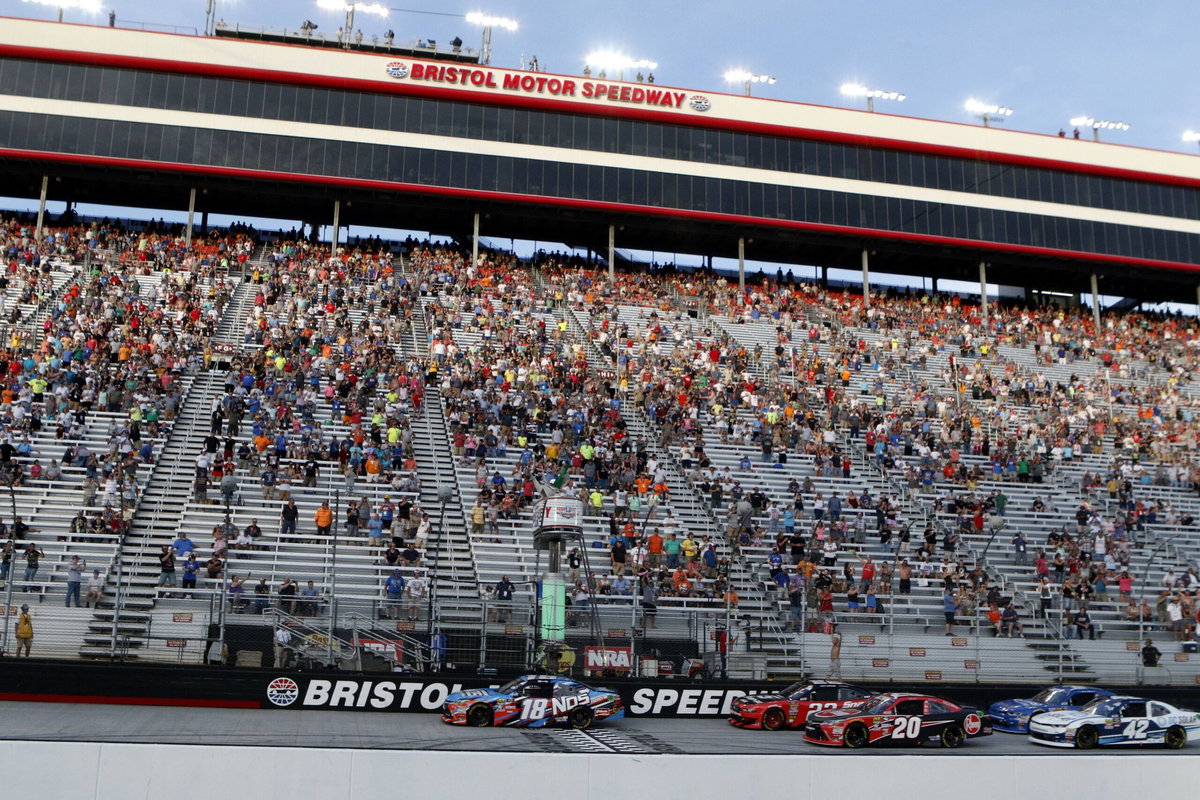
Bristol delivered everything fans expect. There was drama, chaos, and a breakthrough moment. Ty Gibbs finally broke through with his first Cup Series win in overtime, while Kyle Larson dominated early by sweeping Stages 1 and 2. On the flip side, Kyle Busch endured yet another frustrating outing. It had all the ingredients of a classic Bristol race. Yet, despite the on-track spectacle, the empty grandstands told a very different story that’s now sparking serious debate about NASCAR’s schedule.
Watch What’s Trending Now!
Kenny Wallace’s blunt take on empty NASCAR grandstands
“Could you imagine NASCAR going, ‘Oh, we’re only going to run eight or 16 races a year. We’re going to run the Daytona 500, the Southern 500, the Coke 600, maybe the Brickyard. Hell, they’d be packed, too.’ I’ve always said NASCAR races too much. It’s just the way I feel. You know, NASCAR used to only run like what was it? 28 32 races a year. This is just the way it is. Just the way it is.”
That was Kenny Wallace offering a brutally honest perspective on his Coffee with Kenny podcast on what many fans have quietly wondered for years. At the heart of the debate is Bristol Motor Speedway, once dubbed “The Last Great Colosseum.” With a seating capacity of over 150,000, the venue is built for spectacle.
But recent races, including last week’s spring race, have drawn closer to 30,000 fans, creating a visual that feels far more alarming than the actual turnout might suggest. The sheer scale of the track amplifies the emptiness. Part of the issue lies in frequency.

“Coffee with Kenny” Will empty seats at the racetrack always be a surprise for you?
Hosting two races annually has arguably diluted the urgency to attend. Add to that the evolution of fan behavior where streaming, high-definition broadcasts, and the comfort of home have become increasingly appealing and the shift becomes clearer. Rising costs for tickets, travel, and accommodations only widen that gap.
But this isn’t just a Bristol problem. Attendance dips have been visible across multiple NASCAR venues, reflecting a broader change in how audiences consume the sport. Social media only intensifies the perception, with viral images of empty grandstands shaping narratives faster than context can catch up.
Kenny Wallace’s point about oversaturation adds another layer. Compared to series like Formula One and MotoGP, which run significantly fewer events, NASCAR’s 36-race calendar can feel relentless. Scarcity often drives demand, and right now, NASCAR might have too much supply.
Bristol, then, isn’t the problem. It’s just the clearest mirror reflecting a changing sport.
The broadcast dilemma
1.945 million viewers tuned in for the Cup race at Bristol Motor Speedway. Well, that’s a respectable figure by today’s standards, but a far cry from the 5.1 million who watched the same event a decade ago. The viewership was a 5% drop from last year as well.
The timing of this dip is hard to ignore, coming soon after NASCAR secured its $7.7 billion media rights agreement with FOX Sports, NBC Sports, Amazon Prime Video, and TNT Sports.
Financially, the deal checks every box. By spreading races across multiple platforms, NASCAR maximized its value and locked in revenue for years to come. But that same strategy has quietly reshaped how fans access the sport.
In the past, major network broadcasts made races easy to find, even for casual viewers. Now, with a reduced presence on traditional channels and a heavier reliance on cable and streaming, the barrier to entry has increased. It’s no longer about simply turning on the TV. Fans need to know where to look and, in many cases, pay for it.
There’s logic behind the shift. Cable networks depend on live sports to retain subscribers, and NASCAR provides consistent, reliable programming. In that sense, the sport has become a key asset in a much larger media ecosystem.
Still, the fan experience has evolved. And not necessarily in a simpler way. Accessibility has taken a hit, especially for those who aren’t already deeply invested. So while NASCAR’s bank balance looks stronger than ever, its reach tells a different story. And when combined with attendance concerns, it raises a bigger question: is the sport becoming harder for the average fan to engage with?