
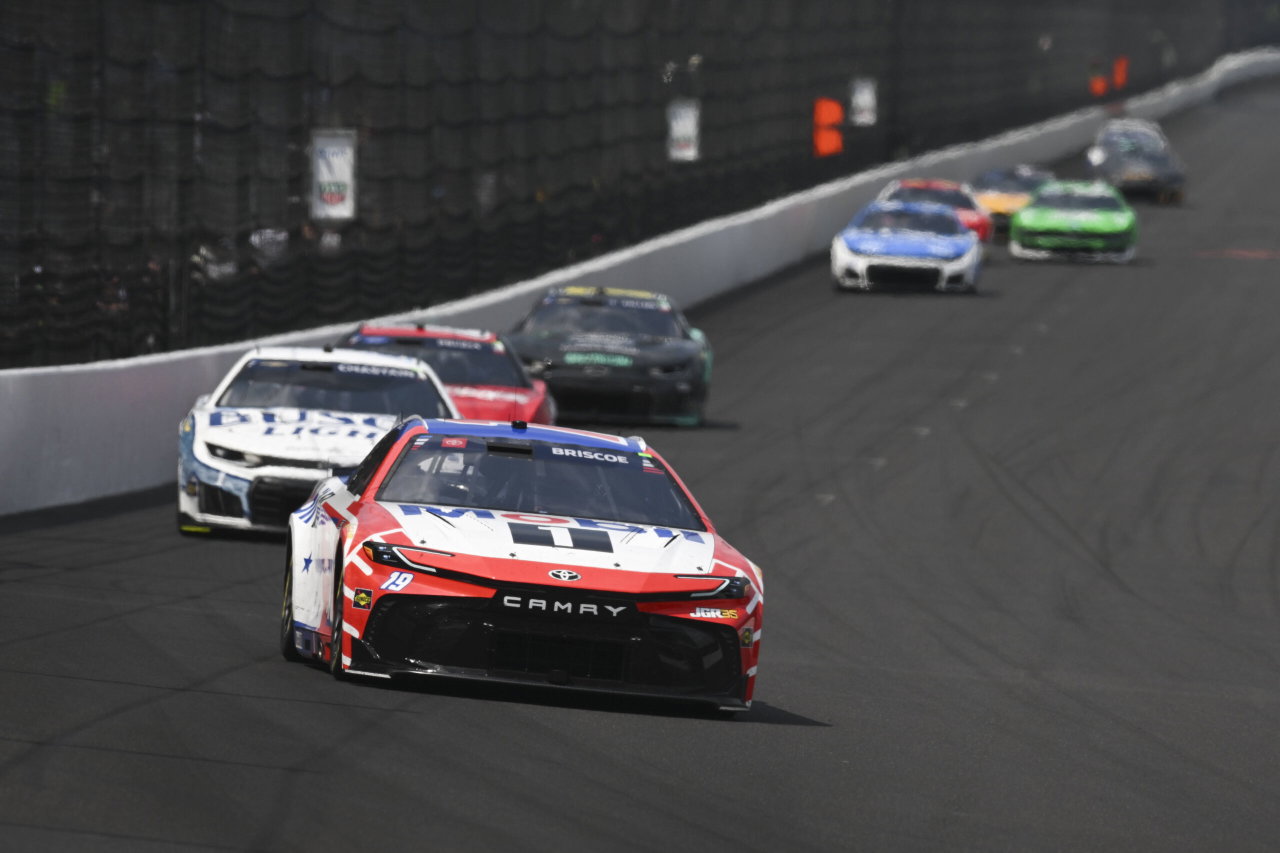
Toyota looked ready to take over Las Vegas before the race had even begun. The manufacturer locked out the top five in qualifying, setting up what appeared to be another strong showing in the Chase. While Chase Briscoe ultimately delivered the win for Joe Gibbs Racing, several of his Toyota teammates failed to turn that early speed into the kind of results the manufacturer appeared capable of producing. Now, veteran NASCAR insiders Jordan Bianchi and Jeff Gluck are questioning how much confidence Toyota’s contenders really deserve.
Watch What’s Trending Now!
“Like, I want to have confidence in these guys, but a lot of these guys you’re like, how can you? When you compete, when you repeatedly have these kind of things happen, a lot of it’s in your control; some of it’s not. But when you repeatedly have these issues, it’s like, I’m sorry. Like, I’m going to go with the guy in the five team who is pretty much flawless. And by the way, when he has a problem, they’re going to figure it out,” NASCAR insider Jordan Bianchi said on the Teardown podcast.
That frustration was easy to understand after Las Vegas. Toyota entered the fifth race of the Chase looking like the manufacturer to beat after Joe Gibbs Racing swept the top four spots in qualifying, with the broader Toyota contingent filling the front of the field. But the advantage quickly became less convincing once the race settled in.
Denny Hamlin started from the pole and led 39 laps, only to spin late in Stage 1 while running near the front. Hamlin’s No. 11 Toyota then encountered another setback on Lap 170 when the team detected a fuel-pressure problem with the first pump. Switching to the backup pump left him vulnerable on the restart, and he lost 12 positions as a result, undoing much of the ground he had gained earlier in the race.
Ty Gibbs, who had been running second early, was also forced to serve a pass-through penalty for speeding on pit road. Bubba Wallace suffered a similar setback after an equipment-interference penalty on pit road before recovering to eighth.
Then came the bigger problems. Tyler Reddick, who had started fifth, dealt with voltage issues and needed a battery change during the Stage 1 break. He still fought his way back to third, but even that recovery came with an important admission from the 23XI Racing driver.
“We’ve had multiple issues,” Reddick said after the race. “We had multiple issues today, and it was nice fighting back from them. But played part in coming up short. I mean, we’ve got to win these races.”
Christopher Bell’s afternoon was even more costly. After finishing second in Stage 1 and third in Stage 2, Bell appeared to have a strong points day developing. Instead, a power-steering failure forced him to run the second half of the race without assistance, dropping him to 23rd. His 17-stage points limited the damage, but he still lost five points to Larson and now sits 55 points behind the championship leader.
That is precisely the problem Bianchi was highlighting. Toyota clearly has the speed to contend. However, too many of its Chase drivers are having to spend races recovering from problems instead of simply maximizing their results. And Larson is providing the uncomfortable comparison.
The No. 5 Chevrolet had its own disaster brewing at Las Vegas. Larson dropped from sixth to 14th early and eventually needed a 26-second green-flag pit stop for major adjustments. He even fell a lap down before a caution allowed him to return to the lead lap.
Instead of allowing the setback to define his afternoon, Larson and crew chief Cliff Daniels kept working. The adjustments transformed the car, and Larson eventually charged all the way back into contention before finishing second. It was not the first time Larson has demonstrated that ability during this Chase.
At Gateway, he faced another chaotic race filled with incidents and late-race challenges. The Hendrick team made an aggressive four-tire call on the final stop, giving Larson the equipment he needed to take advantage of the late restarts and claim the victory.
That is the distinction Bianchi sees. Problems happen to every team. However, championship contenders have to minimize the damage when they do.
Toyota’s issues have not been limited to one isolated weekend, either. Reddick has battled multiple problems during the second half of the season, while Bell’s 19th-place finish at Gateway and 23rd at Las Vegas have turned potentially productive Chase races into damage-control exercises. Hamlin, meanwhile, has watched his championship lead disappear after several difficult outings.
Briscoe’s victory in Las Vegas shows that Toyota can still produce a championship-level performance. He swept both stages, led 175 laps and scored 75 points, cutting his deficit to Larson to 84 points with five races remaining. But one Toyota driver winning cannot erase the broader concern.
Larson has now finished inside the top five in all five Chase races, averaging a remarkable 2.2 finish. More importantly, when his No. 5 team has encountered trouble, it has consistently found a way to turn the day around.
That is why Bianchi’s question carries so much weight. Toyota does not need to prove it has the raw speed. The manufacturer has already done that. It needs to prove its championship contenders can put together complete races when the pressure is highest.