
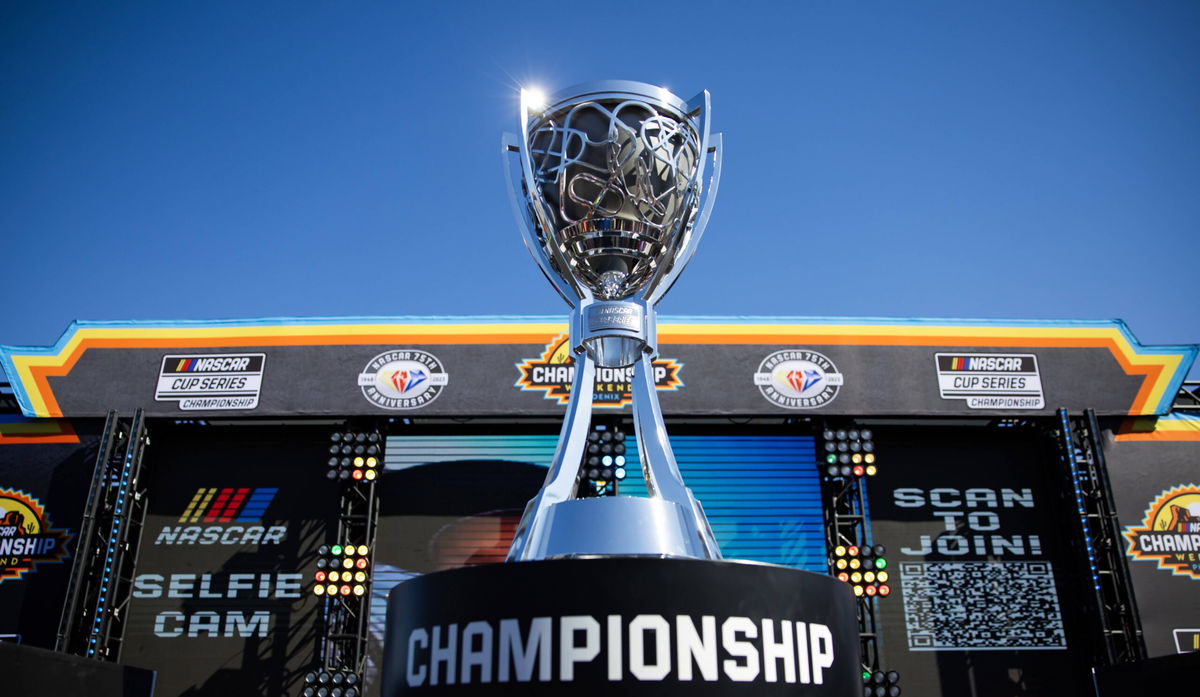
A championship celebration usually comes with a checkered flag, but what happens when the title is settled before the season’s final race? Kyle Larson could face exactly that situation at Martinsville, where scoring 59 points would secure the 2026 Cup Series championship regardless of how his rivals finish. With Homestead still waiting on the schedule, NASCAR could have a newly crowned champion without an immediate trophy presentation. And that possibility has brought an interesting piece of championship history back into the spotlight, raising questions about how the sport has handled early title clinches before.
Watch What’s Trending Now!
Bob Pockrass, via an X post, brought Matt Kenseth’s 2003 championship back into the conversation as NASCAR prepares for a possible early title clinch at Martinsville. Kenseth received his trophy at Rockingham after securing the championship with a race to spare. However, the championship ceremony still took place at Homestead the following weekend.
That distinction matters as NASCAR prepares to keep its official celebration tied to the season finale, even if the title is decided earlier. And Pockrass’ historical reminder offers an interesting look at how the sport has handled both moments.
The discussion began after Pockrass reported that NASCAR would not hold a trophy ceremony at Martinsville if a driver clinched the 2026 Cup Series championship there. The FOX Sports journalist then pointed to Kenseth’s 2003 title, writing: “In 2003, Kenseth was given the trophy at Rockingham.”
He added a caveat about the rules at the time, noting that a driver was not required to start every race and could theoretically still have faced a points penalty during the final weekend.
Kenseth’s championship run was already one of the most unusual in NASCAR history. Driving the No. 17 Roush Racing Ford, he had taken control of the points standings early in the season and maintained the lead for most of the year. By the time the series reached Rockingham for the penultimate race, he needed only a seventh-place finish to secure the title.
Kenseth finished fourth in the Pop Secret 400 on November 9, 2003, while Bill Elliott took the race victory. The result gave Kenseth an unassailable 226-point advantage over Jimmie Johnson with one race remaining.
But winning the championship at Rockingham did not mean NASCAR moved the entire celebration there. Kenseth’s trophy handoff at the track was one moment; the formal championship ceremony was another. The official presentation was scheduled for immediately after the Ford 400 at Homestead the following weekend. Despite having already secured the title, Kenseth still returned for the season finale, where engine trouble left him 43rd. The championship celebration, however, remained part of the final race weekend.
That is the distinction Pockrass’ example brings into focus. NASCAR could acknowledge Kenseth as champion once the title was mathematically settled, while still keeping the presentation for the final race weekend. The 2003 precedent does not necessarily argue against NASCAR’s current approach. Instead, it shows that an early trophy handoff and a season-ending championship celebration can coexist.
There is also a practical reason fans have supported keeping the ceremony at the finale. One fan put it this way: “I think this is understandable. People go to Miami partly to see the championship ceremonies.” Championship weekend is more than the race itself for many attendees. The trophy presentation gives the event a clear focal point, and moving it to an earlier venue could change the experience for fans who planned their trip around the final weekend.
Others see the debate through the lens of NASCAR’s older points system. “Jesus. No matter what the point system is, this sub will always complain about it. I grew up with Winston points. Sometimes the championship was decided with 3-4 races to go.” Before the Chase was introduced in 2004, the championship was decided through cumulative season-long points. That format could produce an early clinch, as Kenseth’s 2003 title demonstrated, but it also meant the championship outcome could be settled before the final event.
Another fan argued that waiting for the finale is hardly a new practice: “There were drivers that won the championship six races before the season ended and they still waited until the last race of the season to present the trophy. This isn’t new.” The broader point is that the date a title becomes mathematically secure and the date of its official celebration do not have to be the same.
The comparison with other sports came up, too. One fan referenced the English Premier League, where a team can clinch the title before the final match but still receive the trophy at a later scheduled celebration. The league has traditionally presented the trophy at the champion’s final home match when the title is secured early. That approach is not identical to NASCAR’s, but it reflects the same idea of separating the achievement itself from the ceremony built around it.
Ultimately, Kenseth’s 2003 season offers a useful precedent for the current debate. He received recognition at Rockingham, but Homestead remained the stage for the championship celebration. NASCAR’s decision not to hold a ceremony at Martinsville can therefore be understood as preserving the significance of the finale, rather than refusing to recognize an early champion.
The title can be decided on Sunday. The full celebration can still wait until the season is over.