
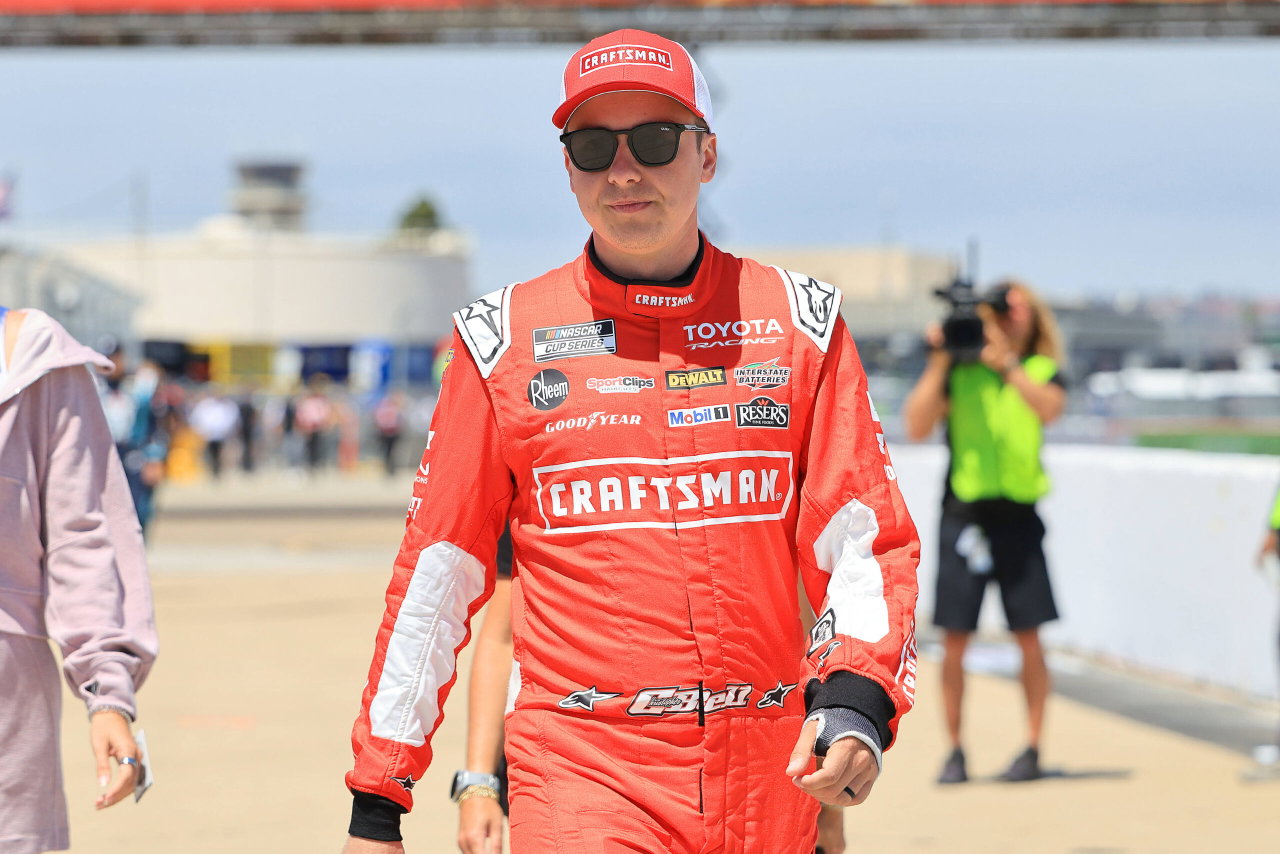
Christopher Bell had little reason to celebrate after returning to the Joe Gibbs Racing hauler at Talladega Superspeedway. His No. 20 Toyota was damaged, his championship hopes had taken a hit, and one mistake on pit road had ruined his afternoon.
Watch What’s Trending Now!
Yet, ahead of Martinsville, Bell was not talking about playing catch-up carefully. He knew his team needed something extraordinary, and he was prepared to take chances to get it.
“Where we’re at now, we know the only way forward is to go out here and win two stages and a race, then go to Homestead and win two stages and a race,” hw revealed. “In reality, we have nothing to lose. So now the pressure is off. It’s just a matter of going out there and throwing Hail Marys. We’re at that point now, and that’s what we’re going to do.”
The frustration behind those words goes back to Talladega. Bell entered the race five points behind Larson, but finished 35th after losing control of his Toyota while entering pit road under green. What looked like one mistake quickly became a series of problems, costing him valuable championship points.
However, Bell believes the unfamiliar low-downforce package played a part in the incident. Teams had discussed the challenge before Daytona, where NASCAR first introduced the package, but there had been no green-flag pit stops to provide useful data.
“Nobody in the field had any data on where the car needed to be, where your brake marks needed to be or anything like that. It was a guessing game for all of us.”
Bell explained that he entered pit road without enough front brake bias. The moment he applied the brakes, his rear tires locked, sending the car out of control. He also admitted that a short pit-road practice session would have helped teams understand how their cars behaved under deceleration.
The incident was only the beginning. Bell suffered tire problems, received a pit-road penalty for having too many crew members over the wall and experienced another right-front tire failure on Lap 67. While Kyle Larson went on to win, Bell was left with a result that made his championship task considerably harder.
Interestingly, the incident did not create a blame game inside the No. 20 team. Bell recalled driving back to the hauler and waiting for his crew because he wanted to see how everyone would respond. Instead of pointing fingers, the team accepted responsibility and moved forward together.
“We all were accountable,” he said. “We all pulled the rope in the same direction. Nobody was pointing fingers and saying, ‘This is on you. This is on you.’”
Bell maintained that his team had handled pressure well throughout the Chase. He pointed to their consistent performances, despite a crash at Gateway and a power steering problem at Las Vegas. Those setbacks had already cost valuable points, but Talladega left them with almost no margin for error.
That is where the 2026 championship format becomes important. The new 10-race Chase uses cumulative points, with no eliminations or resets. Every result carries into the next race, including the championship finale at Homestead-Miami Speedway. Bell needs to win both stages and the race at Martinsville, then repeat that performance at Homestead.
Even with the championship situation demanding aggression, Bell cannot simply throw his car into every available gap. NASCAR’s revised bumper structures, which feature less energy-absorbing foam, could change how drivers approach contact at Martinsville.
Cars often make contact as drivers fight for position through the narrow corners. With the revised bumper construction, those impacts could have more serious consequences, making aggressive moves riskier than before.
Bell specifically pointed to the possibility of cars stacking up during restarts. He even asked his spotter to remind him about the changes throughout the race.
“Making sure you’re mindful of that is going to be mission-critical. So yeah, it’s going to be a talking point for sure.”
The changes could also influence how the rest of the field approaches the race. Under the previous elimination format, Martinsville often carried a last-chance atmosphere. This time, points continue into Homestead, meaning a damaged car or a poor finish could hurt a driver’s championship chances beyond Sunday.
Bell admitted that nobody knows exactly how the field will respond to the different format. However, he expects the bumper changes to discourage drivers from simply plowing through competitors.
He does have confidence in the final stop at Homestead. But reaching that finale with a championship opportunity intact requires a big result at Martinsville. Bell needs maximum points, while also navigating a track where contact could become particularly costly.
His message leaves little room for interpretation. The No. 20 team cannot afford to settle for another respectable finish. Wins are what he needs.