
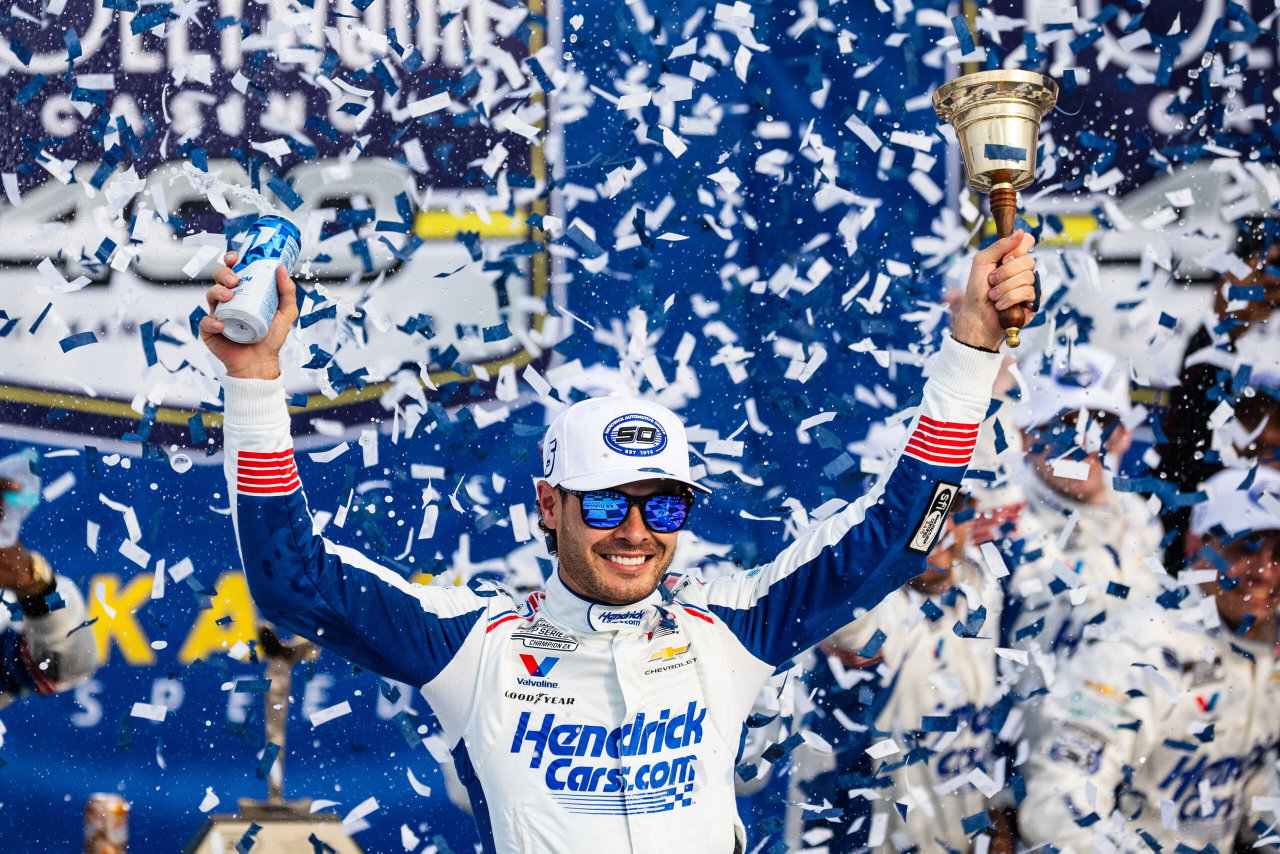
NASCAR’s Chase format divided fans. While it rewarded consistency over flashes of supreme performance, it also reduced the probability of the title fight going down to the wire. And that did happen. Kyle Larson walked into the Homestead-Miami finale with a 67-point lead and easily emerged as the 2026 Cup champion. But four-time Cup race winner Ken Schrader is all for it. While fans didn’t get to witness a closely fought battle that went into the championship finale as in 2025, Schrader doesn’t seem to care about the comparisons.
Watch What’s Trending Now!
“I think it was a good format that they had this year,” said Schrader on the Dirty Mo Media’s Herm and Schrader podcast. “Denny Hamlin couldn’t go in there, or Christopher (Bell) couldn’t go in there, win all the stages and win the race and just do their job really good without Kyle having a tremendously bad day. So he couldn’t just win it. You had to count on Kyle having a bad day. So I like where they’re at now with the format. We just need to leave it alone.”
The championship finale at Homestead-Miami saw Larson go in with a 67-point lead over Bell and Hamlin, which could only be overcome if Larson essentially failed to finish the race and the other two had a perfect sweep of all the stages and the win.
However, despite not being the fastest on race day, Larson managed to finish P4 at the end of Stage 1, enough to clinch the title over his rivals. Ryan Blaney eventually won the race, his fourth of the season, but the big trophy went home with the No. 5 team.
This situation for Larson came about after the Hendrick Motorsports ace came on a hot streak of podiums and wins during the postseason. This time, he didn’t need a caution to turn the tide in his favor, as at Phoenix last year.
The 2025 NASCAR championship was decided after a strategic call on pit road gave Larson the edge over Hamlin, who had dominated the race until overtime, thus giving fans the game-time moment typical of the previous format.
“It’s good, it’s over 10 races,” added Schrader about the new format, touching on the importance of consistency not only during the postseason, but also during the regular season, something which did not carry as much weight last year. “You had to be solid in 2026. If you’re 17th in points, you’re not going to win the damn thing anyway after 26 races. So I liked it.”
Former driver turned analyst Kenny Wallace also chimed in on why there was less chatter around the title clinch before the race than there was a year ago.
“Some people said, ‘Why aren’t they talking about the championship like they usually do?’ I said, ‘Because it’s over,'” said Wallace, referring to Hamlin and Bell’s extremely small chances of a championship upset to defeat Larson in Miami.
The consensus within the NASCAR fraternity around the change has been largely positive. Drivers have backed the current format and how it rewards drivers who put together a complete season, coupled with the postseason, and rise to the top when the title decider comes, whether that means deciding the champion a race earlier than the finale, or two or three races early.
“I’m not saying the past champions weren’t legit, but before, you could win the first 35 races and go to Phoenix (previous finale venue) and blow up and finish fourth in points. It’s not going to be like that anymore,” said Chase Briscoe about the Playoffs format and how it could sometimes feel unfair.
It now remains to be seen how the likes of Joey Logano, who seemed to flourish in the Playoffs era, along with others, switch their mentality and execution to look at the complete year as a whole, instead of relying on the more spectacular, ‘win and you’re in’-type approach. If you were to ask a racing purist, it would be pretty obvious what their answer to the perfect NASCAR format would be.