
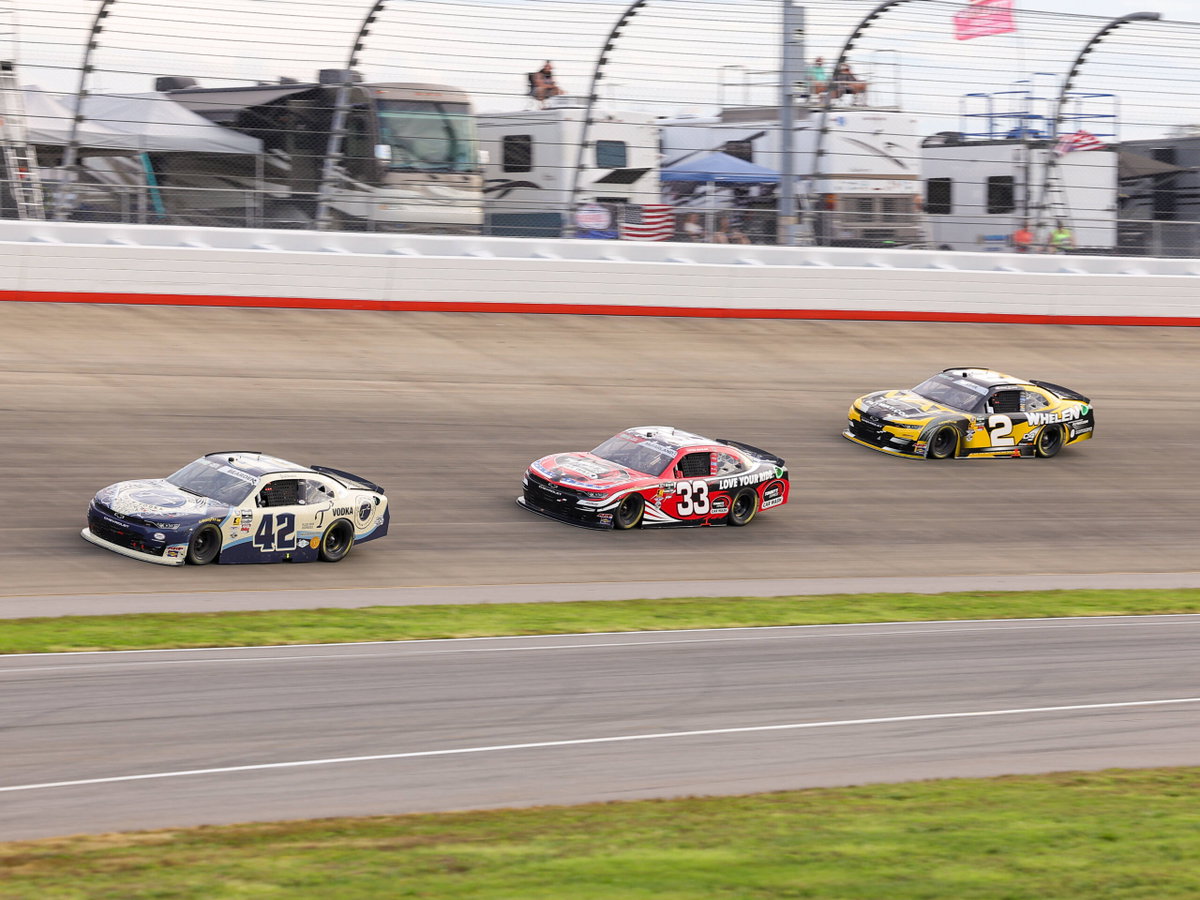
Tommy Joe Martins, a co-owner of Alpha Prime Racing, spends as much time assessing drivers as he does competing against them. Because of his distinct viewpoint, he has come to the direct conclusion that the NASCAR O’Reilly Auto Parts Series has seen a sharp decline in expectations. Martins claims that a competitive imbalance brought about by Cup-affiliated groups has caused people to stop accurately evaluating driver performances, which is detrimental to the series.
Watch What’s Trending Now!
NASCAR O’Reilly driver expectations have become too comfortable
“It’s Cup teams. Look at the owners’ points in the O’Reilly Series right now. The lowest one of those teams is like 14. So there’s 13 of them in the top 14 spots. No, you’re not. It’s class racing. The way that we evaluate the drivers is based on that, like who’s in 14. I think there should be more pressure in those moments. That’s the thing that I want, like when we talked offline about this. I go, we’re not bullying these people enough.”
Most team owners would never say that in public. But Martins believes the sport judges drivers by the wrong metrics. He thinks too many people focus on raw stats rather than the context that underlies them.
To him, a top-10 finish doesn’t prove a driver is great. The sport has changed too much. Today, big-budget Cup Series teams completely run the show in the O’Reilly Auto Parts Series.
These elite teams bring massive manufacturer support, tech alliances, engineering help, and shared pit crews to the lower series. Plus, Cup Series drivers can still run up to 10 O’Reilly races a year. This lets superstars like Kyle Larson drop down and drive championship-level cars whenever they want.
Because of this, powerhouses like Joe Gibbs Racing, JR Motorsports, and Richard Childress Racing lock out the front of the pack almost every week. Martins says this reality should change how we judge everyone else. He points to his own team, Alpha Prime Racing, as proof.
In 2026, Alpha Prime fields Brennan Poole in the No. 44 Chevrolet and Lavar Scott in the No. 45 Chevrolet. Caesar Bacarella also runs the team’s part-time No. 4 car. The stats show the uphill battle they face. Through 20 starts, Poole sits 17th in the standings with just one top-10 finish. Meanwhile, Lavar Scott sits 26th in the standings with zero top-10s.
Martins says fans need to look more closely at numbers like these. He compared NASCAR’s evaluation methods to Formula One. In F1, when a Ferrari runs badly, everyone immediately asks if the problem is the driver or the car. He believes NASCAR rarely looks at drivers with that same depth.
He even compared it to analytics in football. Martins argued that judging a driver just by top-10 finishes is like rating a quarterback strictly on completion percentage. That stat ignores hard throws, bad choices, and a player’s actual impact on the game. To Martins, context matters.
Martins isn’t taking shots at specific drivers. He just hates how the sport grades talent right now. With big-money Cup teams taking over the lower series, people need to talk about driver skill smartly. If they don’t, people will just keep confusing a fast race car with a great driver.