
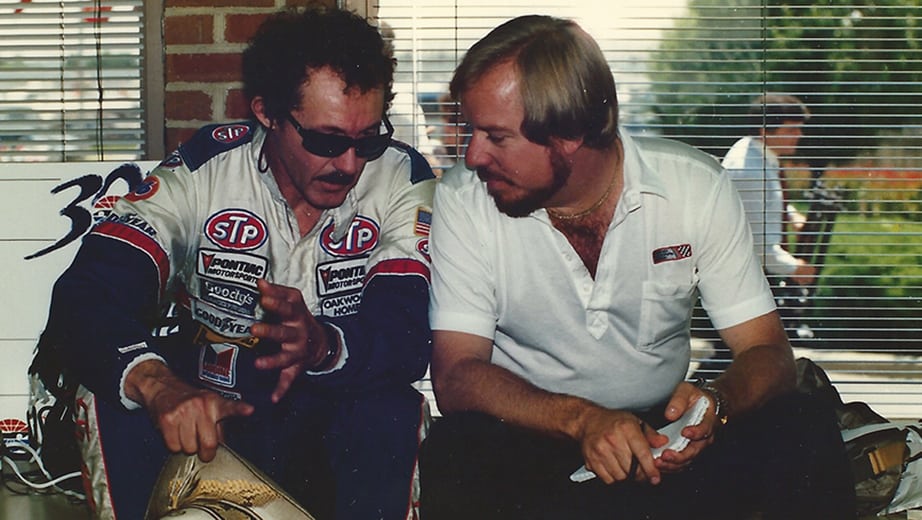
The NASCAR community was hit with the sad news of Steve Waid’s passing recently at the age of 77, following a battle with cancer. As the sport remembers the legendary journalist, it’s important to look at why that label alone would be underselling his influence on NASCAR. Waid covered the sport for nearly 50 years and was instrumental in bringing it to a wider American audience.
Watch What’s Trending Now!
Who was Steve Waid and what was his Career in NASCAR Journalism?
As a freshly graduated person from Old Dominion University, Waid’s motorsports journalism career kicked off in 1970, working for a variety of local publications. Among those media outlets were the Martinsville Bulletin, the Roanoke Times and World News. His stint with the latter lasted for 10 years, and during that time, he began writing about stock car racing. This was in an era where the sport was still residing in its own little bubble, predominantly in the South. With his influence, he helped introduce NASCAR to a wider demographic in the United States and shone a spotlight on it.
In 1981, Waid became executive editor of Grand National Scene, later renamed NASCAR Scene, and remained with the publication until it shut down in 2010. There, he established a major foothold, enjoying a nearly 30-year tenure with the media outlet. Such was his influence in the stock car racing arena that he received the George Cunningham Award, the Henry T. McLemore Award, and the 2019 Squier-Hall Award for NASCAR Media Excellence.
Those were just a handful of accolades in a decorated career, which also included serving as president of the National Motorsports Press Association for 12 years.
What were Steve Waid’s Biggest Contributions to NASCAR Coverage?
Having been in the business since 1970, Waid witnessed multiple NASCAR eras. He joined the scene in the midst of NASCAR’s Gen 2 era and went on to cover five more generations of Cup cars, including the current Next Gen car introduced in 2022. Owing to his decades of reporting, he covered countless drivers and championship battles. He was around for Richard Petty’s dominance in the 1970s and 1980s, and also the Dale Earnhardt-Jeff Gordon rivalry, writing extensively about “The Intimidator.”
It was during that time that he built a reputation for storytelling and his deep knowledge of the sport’s history.
What made his journalistic storytelling style so effective was the relationships he had with various drivers. Steve Waid developed close bonds with the who’s who of NASCAR personnel. Ranging from Alan Kulwicki, Tim Richmond, the late great Earnhardt, and even the Petty family, the list is endless.
Thanks to the trust he established with the racers, Waid had the freedom to cover them honestly and fairly, and he had a wealth of inside information.
What is the Squier-Hall Award, and Why did Steve Waid Receive it?’
In 2019, the NASCAR Hall of Fame presented Waid with the Squier-Hall Award for NASCAR Media Excellence. Earlier in his career, he was inducted into the NMPA Hall of Fame in 2014 and also served as president of the National Motorsports Press Association for 12 years.
A NASCAR statement released following the announcement of his death on Tuesday perfectly captured what he meant to the sport, and why he was showered with prestigious awards in his field.
“For decades, Steve Waid was one of the most respected and trusted voices in NASCAR journalism. He chronicled the sport with passion, integrity, and an unmatched appreciation for its people, history, and traditions…. Steve’s storytelling helped generations of fans better understand NASCAR and the personalities who shaped it,” the statement read.
“Deservedly, Steve was recognized for his exemplary work in 2019 as the recipient of the NASCAR Hall of Fame’s Squier-Hall Award for NASCAR Media Excellence, the culmination of a career that garnered him the admiration of competitors, industry members, and fellow media professionals alike…”
What did Steve Waid do After Retiring from Full-Time Reporting in 2010?
When the NASCAR Scene publication shut shop for good in 2010, it also heralded a new path for Waid. Just like how a NASCAR driver can retire from racing full-time, Waid retired from full-time journalism. However, this wasn’t the last that anyone saw of him, as he switched to the role of a freelance reporter. His work linked him with occasional columns at Frontstretch and other projects.
Then, from 2018 onwards, he co-hosted the weekly “The Scene Vault Podcast” with Rick Houston. Waid also co-wrote a biography of the late Junior Johnson. The book is called “Junior Johnson: Brave in Life”, and his co-author is his friend Tom Higgins.
During his time with Frontstretch, Waid wrote a column called “Waid’s World,” producing nearly 100 articles. Even in his final days, he remained committed to telling the stories of the sport he loved so dearly.
“I will be fine. Little changes. Think I can file Monday if I am out of here,” Waid said to Frontstretch owner and editor-in-chief Tom Bowles just a few days ago. Bowles revealed the same in a tribute to the legendary journalist on his website.