
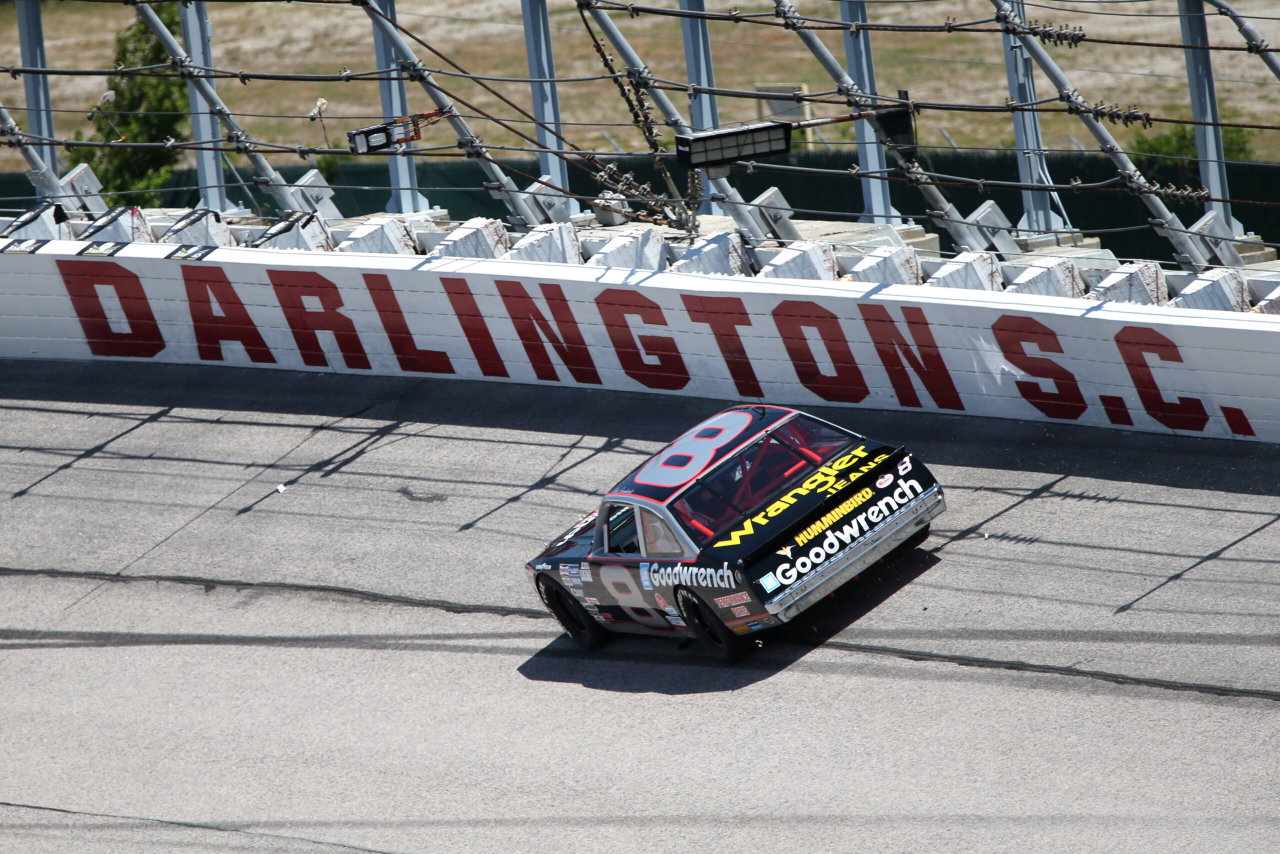
While it may not be a common sentiment, any NASCAR fan hopes to see a very specific kind of damage whenever a car returns to the pit road at Darlington Raceway. That is a black streak running across the right side, the paint rubbed away, and the driver knowing exactly where it came from. On the other hand, if it was another track, that mark would mean that something went wrong. But it’s Darlington. There, it can only mean that the driver got close enough to finding the last bit of speed they needed.
Watch What’s Trending Now!
That is the idea that will take center stage again on Sunday, when the Cookout Southern 500 will open the 2026 Chase at the 1.366-mile South Carolina track. Before the field assembles, fans have the full weekend around one of NASCAR’s oldest races. The Southern 500 is the 77th running of the crown jewel event, and Chase Briscoe is coming in as the two-time defending winner there. NASCAR is also opening its O’Reilly Auto Parts Series postseason at Darlington for the first time this Saturday night.
Everything fans need to know for Darlington weekend
| Detail | 2026 Cook Out Southern 500 Weekend |
| Cup race | Sunday, September 6 |
| Green flag | 5 p.m. ET |
| TV | USA Network |
| Streaming | HBO Max, NBC Sports App |
| Radio | MRN Radio, SiriusXM NASCAR Radio |
| Distance | 367 laps, 501.32 miles |
| Chase status | Race 1 of the 10-race 2026 Chase |
| Saturday O’Reilly race | Fleetio 200, 7:30 p.m. ET, The CW |
| Cup practice | Saturday, 4 p.m. ET |
| Cup qualifying | Saturday, 5:05 p.m. ET |
| Fan Zone | Opens Saturday at 10 a.m.; Sunday at 10 a.m. |
| Friday activities | Hauler Showcase at Florence-Darlington Technical College, followed by the hauler parade through downtown Darlington |
| Sunday activities | Driver Q&As, autograph opportunities, pre-race track access from 1:30 p.m., driver introductions at 4:20 p.m. |
| Weather outlook | Hot conditions with a chance of afternoon thunderstorms Sunday; Saturday is expected to be hotter |
| Grand marshal / major concert | No separately announced Cup grand marshal or concert headliner appears on the official weekend schedule as of Sept. 4 |
As is confirmed by the latest weekend guide, the Cup Series will run on Sunday at 5 p.m. ET as part of the USA Network, with HBO Max, MRN, and SiriusXM also carrying the event. The Cup field has 15 tire sets, while the O’Reilly field gets seven.
The weather is worth noting before the race begins. The current National Weather Service outlook calls for a hot Sunday near 90 degrees, with thunderstorms possible during the afternoon. Saturday is expected to be hotter, with temperatures approaching the upper 90s.
The weather conditions can therefore be very different between the practice, qualifying, and Sunday night’s race. Since Darlington’s track is not static, that is an essential piece of information. The surface alters itself with heat, sunlight, rubber, and tire wear as well. A driver who would feel comfortable against the wall on Saturday afternoon might have to face a different car after the sun starts dropping on Sunday.
What the Darlington Stripe actually is
Getting back to the damage part of it, when it comes to Darlington, there’s a name for it: the Darlington Stripe. What does it mean? It’s a mark left on a stock car when its right side brushes the outside wall. It may look dramatic in photographs, but that mark does not tell you how serious the contact was. If you want to understand Darlington, that is something you need to hammer on. A light brush can leave scraped paint and rubber while costing very little in terms of speed. A harder one, on the other hand, can bend bodywork, damage a tire, or even upset the car’s aerodynamic balance. That is a different outcome.
The reason the wall is a major player here is because of Darlington Raceway’s shape. The track is 1.366 miles long, with 25 degrees of banking in Turns 1 and 2 and 23 degrees in Turns 3 and 4. The frontstretch and backstretch are both 1,229 feet long. It’s not a symmetrical oval. Rather, Darlington’s two ends have different shapes and radii. That odd layout has been there before NASCAR had even worked out the tools that the teams use today.
Harold Brasington bought 70 acres for the speedway in 1949, but landowner Sherman Ramsey required a minnow pond to remain untouched. So Brasington built around it. The egg-shaped track came out of it as a result. Its construction began on December 13, 1949, and the original track was 1.25 miles long. The first Southern 500 was on September 4, 1950. It was NASCAR’s first major paved event that ran over a mile and its first 500-mile race. Seventy-five cars started in it, and Johnny Mantz won by nine laps.
Tire wear was apparently a problem. The crews underestimated how many tires the abrasive surface would actually consume, and some reportedly even bought replacements from spectators. Mantz survived with a harder tire choice.
That history lesson is why the wall is a significant actor here. The four corners do not pose a question to the driver about repeating the same move. The car needs to have a balance between speed, grip, and the outside wall, with very little room for a mistake.
Goodyear describes the surface in similar terms even today. Its September 2026 notes call Darlington’s rough surface and egg-shaped layout demanding on tires. Sunday’s Southern 500 will use 15 total Cup sets: 12 new sets for the race, two for practice, and one qualifying set that will transfer into the race as well. The March Goodyear 400 used 12 total sets. The extra three this weekend are for the longer distance and additional practice.
When you account for NASCAR’s 2026 package, the tire story comes into perspective. As per it, Darlington’s Cup cars are on a 750-horsepower short-track setup, with a three-inch rear spoiler and fewer diffuser strakes. The goal is to reduce aerodynamic security and make the driver manage more of the car.
In March, that combination gave out heavy tire falloff. NASCAR reported about 1.5 seconds of lap-time loss over a 10-lap stretch in practice. Austin Cindric was the one to lead the 10-lap average at 160.175 mph in that session, ahead of Carson Hocevar, Tyler Reddick, Kyle Busch, and Riley Herbst. That gap between one-lap speed and the long-run speed explains why Darlington cannot be attacked with the same aggression for 50 laps straight.
Christopher Bell was still looking for all the answers to that problem before the spring race. His question was not about going fast. It was how to save the tire long enough to remain fast.
“I’m still looking for that magic answer if anyone else has it.”
Ryan Blaney saw the other side of it after the race. He said the package created “tons of falloff,” and that drivers could use too much tire early and then pay for it later. He also noticed something unusual, which was that he could let another driver go during a run and then expect to see that car again later. That is the puzzle of Darlington. The driver wants to run near the wall, but the driver also has to decide when the wall is worth the price.
How the stripe became a badge of honor
That attitude is much older than the Next Gen car. David Pearson called the marks “fenderprints.” The 10-time Darlington winner remembered seeing different paint colors on the old guardrail and then spotting the matching black marks on cars’ right-rear quarter panels. Pearson also remembered teams adding extra braces because they expected drivers to hit the railing. His explanation was such,
“You could pick up speed especially in the old Turns 3 and 4 by hitting the wall and bouncing off.”
That tells us something important about the stripe’s history. The contact was not always an accidental byproduct of racing. Drivers and teams sometimes expected it and prepared the car for it. Bobby Isaac described the old Turn 3 as “The greatest test of raw nerve at any race track, anywhere.” He said a driver had to feel the car slap the wall before knowing he was really running hard.
Glen Wood understood the same problem before the 1965 Southern 500. His Wood Brothers team arrived with a brand-new No. 21 Ford, and he already knew how the right side might look later.
“It’s the prettiest car we’ve ever had, but I know the side will get crushed at Darlington.”
Richard Petty made the old approach sound almost routine. His 1971 description of running Darlington involved touching the wall in multiple corners. The joke worked because everyone in that era understood what the track could demand.
The phrase itself has a less tidy origin. NASCAR’s historical research says there is no official record identifying who coined “Darlington Stripe.” One of the earliest known newspaper references appeared in 1963, when Darlington publicist Russ Catlin described drivers sideswiping the rail while carrying too much speed. That makes Catlin an early documented user of the phrase, not its confirmed inventor.
The Red Byron story is even more uncertain. Darlington folklore credits the 1950 winner with discovering that wall contact could help him carry speed. Byron damaged Raymond Parks’ Cadillac and finished third in the inaugural Southern 500. NASCAR, however, treats the origin story as folklore rather than documented fact.
The tradition also survived physical changes to the track. Darlington was widened and reconfigured over the years, and the start-finish line moved in 1997. That changed which corner people associated with the stripe. Repaving projects followed in 1995 and 2008. The wall contact went nowhere, and so the culture around it was preserved too. Chase Briscoe’s experience gives you a better idea of why. His first Darlington Stripe was in 2019 while racing Dale Earnhardt Jr. He had avoided the wall through practice and qualifying, then finally brushed it during the race.
“A rite of passage right there.”
Briscoe later added, “And now, I mean, you use it all the time.”
There’s a beautiful progression to it. At first, the wall starts as something a young driver fears. Eventually, a driver learns how close the car can safely get. AJ Allmendinger comes in with a word of caution as opposed to what Briscoe said. His early Darlington experience with the No. 84 Red Bull car went from a practice hit to a harder contact that eventually “KO’d it.” His conclusion was less romantic,
“I still don’t really know how to get around it.”
Why the stripe still matters in 2026
Tyler Reddick gave the cleanest modern example in March. During qualifying for the Goodyear 400, Reddick scraped the Turn 4 wall on his way to the pole. He posted a 169.152-mph lap in 29.072 seconds, beating teammate Bubba Wallace by 0.124 seconds. He was the only driver above 169 mph. Reddick’s explanation made the image even better for this story. He felt he had under-driven the center of Turns 3 and 4, then decided to stay in the throttle.
“basically just ran it into the wall.”
There was no ruined qualifying attempt, and he got the pole. The following day, Reddick won the race. His No. 45 team also overcame an early charging problem, a battery change and a trip to the rear. He still took the lead for the final time with 27 laps remaining and beat Brad Keselowski by 5.847 seconds.
That is the clearest answer to the headline. The stripe was not evidence of a failed lap. It appeared on a car that won the pole and then won the race. Keselowski gave the mark another meaning. He finished second in a special scheme honoring Greg Biffle, and his car carried its own right-side stripe. After the race, Keselowski said,
“I think that would make Greg proud.”
The stripe was no longer just a mark from contact. It became part of a piece of racing history. Yet Reddick and Keselowski also show why context matters. Reddick’s stripe came on a single qualifying lap with fresh tires and little fuel. A race stripe arrives under very different conditions. Tires are aging, traffic is affecting the air, the car’s balance is changing, and every pit cycle can alter the strategy. A light scrape can remain cosmetic, but a harder hit can become an aerodynamic problem.
Jimmie Johnson showed how quickly that line can disappear. After right-rear quarter panel damage at Darlington, his team needed multiple pit stops to push the panel back into shape and recover some of the side force the car needed. The damage was not just something the camera could see. It changed how the car worked.
That is why “using the wall” and “losing the car” should never be treated as the same thing.
The same difference appeared in Larson’s 2021 Southern 500 gamble. Chasing Denny Hamlin for the win, Kyle Larson deliberately kept using the wall late in the race. He had enough playoff cushion to accept the risk and knew he needed something beyond normal pace. The move produced heavy right-side damage without producing the victory.
Reddick and Larson therefore form the perfect modern comparison. Reddick found the edge and stayed just inside the useful side of it. Larson pushed the same idea further because the win demanded it, and the car paid for that decision. Darlington also makes the driver think about something less obvious than the wall: air.
Briscoe’s 2024 Southern 500 victory showed why. On Lap 342, he went to the bottom in Turn 3 and cleared Ty Gibbs, Larson and Ross Chastain for the lead. He knew the move had to put him into clean air, and he described the final attack simply.
“I was just taking it all the way to the wall.”
At Darlington, track position and wall proximity can become connected. A driver stuck behind another car may lose the chance to use the full corner. Once that driver gets into clean air, more of the available track becomes usable. That is also why pit road matters.
Darlington’s pit-road entrance comes off the long sweep through Turns 3 and 4. Drivers have to slow from the banking while finding the entry. Some early pit stalls also sit around the curve, making certain boxes harder to enter and leave. Crew chiefs have pointed out that pit-stall selection can therefore matter more here than simply having the first box available. So qualifying can influence more than the starting position. It can shape the pit cycle that follows. The 2026 Chase adds another angle.
Denny Hamlin starts the postseason as the No. 1 seed. Ryan Blaney is second, Tyler Reddick third, Chase Briscoe fifth, Christopher Bell sixth, Kyle Larson seventh, Chase Elliott eighth, Joey Logano ninth, Chris Buescher 10th and Carson Hocevar 12th. Reddick is entering one of his best tracks after winning the spring race, while Briscoe is defending two straight Southern 500 victories.
Briscoe has led 338 Cup laps at Darlington, more than at any other track. He led 309 laps in the 2025 Southern 500, the most in a Darlington race since Earnhardt led 335 in 1986 in the Transouth 500.
That is why Sunday’s first Chase race will ask more from these drivers than simply keeping the car off the wall. They will have to judge when a stripe is useful. They will have to know when the tire is worth saving. They will have to understand when the car is stable enough to run the high line and when the right side is asking for too much.
The track still asks how much a driver is willing to take. The best answer is not a giant hit; it is a small mark that says the driver found the limit, stayed in control, and kept going. That is why the Darlington Stripe is a compliment. It does not celebrate crashing, but records the moment when speed and risk got close enough to touch. And at the Lady in Black, that thin black mark can still tell you something a clean body panel could never.