

It was at Nashville Superspeedway on May 31, 2026, in Denny Hamlin’s 735th Cup start, that he committed his first-ever start/restart violation. He was penalized with a pass-through penalty and dropped to the back of the 38-car field. The fact that he still won the race, clawing from last to first in a JGR 1-2-3 finish by 0.115 seconds, is a remarkable story on its own, but it simply cannot bury what came later.
Watch What’s Trending Now!
Now, William Byron’s reaction on the Racin’ With The Boys podcast is making the #11’s penalty feel a lot less like one veteran making a careless mistake and a lot more like something bigger.
“I guess you got to start in the restart zone. I didn’t know that either. I probably would have done what he did at some point in my career just because you think at the start of the race, the flag guy waves the green and you go. So, you’re just kind of guessing,” Byron said.
For context: NASCAR’s rulebook states clearly that “the initial start and all restarts shall be initiated within the restart zone on the racetrack,” marked by double red lines on the outer wall. The leader cannot accelerate before reaching those lines. It is not a gray area.
And yet here was Denny Hamlin, who is a 20-year veteran, co-owns 23XI Racing, sits on the Driver Advisory Council, hosts his own podcast, and talks NASCAR rules constantly, saying he had always operated under a different assumption.
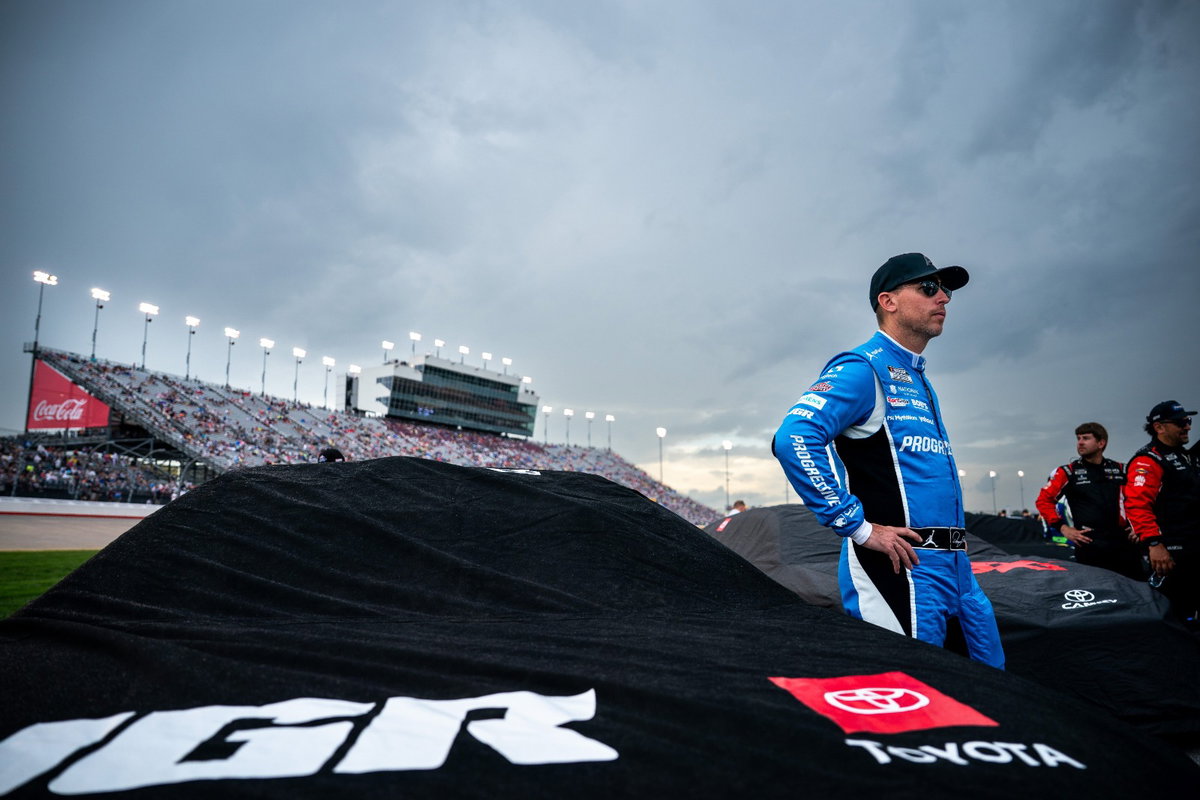
Imago
NASCAR Cup Series driver Denny Hamlin waits by his car as rain falls before the Cracker Barrel 400 at Nashville Superspeedway in Lebanon, Tenn., Sunday, May 31, 2026.
“I guess I just definitely wasn’t aware that you have to be in the restart zone. I’ve started many, many races from the pole, and I have always just used the rule of thumb, like as long as you wait a little while, as they say in the driver’s meeting they say, when the green flag is displayed, you can start the race,” Hamlin admitted post-race.
And well, even Byron is a current member of NASCAR’s Driver Advisory Council, the body that is supposed to be the communication bridge between the garage and the sanctioning body. So, if he, too, didn’t know the restart zone rule, this starts looking more like a garage-wide gap.
And Byron made that clear with what he then confessed about the earlier pre-race drivers’ meeting, which turned into electronic communication.
“And as soon as that video comes on, I’m like start yawning. I’m like, ‘Oh, man. This is Let’s get through it.’ That’s kind of when I go into my zen. Like, get my little mini nap in before the race starts. But if I don’t know the rules at by that point, I probably don’t.”
The pre-race drivers’ meeting used to be mandatory for all drivers, crew chiefs, and race officials, and the session covered restart procedures, pit road protocols, track-specific rules, emergency access points, and event scheduling, using a well-produced video with cool graphics. On paper, it should have been impossible to leave that room without knowing what the restart zone is. But as it appears, not really.
Then, when COVID-19 hit, and everything went online, all sense of tradition vanished as videos began arriving in emails. Nothing really binds the drivers to watch them. During the in-person meetings, drivers at least risked a starting position penalty if they didn’t arrive on time. Add to that the repetitiveness of these videos, which made Christopher Bell say:
“It’s just the same thing over and over again. If it was a little bit more unique to every racetrack, I’d say it would be more important. There’s way more efficient ways to go about it nowadays.”
So, that’s not necessarily a William Byron or Denny Hamlin problem. That is an issue with involvement, since NASCAR’s pre-race meeting was largely a video presentation, and there was no formal mechanism for real-time Q&A, interactive rules review, or even a quick confirmation that the material had been understood. And the chances grow slimmer with emails and digital updates.
Compare that to Formula 1, where the FIA holds a dedicated drivers’ briefing every Grand Prix weekend, a live session attended by all active drivers, the race director, and stewards, specifically designed to address track limits, explain rulings, and take questions directly from drivers in real time. And while they have their own criticisms, the format at least creates room for comprehension.
Now, that being said, NASCAR doesn’t need to copy Formula 1. However, Nashville has shown that if several drivers misinterpret the same regulation for years, the solution cannot simply be “pay more attention”. So, get rid of that video and have more human interactions, maybe?
But maybe the problem goes deeper?
Bringing back traditional in-person pre-race meetings, where you don’t do much but stare at a video, won’t bring about any change. Drivers have made that clear plenty of times. The tradition itself was a spectacle, as sponsor bigwigs, media interviews, and lunch, too, took center stage. But there was no useful race-related information as such. So, none of the drivers actually miss that format even as they now wonder about penalties like Denny’s.
“It was the classic ‘This could have been an email’ meeting,” Brad Keselowski once said, as reported by The New York Times.
“There’s not a single thing I miss about not having drivers meetings,” Chase Elliott added while Byron was blunt: “They were pretty pointless.”
Alex Bowman had further testified that 90% of the drivers were never willing to raise their hands to engage in discourse – “Aside from (Ryan) Newman, I don’t think anybody asked any questions”.
Why? Because NASCAR officials didn’t always prefer that. Moreover, as Joey Logano said:
“Everyone walked up to the front and asked a bunch of questions (afterward). A lot of people aren’t comfortable asking a question in such a large setting, too.”
So, when NASCAR decides to make the process more human, it would also need to focus on being more welcoming, useful, and less repetitive.