
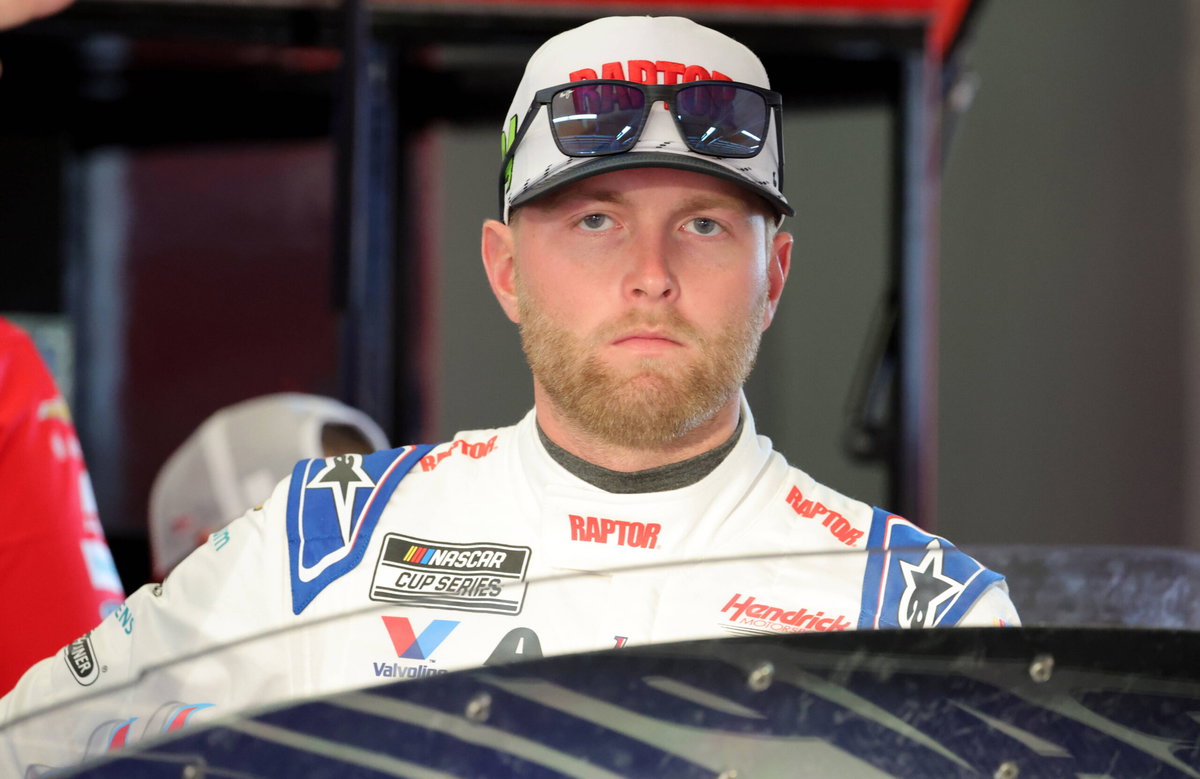
William Byron helped Hendrick Motorsports secure a 1-2 finish at Talladega, but watching Kyle Larson take the checkered flag made his own near-victory sting a little more. The No. 24 Chevrolet driver finished just 0.041 seconds behind his teammate after a frantic final lap, having played a supporting role before making a late push for the win himself. While Larson celebrated his first Talladega victory, Byron had a different takeaway from the afternoon. His post-race comments revealed growing frustration with NASCAR’s fuel-saving approach and its impact on the racing.
Watch What’s Trending Now!
“It’s s****. We’ve got to fix that. The cars are very draggy side by side. I think that’s, in my opinion, what creates it. I just wish it wasn’t quite that bad. I wish we could have a little bit more ability to make some moves and slingshot forward. We’re just kind of stuck running 2×2 and 53-second lap times or whatever it was.”
In a post-race interview, William Byron did not hide his frustration with the fuel-saving tactics that dominated the opening stage at Talladega. The Hendrick Motorsports driver wanted more aggressive racing, but the need to conserve fuel left much of the field circulating in tightly packed, two-by-two lines.
Rather than constantly attacking for position, drivers were managing their throttle and waiting for the race to become more competitive. According to reporting from The Athletic’s Jeff Gluck, some cars farther back in the pack were running at just 25% throttle, while Joey Logano was around 43% after his team radioed “max saving.” Lap times climbed to roughly 58 seconds, more than 10 seconds slower than the fastest lap of the stage.
However, RFK Racing decided to challenge that pattern with an alternative strategy. Around the middle of Stage 1, Brad Keselowski, Ryan Preece, and Chris Buescher broke away from the main pack in their three-car Ford line. Instead of lifting to save fuel, they ran wide open and steadily built an advantage over the field.
The gamble paid off spectacularly. While much of the field ran at roughly 32% throttle, the RFK trio maintained speed and surged ahead. They crossed the finish line approximately 18 seconds clear of the rest of the field, sweeping the top three positions in the opening stage. Buescher took the stage win, followed by Preece and Keselowski.
Byron’s criticism was not simply about slow lap times. The aerodynamic drag created by running side by side made it difficult for drivers to build momentum, pull out of line, and slingshot forward. The RFK move briefly broke that pattern, but it also raised a question: would other teams copy the tactic, or would the field return to fuel-saving once the advantage became harder to sustain?
William Byron plays Hendrick wingman
Byron’s frustration with fuel saving was only part of his Talladega story. He also found himself balancing two competing goals: helping Kyle Larson’s championship campaign and giving the No. 24 Chevrolet a chance to win.
Before the race, NASCAR reporter Danielle Trotta reported garage chatter suggesting Chevrolet had instructed its teams to help Larson maximize stage points and avoid being stranded at stage endings. The alleged directive was not independently confirmed as an official manufacturer order, but the reported strategy made sense in a championship fight where every point mattered.
Byron, Chase Elliott, and Alex Bowman could help their Hendrick teammate maintain drafting support, while other Chevrolet drivers could strengthen the manufacturer’s numbers near the front.
Larson benefited from that collective support throughout the race, scoring 16 stage points, the most of any Chase contender. Byron understood his role, explaining that with his own season not unfolding as hoped, helping Larson was part of doing everything possible for the team. Still, he was not prepared to abandon his own chances once the closing laps offered an opportunity.
On the final restart, Byron was trapped on the bottom while pushing Todd Gilliland’s No. 34 Ford. The outside lane carried stronger momentum, and the resulting shuffling opened a path for Byron to challenge near the front. But as drivers blocked and changed lanes, the bottom opened up elsewhere, giving Larson an opportunity to recover after dropping outside the top 10.
Austin Hill initially pushed Larson forward, while Ross Chastain later gave the No. 5 Chevrolet crucial help as the field approached the final turns. Larson found momentum in the lower lane and surged past the leaders, beating Byron for his first Talladega Cup victory.
Byron admitted Larson executed the final lap brilliantly, even as he lamented how close he had come. Chevrolet’s collective support helped put Larson in contention, but the finish still required timing, positioning, and a decisive last-lap charge. For Byron, it was a team success that came with a painful personal near-miss.