
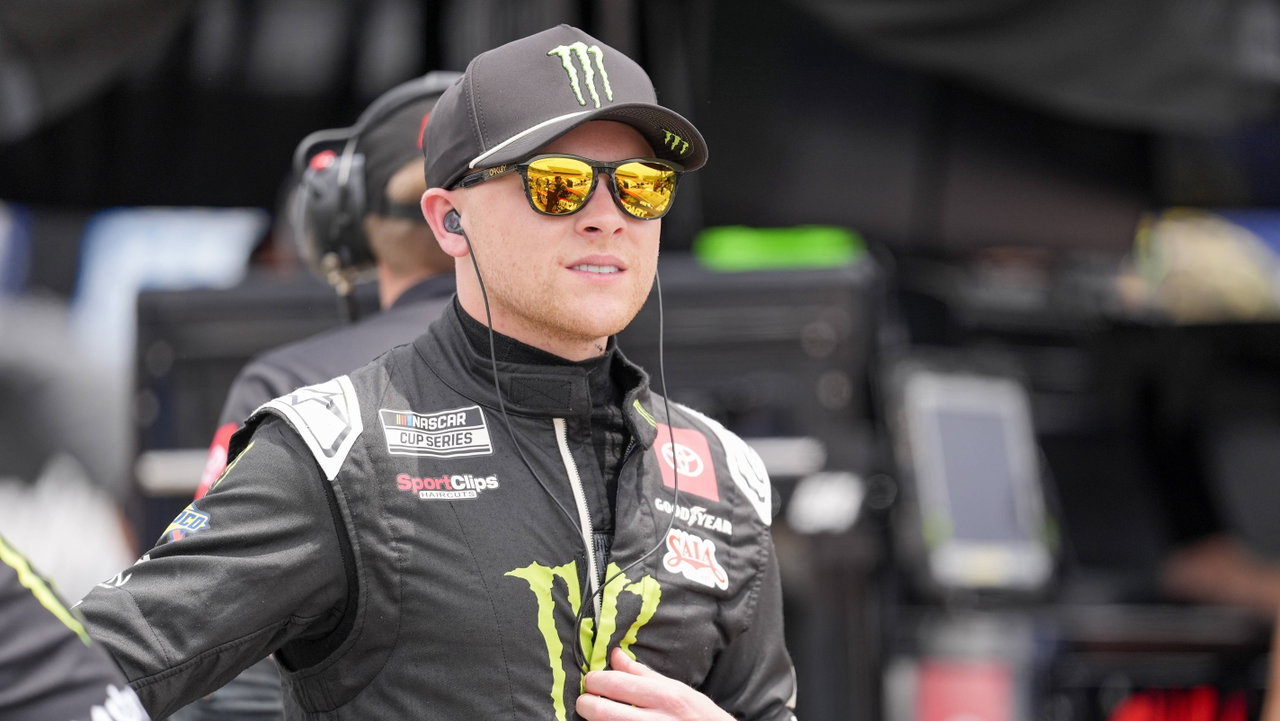
The way Cup Series drivers perceive and respond to other vehicles has altered as a result of NASCAR’s digital transformation. Drivers have access to more information than ever before thanks to everything from improved telemetry and real-time data to in-car digital cameras and cockpit displays. Decision-making and safety have been enhanced by such technology. But according to Ty Gibbs, one such technology could also be promoting drivers who are not skilled to race in the Cup Series.
Watch What’s Trending Now!
“Honestly, I think if you took the digital camera out of the car I think it would be a mix of drivers that probably even wouldn’t be in the Cup Series anymore,” Ty Gibbs said on the latest episode of the Dale Jr. Download podcast.
Gibbs was talking about the amount of information that modern Cup drivers are provided with when competing. He claimed that eliminating some of the technology may make drivers depend more on their racecraft and intuition.
In 2022, NASCAR debuted its digital rearview camera system with the Next Gen vehicle. A monitor within the cockpit receives high-definition video from a tiny camera fixed on the back molding. The main purpose of the system’s introduction was to solve the serious blind-spot issues brought about by the Next Gen car’s design.
At the time, veteran crew chief, Steve Letarte, highlighted the safety benefits of the technology.
“So we talk about visibility and drivers and safety, and this is an area that drivers now literally have an HD view of what’s going on.”
The big camera aids the the lead car to throw in the defensive block. And given how aero dependent the Next Gen car is, this works against a driver trying to make passes on short ovals. This tactic is better known as mirror-driving and everyone makes the most of it.
“The camera or the mirror right now is zero separation. You can literally just watch the thing and just go [move to air block] instantly, right?” Even Kyle Busch had been a strong critic of the digital rear view camera. What’s fascinating is that, Ty himself who won the race using the tactics is in favor of getting the camera off the racer car.
Ty Gibbs’ Iowa victory provided a recent example. Christopher Bell had four fresh tires late in the Iowa Corn 350, while Gibbs had taken only two. On paper, Bell appeared to have the clear advantage. Yet Gibbs continued to hold him off through the closing laps.
Bell repeatedly closed in but could not complete the pass. With six laps remaining, he looked to the outside through Turns 1 and 2, only for Gibbs to block the attempt. Gibbs eventually held on for the win.
The result highlighted a broader issue. Even with a tire advantage, a faster car can struggle to pass when the leader can protect the preferred lane and control the defensive line. Ty Gibbs believes removing the digital camera could change some of that dynamic.
“Obviously we want to have a car that races a little better in dirty air, but for the time being, like, I think if you took those out, like I think it’d make the racing a little bit better because you can’t just sit there and like look at your iPad and just, blip go up, and just hose somebody on their line,” Gibbs added.
The technology was designed to solve a safety problem. But Ty Gibbs’ criticism points toward an unintended consequence: giving drivers more information than they need. And in turn, it promotes a style of racing that isn’t entertaining for the fans.